Group Emergency Food Days Calculator
Estimate how many full days your stored camp, RV, cabin, or evacuation food can feed a mixed group using calories, meal coverage, reserve days, and realistic edible yield.
⚡Named group presets
👥Group demand inputs
🥫Stored food inventory
📦Emergency food spec grid
Bulk entries use common dry-food planning averages. Label calories should replace these assumptions whenever exact package totals are available.
📊Calorie planning reference
| Person type | Low shelter day | Normal camp day | Cold or active day |
|---|---|---|---|
| Adult | 2,000-2,200 kcal | 2,300-2,500 kcal | 2,700-3,100 kcal |
| Teen or high-output helper | 2,100-2,400 kcal | 2,500-2,800 kcal | 3,000-3,500 kcal |
| Child | 1,200-1,400 kcal | 1,500-1,700 kcal | 1,800-2,100 kcal |
| Senior or light eater | 1,600-1,800 kcal | 1,900-2,100 kcal | 2,200-2,500 kcal |
🧮Food density reference
| Food module | Calculator unit | Calories used | Best emergency role |
|---|---|---|---|
| Rice, dry grains, couscous | 1 lb / 0.454 kg | 1,650 kcal | Base carbohydrate |
| Oats, cereal, granola base | 1 lb / 0.454 kg | 1,760 kcal | Breakfast and quick meals |
| Pasta, noodles, potatoes | 1 lb / 0.454 kg | 1,680 kcal | Fast group dinners |
| Beans, lentils, textured protein | 1 lb / 0.454 kg | 1,560 kcal | Protein and slow energy |
| Freeze-dried meal pouch | 1 pouch | 520 kcal | Low-cook backup |
| Nut or seed butter jar | 16 oz jar | 2,660 kcal | Dense fat calories |
| Canned meal, fish, chili, stew | 1 can | 380 kcal | No-soak meal support |
| Energy or protein bar | 1 bar | 240 kcal | Grab-and-go ration |
📝Group target table
| Group example | Daily target | 3-day cache | 7-day cache |
|---|---|---|---|
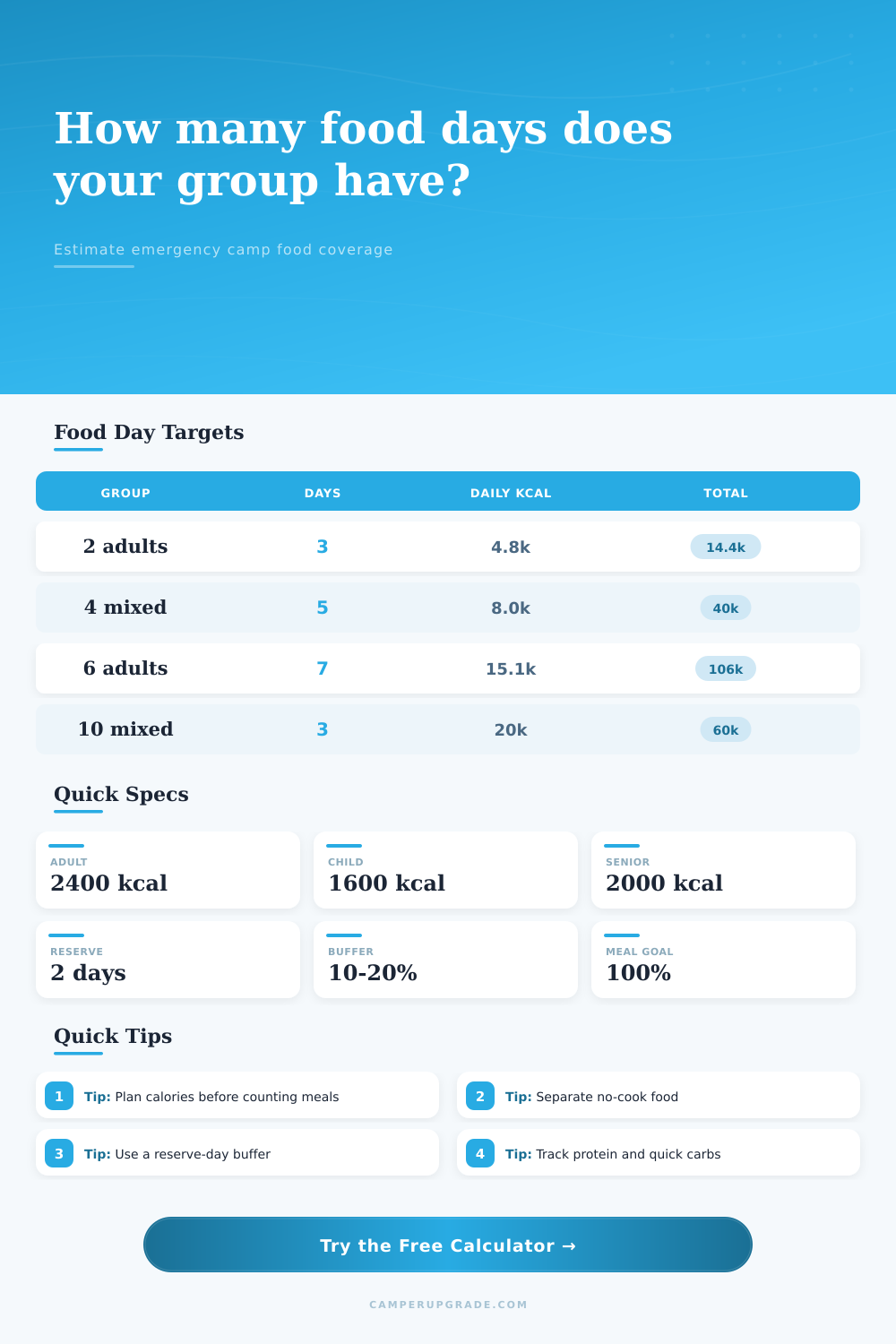
| 2 adults | 4,800 kcal | 14,400 kcal | 33,600 kcal |
| 2 adults, 2 children | 8,000 kcal | 24,000 kcal | 56,000 kcal |
| 4 adults, 2 children | 12,800 kcal | 38,400 kcal | 89,600 kcal |
| 6 adults | 14,400 kcal | 43,200 kcal | 100,800 kcal |
| 8 teens or adults | 19,200 kcal | 57,600 kcal | 134,400 kcal |
| 10 mixed evacuees | 20,000 kcal | 60,000 kcal | 140,000 kcal |
🗂Storage module planning table
| Module | Typical contents | Approx calories | Planning use |
|---|---|---|---|
| Grab tote | Bars, pouches, cans | 18,000-28,000 kcal | Vehicle or RV exit food |
| Dry bucket | Rice, oats, pasta, beans | 35,000-55,000 kcal | Longer stationary meals |
| No-cook crate | Nut butter, cans, bars | 25,000-40,000 kcal | Power or stove outage |
| Meal pouch box | 24 freeze-dried pouches | 12,000-16,000 kcal | Lightweight backup ration |
| Group pantry shelf | Mixed dry and ready food | 90,000-150,000 kcal | Cabin, basecamp, host site |
✅Calculation notes
There’s that big bag of rice in there. And some freeze-dried meals. A can or two of chili. Looking at that pile of stuff makes you feel good. You’ve got food. But do you? For how long?
When it comes to planning for emergencies, people tend to think in terms of meal instead of calories. One meal equals one packet. This is dangerous thinking if you are responsible for others. Add in kids, seniors and adults and suddenly the math become messy very quickly. Everyone has different appetites, and everyone have different energy requirements.
Stop Counting Meals, Start Counting Calories
Plug into the group and your equipment, and let the calculator do all the heavy lifting (above). No more guessing about whether 20 lbs. Of rice will last a week. In a group situation, most folks grossly overestimate their carbohydrate supplies. Standard camp rations seems to stretch a family of four in five-day increments during normal weather. However, introduce an active lifestyle such as digging out your driveway or chopping wood, or simply a single cold snap, and that ration become a lot smaller. The activity multiplier factor into the tool. If you’re working hard, it increase your base caloric need per day. Sheltering in place? That lowers your base calorie burn.
The important thing to realize: Calories is what matters. Not boxes. You may look at a can of soup and think “this will be filling,” but many cans gives you just three or four hundred calories. You could down six cans and still wind up in a deficit. The calorie-dense foods page has a table that lists calorie content for various things. You can see right away how many calories are in every pound of oats. How many you get from every jar of nut butter. You’re no longer looking at abstractions (weight), but at concrete measurements of energy. You transition from thinking about boxes to thinking about energy budget.
Add a reserve: This is something that you don’t tap into unless there’s really no way around it. Consider it an insurance policy for bad luck. What if you get blocked off the road longer than expected? Or what if the water filter goes kaput. Add two more reserve days to whatever number you calculated. That means you’ve got a safety net. Rather than running out on day three and panicking, you’ll have some leftover and feel guilty about it.
You can use buffer in the calculator. That will help you determine whether your stash will cover your planned time PLUS the safety net. If the answer say you’re coming up short, then you know exactly where to tack on some calories. You won’t have to overbuy anything bulky you don’t need.
Forgetting about edibility is another error people make. Just because something is on the label doesn’t mean a single ounce of it get to your mouth. You also have to deal with waste, spillage, and things that don’t turn out well when you have limited power or water. Accounting for a lost percentage in your math keep the final number realistic different than optimistic. It brings your plan back down to earth into the dirty world of field cooking. This isn’t a kitchen where you have an endless supply of everything. You will more likely have one pot, some fuel, and weary hands.
For planning as a group, consider the balance between efficiency and variety. Focus on protein for satiety, carbs for quick energy, and fat for density. Meals in pouches is expensive for the amount of calories they provide but are easy to prepare. Dried beans and grains is cheap and dense, but they need time and water. How much do you want/need to cook? What can you store? Ready-to-eat bars offer one piece of balance, providing instant gratification (and won’t take up much precious space). Heavier dry goods will sustain you long term. Mixing it up like this help avoid getting sick of what’s in the pantry. It also ensures you have something to rely on when the cooking system go down.
At the end of the day, it’s not about scraping by on pennies. It’s about staying energetic and keeping morale up. Weakness and irritability is side effects of hunger. Food supplies give us clarity and focus. Run some numbers, confirm your assumptions, check your stockpile. It doesn’t take long and it brings an enormous sense of relief.
You don’t want to be caught in the dark, waiting for disaster… You want to know your kitchen’s prepared for whatever life throws at it. The only way you can have that confidence is if you do the math before it happens; not hope for the best after everything goes to hell. Get the base covered, tack on the buffer, follow the data. When the lights stay out longer than expected, you’ll thank yourself later.