Sunburn Time by UV Index Calculator
Estimate first-redness timing from UV Index, skin type, SPF condition, altitude, shade, clouds, surface reflection, and planned outdoor minutes.
📍Named Outdoor Presets
☀️Exposure Inputs
This estimator uses UV Index intensity and erythemal-dose assumptions. Personal medical risk, medications, skin history, and uneven sunscreen coverage can change real burn timing.
📊Surface Reflection Grid
📘Reference Tables
| Skin Type | Typical Burn Response | Calculator MED | Clear-Sky Burn at UVI 8 |
|---|---|---|---|
| Fitzpatrick I | Always burns, rarely tans | 200 J/m² | 17 min |
| Fitzpatrick II | Burns easily, tans minimally | 250 J/m² | 21 min |
| Fitzpatrick III | Sometimes burns, gradually tans | 300 J/m² | 25 min |
| Fitzpatrick IV | Rarely burns, tans well | 400 J/m² | 33 min |
| Fitzpatrick V | Very rarely burns | 600 J/m² | 50 min |
| Fitzpatrick VI | Least likely to burn | 800 J/m² | 67 min |
| UV Index | Exposure Band | Erythemal Irradiance | Type II Burn Estimate |
|---|---|---|---|
| 1 to 2 | Low | 0.025 to 0.050 W/m² | 83 to 167 min at UVI 2 to 1 |
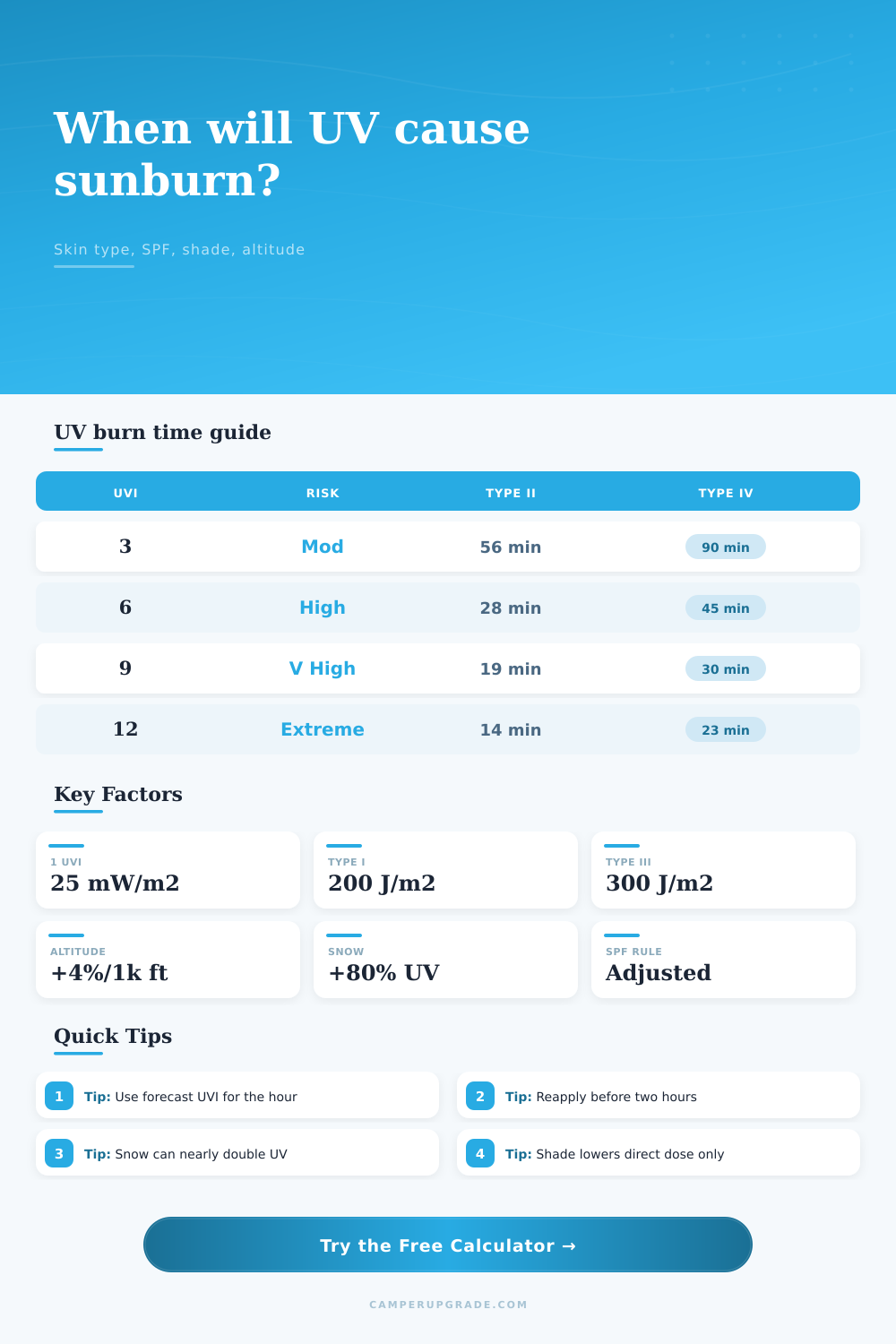
| 3 to 5 | Moderate | 0.075 to 0.125 W/m² | 33 to 56 min |
| 6 to 7 | High | 0.150 to 0.175 W/m² | 24 to 28 min |
| 8 to 10 | Very high | 0.200 to 0.250 W/m² | 17 to 21 min |
| 11+ | Extreme | 0.275+ W/m² | 15 min or less |
| Adjustment | Calculator Factor | What It Changes | Example |
|---|---|---|---|
| Altitude | +4% per 1,000 ft | Raises effective UVI | 5,000 ft adds about 20% |
| Thin bright cloud | 1.05 | Can leave UV high | Use when glare is strong |
| Broken cloud | 0.65 | Lowers direct UV | Still burns at high UVI |
| Shade | 1 minus shade share | Lowers direct dose | 30% shade uses 0.70 |
| Surface reflection | 1 plus reflected share | Adds bounced UV | Snow uses 1.80 |
| Sunscreen Condition | Multiplier | Used For | Calculator Effect |
|---|---|---|---|
| Even recommended amount | 1.00 | Application quality | Uses full labeled SPF before time loss |
| Typical outdoor layer | 0.75 | Application quality | Reduces the practical SPF boost |
| Heavy sweat | 0.62 | Water and rubbing | Shortens SPF-adjusted time |
| Swimming or towel-dried | 0.50 | Water and rubbing | Assumes major sunscreen loss |
| After 2 hours | Decay begins | Time since application | Subtracts 15% per extra hour, capped |
| Common Outdoor Scenario | Typical UVI | Main Modifier | Planning Note |
|---|---|---|---|
| Miami Beach Noon | 11 | Sand reflection | Very short unprotected window |
| Denver Trailhead | 8 | Altitude | High-country UV rises fast |
| Honolulu Surf | 12 | Water plus wet sunscreen | Reapply after water exposure |
| Aspen Snowfield | 9 | Snow reflection | Reflected UV can dominate |
| Orlando Theme Park | 10 | Concrete and partial shade | Queue shade helps but is uneven |
💡Calculation Tips
The sun deliver some energy that your body tolerates better or worse depending on where you are and who you are. Step outside for a short errand and feel the pain. The UV Index calculator predicts when you’ll get red, so knowing what the variables is helps make the tool more useful.
The UV Index itself is a standardized measure of intensity, but it is just a starting point. An index predicted to be eight are based off clear skies and sea level. Change any of those factors and the risk of exposure change significantly.
Why Knowing the Details Matters
The individual factor that’s most unique to each person in this equation are your skin type. Skin ranges on the Fitzpatrick scale from Type I (which burns immediately) to Type VI (with strong native resistance). That’s your minimum erythemal dose. The amount of ultraviolet energy needed to produce redness in the skin. Fair-skinned people don’t have much room for error, as even a brief lapse in sunscreen application can push them past their limit before they feel any heat on their face. A few minutes without sunscreen can be enough to exceed your limit and send you over edge before your body even registers any warmth.
The calculator prompts you for your skin type as an anchor point to your own physiological reality. Everyone underestimates their sunscreen safety buffer zone. What about SPF 30? That’s if you’re super careful to apply it properly, and don’t go into the water at all, or whatever. Real life: It will be washed off in minutes, even seconds, especially if you’re sweating and in the water. This model incorporates that fact, since it asks how well you think you applied it, and how long ago you last applied it. If you slathered up an hour ago and went for a swim, your actual protection are probably half of what bottle says. People treat sunscreen like a static defense instead of something that needs refreshing.
Exposure is largely dependent on environment. For example: The higher the altitude, the greater level of UV. About four percent additional UV radiation is felt per one-thousand feet of elevation gain. So while hiking in Denver may have the same UV Index reading as walking along streets of Miami, it’s going to expose you to slightly more radiation.
To make things worse, reflection makes the problem worse. Up to eighty percent of UV rays reflected off snow will return to your body, essentially doubling your exposure. Other surfaces such as water, sand, and concrete also reflect but not as much. If you’re hanging out on the beach, you’ll be getting radiation from below you and from above you.
Add clouds into this equation. Most of us believe that “cloudy” means we’re protected from the sun. However, even thin clouds will scatter UV rays, which can sometimes make it worse. In any case, they never shield all incoming UV. Thick clouds prevent more, but no one’s ever seen a sharp line separating “clear” from “partly cloudy.” Luckily, the calculator accounts for such weather; however, try to scan the heavens and judge the glare. Is it bright enough to produce well-defined shadows? Then you’re in the red zone.
So what do the numbers tell you? This is the pure unprotected exposure time (i.e., how long you’re safe before going back into cover). SPF-adjusted: How much longer does your sunscreen give you? This assumes you’ll keep it on. If your outing falls beyond the SPF-adjusted time frame, you’re at risk and need to get some shade ASAP. Or apply more protection right away.
Why? This helps you avoid DNA damage, which builds up over time and stays hidden until it’s too late. If you want to put things in context, use the reference tables on the page. They will help you see how various scenarios compare: a stroll in the park compared to a day at the ski resort.
This isn’t about never going outside again. This is about making educated decisions about when to go out into the light. Sun safety is all about respecting the amount of energy you are working with. Understand the inputs. Then the outputs make sense. No more guesswork. It is just planning. That quick errand turns into a calculated risk you could of manage with planning.