Average Moving Pace Calculator
Calculate your true moving pace for campground walks, hikes, bike rides, portages, snow routes, and RV supply runs by removing stopped time and adjusting for terrain, elevation, load, and heat.
Moving Pace Results
| Activity | Easy Pace | Steady Pace | Fast Pace |
|---|---|---|---|
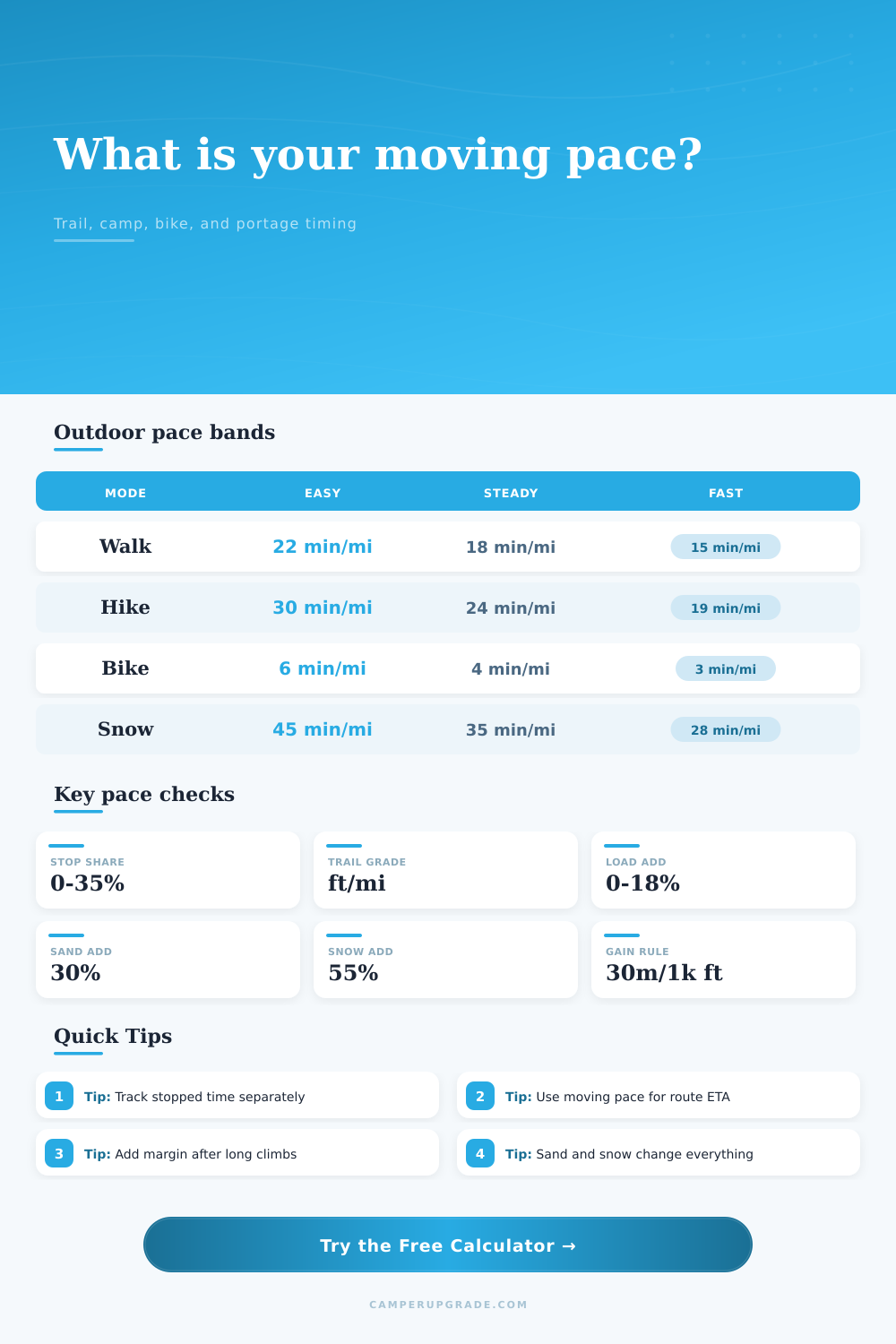
| Campground walk | 22-26 min/mi | 17-21 min/mi | 14-16 min/mi |
| Day hike | 28-35 min/mi | 21-27 min/mi | 16-20 min/mi |
| Loaded backpack | 34-45 min/mi | 26-33 min/mi | 20-25 min/mi |
| Gravel bike | 6-8 min/mi | 4-5.9 min/mi | 3-3.9 min/mi |
| Snowshoe route | 42-55 min/mi | 32-41 min/mi | 25-31 min/mi |
| Surface | Factor | Best Use | Timing Note |
|---|---|---|---|
| Paved campground road | 1.00x | Loops, errands | Baseline pace |
| Packed gravel | 1.08x | Bike paths, pads | Small rolling loss |
| Maintained dirt trail | 1.15x | Park hikes | Roots and turns add time |
| Rocky roots or uneven tread | 1.25x | Backcountry approach | Foot placement slows pace |
| Loose sand or dry wash | 1.30x | Beach, desert wash | Soft ground drains speed |
| Packed snow | 1.55x | Snowshoe routes | High resistance travel |
| Elevation Gain | Added Time Rule | Metric Equivalent | Use In Result |
|---|---|---|---|
| 250 ft | 7.5 min | 76 m | Short overlooks |
| 500 ft | 15 min | 152 m | Rolling trail |
| 1,000 ft | 30 min | 305 m | Main climb |
| 1,500 ft | 45 min | 457 m | Hard ascent |
| 2,000 ft | 60 min | 610 m | Full day climb |
| Common Route | Distance | Typical Moving Pace | Moving Time |
|---|---|---|---|
| RV supply walk | 2.5 mi / 4.0 km | 18 min/mi | 45 min |
| Campground loop | 1.2 mi / 1.9 km | 22.5 min/mi | 27 min |
| Overlook hike | 3.4 mi / 5.5 km | 23.5 min/mi | 80 min |
| Beach access carry | 1.6 mi / 2.6 km | 25 min/mi | 40 min |
| Backcountry approach | 7.5 mi / 12.1 km | 29.3 min/mi | 220 min |
| Gravel bike loop | 12 mi / 19.3 km | 5 min/mi | 60 min |
With watch started and GPS device humming in your hand, you stand at the trailhead. According to the map, this four-mile round trip sounds manageable enough for a morning excursion. You can handle that first thing in the morning.
The problem is that maps don’t consider the time spent struggling across a patch of loose scree, pausing to take a photo of a deer, or waiting for a fellow hiker with clunky boots to get past a narrow ledge. This is where distance and actual time does not match. Most trip plans is doomed by this stoppage of time.
How to Plan Your Hike Time
Use the calculator above to do the math for you. It will cut through the noise of paused time to uncover true pace of your movement. And that number counts; it transforms an estimate into a reliable schedule.
Moving time vs. Elapsed time: This is something most people gets confused on. Elapsed time is amount of time from beginning to end on the clock. But when you’re hiking, that’s not necessarily your moving time. Moving time is just the number of minutes during which you were moving.
For instance, if you hike for two hours but stop for forty-five minutes to eat lunch and take photos, your moving time is only seventy-five minutes. Understanding this difference help when planning your day. You may look at a campground walk and think “ugh, it was so slow,” until you realize that you stopped and chatted with other campers, and the truth was that you walked pretty briskly after accounting for resting time.
The tool breaks up these two number so you can understand exactly how much time you spent moving around versus resting. But there’s yet another wrinkle: terrain. No amount of pure speed can account for it. A person who walks on level pavement isn’t doing the same thing as someone trudging through knee-deep snow, nor is one who carries a canoe across uneven ground.
That’s why the table on the page makes things so clear, different types of surface are multiplied on the amount of effort they require. For instance, sand acts like a brake: It slows you down considerably, because every footstep sinks a bit, demanding more oomph with each step. Even worse: Walk or snowshoe on compacted snow and you add resistance to the equation.
By multiplying for these variables, the calculator account for them and gives you factors that correspond to the additional work. There’s no need to understand the precise physics of the interaction between your feet and a pile of loose gravel. Just know that a given route through packed snow will be slower than a corresponding-length dirt trail.
The other silent time thief is elevation gain. Hiking uphill takes more muscle power and oxygen than hiking on flat land. Adding half an hour per thousand feet of climb is a popular rule of thumb and it’s no joke, it reflects bodily realities. It take your body longer to recover from all the extra work of climbing and it needs more fuel along the way.
To adjust for this additional burden, the calculator has an input for elevation. Hiking to the top of a hill that rises six hundred feet means you’ll be moving slower than you would if your hike were completely flat. If you don’t consider this, you will underestimate how long it takes to reach the summit.
Your pace depends on other factors as well, namely load weight. How does it feel to carry a full overnight pack compared to just a light daypack? Your muscles and joints gets strained by more weight, which will slow you down regardless of how fit you are.
You can choose type of load (no pack, camp gear, etc.) that best matches your conditions, and the tool will help to refine the estimate accordingly. If you’re on a flat trail with no load, your fast pace won’t compare to someone climbing a steep hill with heavy pack at a slower pace. Pace needs context for you to know what it really means.
Another thing that gets missed is heat and exposure. If it’s hot out, you have to go slower because you’re heating up and risk overheating. If it’s cold, there may be frost or ice on the ground which makes footing dangerous. Those conditions affect how easy you can move around comfortabley.
You’ll see on the calculator, you can pick the temperature conditions and that will affect the outcome. That way your plan reflects what might actualy happen on the day versus some ideal set of conditions on a spreadsheet.
That knowledge also serves as a guard against one of the most frequent mistakes: cutting your timing too short. It’s always good to have some wiggle room. Particularly in bad weather or gnarly terrain. If you understand how fast you’re really moving, then you can add that wiggle room in a smart way. You’ll be able to tell whether you’ve got an extra hour or are running behind.
That provides a sense of security. It takes away the worry and anxiety. It also makes for safer travel because you can make an informed decision to go forward or turn around, instead of guessing.
At the end of the day, this all boils down to expectation management when planning a trip outdoors. Measuring distance is simple. Estimating time is not-so-simple, since time is subject to so many variables. Break time down into both “stopped” and “moving” time. Then, factor in load, elevation, and terrain to help us better understand our expectations.
It’s one thing to have a vague plan; it’s another to know exactly when it will happen, which makes for a concrete schedule to follow. With the numbers figured out, you could of stop looking at your watch so much while enjoying the hike.
The trail will remain beautiful. The view will remain worthy of the climb. You’ll just no longer be surprised at how long it took to reach them. That peace of mind is worth the time spent doing the math before you hit the trailhead.