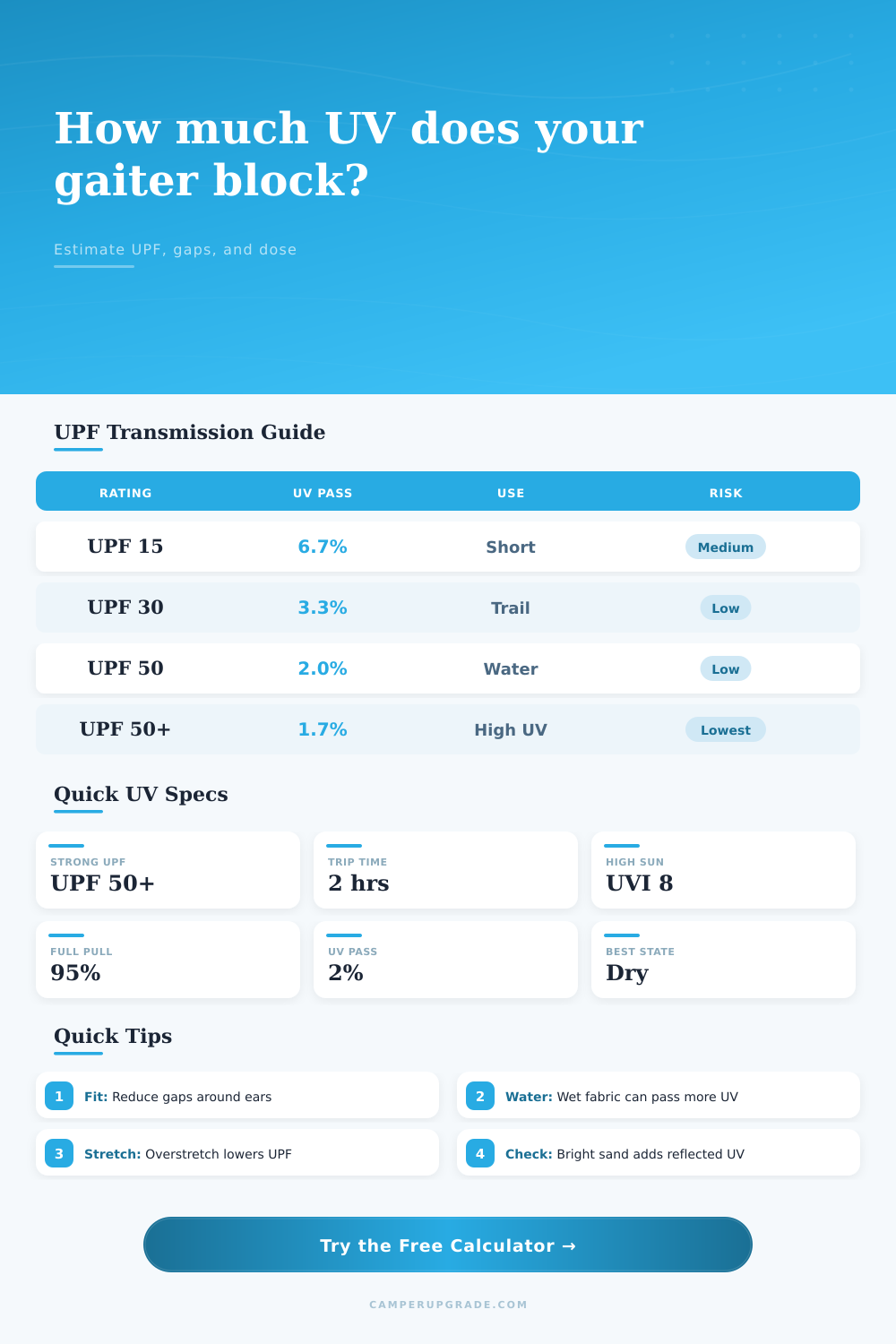
Neck Gaiter UV Coverage Calculator
Estimate how much ultraviolet exposure reaches your neck, ears, and lower face after UPF rating, fabric condition, stretch, coverage gaps, time, and reflected light are combined.
Coverage Estimate
Use the label on your actual gaiter when available. The grid is a planning guide for typical outdoor fabrics and does not certify a garment.
| Fabric Rating | UV Transmitted | UV Blocked By Fabric | Best Calculator Use |
|---|---|---|---|
| UPF 8 | 12.5% | 87.5% | Loose weave or unknown fabric |
| UPF 15 | 6.7% | 93.3% | Minimum sun-protective estimate |
| UPF 25 | 4.0% | 96.0% | Wool blend or midweight knit |
| UPF 30 | 3.3% | 96.7% | General outdoor gaiter |
| UPF 40 | 2.5% | 97.5% | Dense nylon or high shade fabric |
| UPF 50 | 2.0% | 98.0% | High sun, water, or long exposure |
| UPF 60 | 1.7% | 98.3% | UPF 50+ estimate for calculations |
| Wear Position | Planning Area | Typical Coverage | Common Gap To Watch |
|---|---|---|---|
| Neck only | 175 sq in | 80% to 95% | Back collar line |
| Neck plus under-chin | 215 sq in | 82% to 96% | Front fold under jaw |
| Neck plus lower face | 260 sq in | 78% to 94% | Nose bridge and cheek gaps |
| Neck plus ears | 225 sq in | 74% to 92% | Ear rims and strap lines |
| Neck, lower face, and ears | 310 sq in | 76% to 93% | Ear gaps plus slipping |
| High pull below sunglasses | 340 sq in | 82% to 96% | Sunglass and nose gaps |
| Input Setting | Multiplier | What It Represents | Formula Effect |
|---|---|---|---|
| Dry, clean, original weave | 1.00 | Best practical fabric state | No UPF reduction |
| Sweaty but not saturated | 0.90 | Warm trail or camp labor | 10% lower effective UPF |
| Damp from spray or perspiration | 0.75 | Paddling spray or heavy sweat | 25% lower effective UPF |
| Wet or rinsed thin | 0.65 | Soaked lightweight knit | 35% lower effective UPF |
| Salt crust or dusty weave | 0.80 | Uneven fabric surface | 20% lower effective UPF |
| Heavy stretch | 0.60 | Opened weave at pressure points | 40% lower effective UPF |
| Scenario | Typical UVI | Reflect Multiplier | Useful Starting Coverage |
|---|---|---|---|
| Forest trail morning | 3 to 5 | 1.00x | Neck only, 88% |
| Open RV setup | 6 to 8 | 1.08x | Neck plus lower face, 90% |
| Lake fishing | 7 to 10 | 1.12x | Face and ears, 91% |
| Bright sand walk | 8 to 11 | 1.18x | High pull, 94% |
| Snow travel | 5 to 9 | 1.65x | High pull, 95% |
A neck gaiter will keep you warm if pulled up over your nose in cool temperature or worn down at your neck as a bit of shade. Tie it around your wrist maybe. It’s cheap, handy, and useful for outdoor activities.
But just because something is convenient doesn’t mean it will protect you. What feels like thick material at the store can become a sieve for ultraviolet radiation out on the trail. You think it must be good enough since you are covered, that thinking is rarely correct. Everyone focus on the UPF rating on the label. Fifty sounds good. Sounds like two percent of the bad stuff gets through it. But here’s the deal: That rating assume perfect lab conditions. Those tests are done with the fabric stretched out, dried and laying flat. None of that happen when you put that gaiter on.
Why Neck Gaiters May Not Protect You
The calculator up there do the math for you. It factors in real world and adjusts theoretical rating to match.
How does it fit? That matter first. How much do gaps hurt protection? Your neck is unprotected if the gaiter fall off. It’s less protective if it tighten so much on your nose that the weave open. In both those scenario, its protection will decrease more faster than you’d think. One option is worse: a highly rated fabric that doesn’t cover your face well, compared to a more modest fabric that covers well. The question is how much of you is actualy covered. And tell the truth about it. The higher the percentage you enter, the more the calculator will weigh that against the blocking power of the fabric and report what’s actually being covered. Because if you find yourself adjusting the gaiter all the time, it’s covering less of you.
Finally, consider the fabric itself. Once water gets involved, things change. Lightweight synthetics can goes from opaque to see-through when they are exposed to water. And if your gaiters get wet from sweat, fishing or paddling, then the dry rating on their tag doesn’t mean much. The calculator use factors for dusty, salty or just plain damp conditions. So what might block out ninety-eight percent of UV rays when brand-new and dry could drop down to blocking only eighty-five percent when extended and soaking wet. That make a difference over a long day in the sun.
Another variable is how reflective the environment are. Not only will sunburn be coming down at you, but it can also bounce up from snow, sand, or light-colored rock (and water). Think of UV dose to your chin from being out there standing on that bright sand, the reflection from beneath you has increased it. The calculator also consider this. For example, snow reflect almost twice as much UV as dark soil. Even though the sky may appear identical, a couple of hours walking through snow will have a far heavier UV load different than a couple of hours spent walking along a forest floor.
The last multiplier is time. You accumulate UV damage over time. The tool turns your real-time exposure into equivalent unprotected minutes under todays UV index in your location. So now, instead of guessing whether you’re okay, you know exactly how many minutes of full-on sun your existing outfit provides. High? Time for a clothing adjustment (or some sunscreen). Low? Carry on, my good man.
You’re not trying to achieve total coverage; that doesn’t happen out on the trail. But rather than just making an educated guess, you should of know your trade-offs: perhaps you prefer a tighter fit over a higher UPF rating. Maybe you can get some extra skin covered with the gaiter pulled up higher, but now the stretchy fabric won’t be as effective. It’s a choice you make in-the-moment and the calculator will help you see what happens if you choose one option or another prior to going outside.
Sun protection isn’t just about gear; it’s an issue of awareness too. A gaiter with the best UPF rating won’t help at all if it keeps sliding down on your neck. The most well made fabric in the world won’t do anything for you if it’s soaking wet or stretched out and thin. Take these numbers as guidance but never a guarantee. Check your fit, adjust your expectations, and pay attention to how things naturaly turn out. Once you know how light is really hitting you, you’ll stop making guesses and you’ll start to protect yourself.