Base Layer Count by Trip Days Calculator
Estimate hiking and camping base layer tops, bottoms, sleep layers, pack weight, and dry reserve by trip length, climate, activity, fabric, and laundry access.
| Fabric | Top Reuse | Bottom Reuse | Dry Speed |
|---|---|---|---|
| 150 gsm merino wool | 2.8 days | 3.6 days | Moderate |
| 200 gsm merino wool | 3.2 days | 4.0 days | Moderate-slow |
| Light polyester grid | 1.6 days | 2.2 days | Fast |
| Midweight polyester | 1.8 days | 2.5 days | Fast-medium |
| Wool synthetic blend | 2.4 days | 3.2 days | Medium |
| Silkweight synthetic | 1.4 days | 2.0 days | Very fast |
| Heavy thermal knit | 2.2 days | 3.0 days | Slow |
| UPF synthetic hoodie layer | 1.8 days | 2.0 days | Fast |
| Condition | Top Factor | Bottom Factor | Planning Note |
|---|---|---|---|
| Dry desert or high alpine air | 0.88 | 0.92 | Good airing allows longer rotation |
| Mixed mountain weather | 1.00 | 1.00 | Baseline for shoulder-season trips |
| Humid forest or lake country | 1.18 | 1.10 | Drying slows after sweat or rain |
| Wet coastal rain pattern | 1.35 | 1.22 | Carry a reliable dry reserve |
| Snow, frost, or below-freezing camp | 1.12 | 1.28 | Bottoms and sleep layers matter more |
| Trip Length | No Laundry | 3-Day Rinse | Dedicated Sleep |
|---|---|---|---|
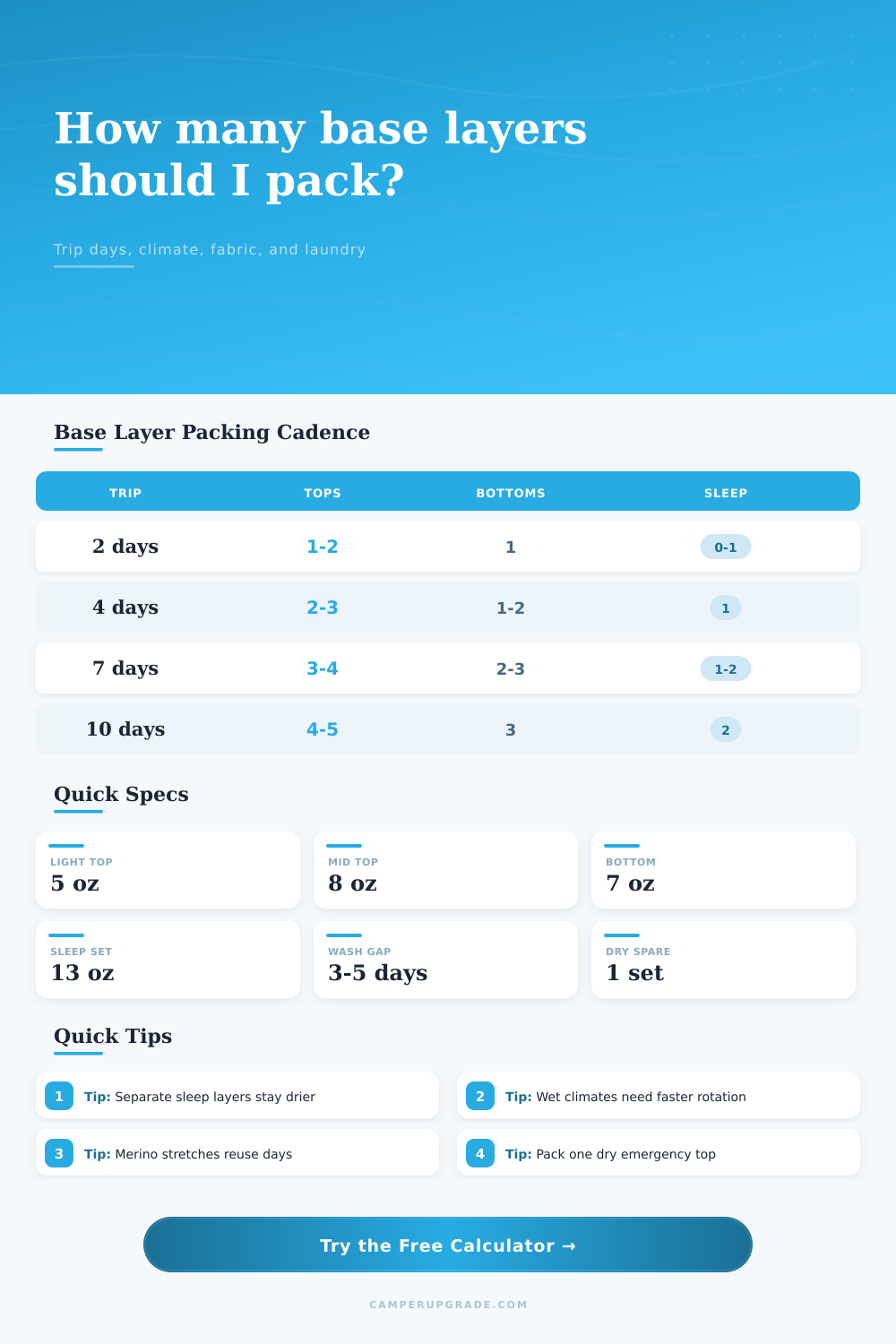
| 2 days | 1-2 tops, 1 bottom | 1 top, 1 bottom | 0-1 pieces |
| 4 days | 2-3 tops, 1-2 bottoms | 2 tops, 1 bottom | 1-2 pieces |
| 7 days | 3-5 tops, 2-3 bottoms | 2-3 tops, 1-2 bottoms | 2 pieces |
| 10 days | 4-6 tops, 3-4 bottoms | 3 tops, 2 bottoms | 2-4 pieces |
| 14 days | 5-8 tops, 4-5 bottoms | 3-4 tops, 2-3 bottoms | 2-4 pieces |
| Common Trip | Days | Inputs Assumed | Typical Solo Count |
|---|---|---|---|
| RV park week | 7 | Low sweat, laundry day 4 | 2 tops, 1 bottom, 2 sleep pieces |
| Wet coast trek | 5 | High sweat, rain, no dry window | 5 tops, 3 bottoms, 2 sleep pieces |
| Winter ski camp | 3 | Cold, snow, full sleep set | 2 tops, 2 bottoms, 2 sleep pieces |
| Bikepacking week | 7 | Very high sweat, 3-day rinse | 4 tops, 3 bottoms, 2 sleep pieces |
| Cool scout weekend | 2 | Moderate sweat, group count | 1 top, 1 bottom, 2 sleep pieces |
The reality is that by day three of a trip, you might realize you’ve used up all your dry clothes, including the one you wore in the rain on Tuesday. Why? Most folks just pack for duration of their trip, without rotation plan. And they don’t realize base layers aren’t interchangeable. The same synthetic grid knit isn’t going to do the job as well as a merino wool top, particularly if it’s humid out.
A lot of folks will bring three shirt in hopes it works out. It doesn’t work when weather changes or when their activity level rise. What does this mean? The calculator know how many tops and bottoms is needed based off how fast they dry and other weights (like how much the fabric weigh). The calculator use that information to find what is needed.
How to Pack Clothes for Your Trip
So first, you begin with party size and trip length. Next you pick fabric type. The app will adjust results accordingly. A lighter polyester grid is easy to dry but less comfortabley. So you might need more shirts then it would recommend with heavier merino wool. Though seemingly minor in the math, that’s an extra couple of pounds of gear if you’re not paying attention.
The biggest variables is climate and activity levels. Even though the material may resist smell, high-sweat clothing will decrease your shirt life (since less laundry = more shirts). Wet conditions slow down drying. The calculator adjust based on your location, as coastal weather leads to wetter shirts. It’ll also cut back the number of thick wool shirts if you can’t hang your shirt in a wet tent.
This is an acceptable trade-off: Hypothermia happens quicker with wet clothes different than fatigue from extra weight. Finally, it takes into account how much laundry access you have (a common rookie mistake). A rinse every three days only help if you actualy have sunlight and wind to dry the items. Choose no reliable wash window if you’re bivying in a rainstorm or shady forest.
The final variable, and one most people mess up, is sleep strategy. Wearing specific layers only for sleep prevents them from coming into contact with sweaty skin and trail dirt, which will make your sleeping bag dirty. The calculator treat these separate layers as different than the ones you hike in. Sleeping in your day clothing contaminates your insulating layer, forcing your sleeping bag to compensate by keeping you warmer then necessary.
This could of been easily done, but it makes a huge difference at night. Look at reference table to see how a dedicated sleep set keeps your day layers fresh. The last items are weight and volume. With this tool, you’ll know whether or not it’s possible to carry all that stuff. Add in a twenty percent storm reserve, and maybe those base layer go from four ounces to a dozen. That’s the price of security: do you want to hike with the possibility of being wet on day two?
That depends on the length of your trip. On a weekend trip, the answer is probably no. You might spend ten days in unpredictable mountain weather. Time for some reserve.
Planning is less about owning the right gear and more about understanding how that gear behave under pressure. I could spend all my money on a fancy new merino shirt but if I don’t rotate it, it’s going to get wet and stinky anyway. So plan to bring just enough redundancy to stay comfortable while avoiding making this whole thing a mobile warehouse.
Begin with the calculator, tweak based off your comfort level with being slightly damp, and go with confidence that means pulling out a clean, dry layer on day three rather than rummaging around in a sopping wet pile.