Camp Shower Tent Floor Area Calculator
Size the usable floor, splash liner, drainage layer, bag count, and packed weight for a camping shower tent footprint.
Full Calculation Breakdown
| Depth | Coverage from 1 cu yd | Metric equivalent | Use case |
|---|---|---|---|
| 0.5 in | 648 sq ft | 60.2 m² at 1.3 cm | Leveling under rigid shower tiles |
| 1 in | 324 sq ft | 30.1 m² at 2.5 cm | Light runoff under a mat |
| 2 in | 162 sq ft | 15.1 m² at 5.1 cm | Typical camp shower drainage |
| 3 in | 108 sq ft | 10.0 m² at 7.6 cm | Soft ground and longer stays |
| 4 in | 81 sq ft | 7.5 m² at 10.2 cm | Shared wash station pad |
| 6 in | 54 sq ft | 5.0 m² at 15.2 cm | Deep sump below a raised deck |
| Container | Volume per unit | Units per cubic yard | Coverage at 2 in depth |
|---|---|---|---|
| Small top-off bag | 0.5 cu ft | 54 bags | 3 sq ft per bag |
| Standard landscape bag | 2 cu ft | 13.5 bags | 12 sq ft per bag |
| Large landscape bag | 3 cu ft | 9 bags | 18 sq ft per bag |
| Half cubic yard | 13.5 cu ft | 0.5 yd³ | 81 sq ft |
| One cubic yard | 27 cu ft | 1 yd³ | 162 sq ft |
| Camp shower setup | Interior area | Protected area with 6 in margin | 2 cu ft bags at 2 in depth |
|---|---|---|---|
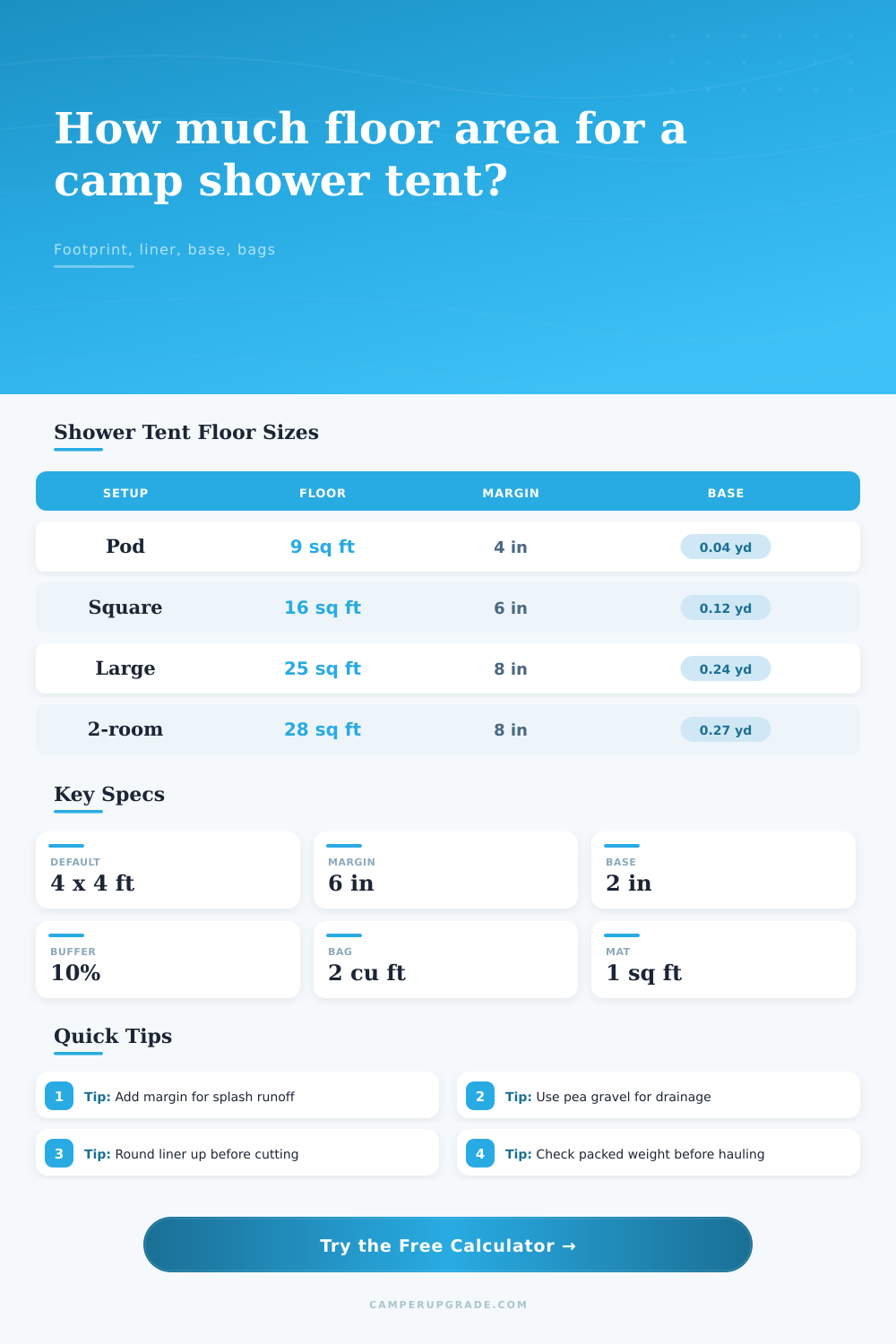
| Compact changing pod 3×3 | 9 sq ft | 16 sq ft | 2 bags |
| Standard square shower 4×4 | 16 sq ft | 25 sq ft | 3 bags |
| Oversize privacy tent 5×5 | 25 sq ft | 36 sq ft | 4 bags |
| Narrow 2-room shower 7×3.5 | 24.5 sq ft | 36 sq ft | 4 bags |
| Round shower deck 4 ft diameter | 12.6 sq ft | 19.6 sq ft | 2 bags |
| Result | Formula | Conversion used | Why it matters |
|---|---|---|---|
| Interior floor area | L × W, πr², or 0.5 × B × H | 1 m = 3.28084 ft | Sizes the standing area inside the tent |
| Protected liner area | (L + 2M) × (W + 2M) | 1 sq ft = 0.092903 m² | Allows splash runoff outside the tent wall |
| Drainage volume | Area × depth / 12 / 27 | 1 yd³ = 0.764555 m³ | Converts the wet base into cubic yards |
| Base weight | yd³ × material lb/yd³ | 1 lb = 0.453592 kg | Checks whether the load is easy to haul |
Here’s the issue: You pull up to a shower tent, open the door, walk in (and slip on a slimy carpet of soapy mud). Yeah, that sucks and it are downright dangerous. The tent itself become the last line of defense for most campers. However, all of the action take place underfoot.
What’s underneath should of be capable of diverting water without becoming a bog. You can use the calculator above to do the math, or better yet, know the variables to save your weekend.
How to Fix Shower Tent Drains
The number one error campers make is calculating only the interior tent size. Four by four feet seems small enough, but then you remember, water doesn’t confine itself to the tent walls. It spill over your legs and spreads out. Water collect in puddles. Enter the splash margin (aka drainage area beyond the tent’s footprint). Without it, water gets into the skirt and makes a muddy mess around your change-of-clothes area.
How thick should your drain material be? Depending on what it’s sitting on, maybe just a half-inch of pea gravel would flatten out an area enough for laying down a stiff mat. But it won’t hold up to a long hot shower or heavy rains. Most camp sites seem to settle into two inches as being just right; it will absorbs the initial runoff without being so high that the overall weight of all those materials becomes too much to manage. Anything more than that mean a serious haul time.
Washed stone is heavy. A cubic yard of it weigh almost three thousand pounds, and that’s not the sort of thing you want to lug uphill. That’s where the tool comes in. It translates depth and area into numbers of bags. That is when things get real.
Sure, you might be able to look at a price tag and see how much gravel costs, but you want to know how many bag to buy. How does one standard, two-cubic-foot bag cover an area? Turns out, not very much when spread to a thickness of just two inches! How much do they weigh all together? How many of those bags could I actualy buy at the home improvement store? That’s what the tool breaks down, from volume into something you can go out and buy. And it even calculates weight.
If you get an output suggesting you’ll have to haul around eighty pounds of stone so you can take a ten minute shower, maybe its time to rethink the setup. The amount of material matters because the weight is important. Many people like pea gravel for its draining qualities and staying in place, but it’s quite heavy. Decomposed granite packs together and can get dusty when dry; but when wet, it do lock down. On soft ground, you might want a thicker layer of coarse rock to create a more solid surface to stand on. The table on the page spells this out, with the various thicknesses and how they covers an area per yard.
Remember that it isn’t just about the space; volume is also about mass. Or, in some cases… People just forego the gravel altogether and lay down interlocking deck tiles. If you have pretty level ground this is definitely an option. You can enter the dimensions of your tiles into the calculator to see how many panels you need. It’s a nice clean option… but it’s also a little loose feeling (plastic on dirt). Just make sure that those tiles stays flat, because any rocking is pointless. The end result, however, is a solid platform and dry feet.
This is your own miniature infrastructure project within a nylon shelter. There’s no need for perfection, just functionality. Planning a bit ahead will save you from the post-shower rush for someplace dry to stand. The math isn’t complicated, but the comfort payoff is massive.
Start with the margin, build up the depth, and check the weight before you load the car. Adjusting a number on a screen is much easier different than digging yourself out of a muddy tent in the rain.