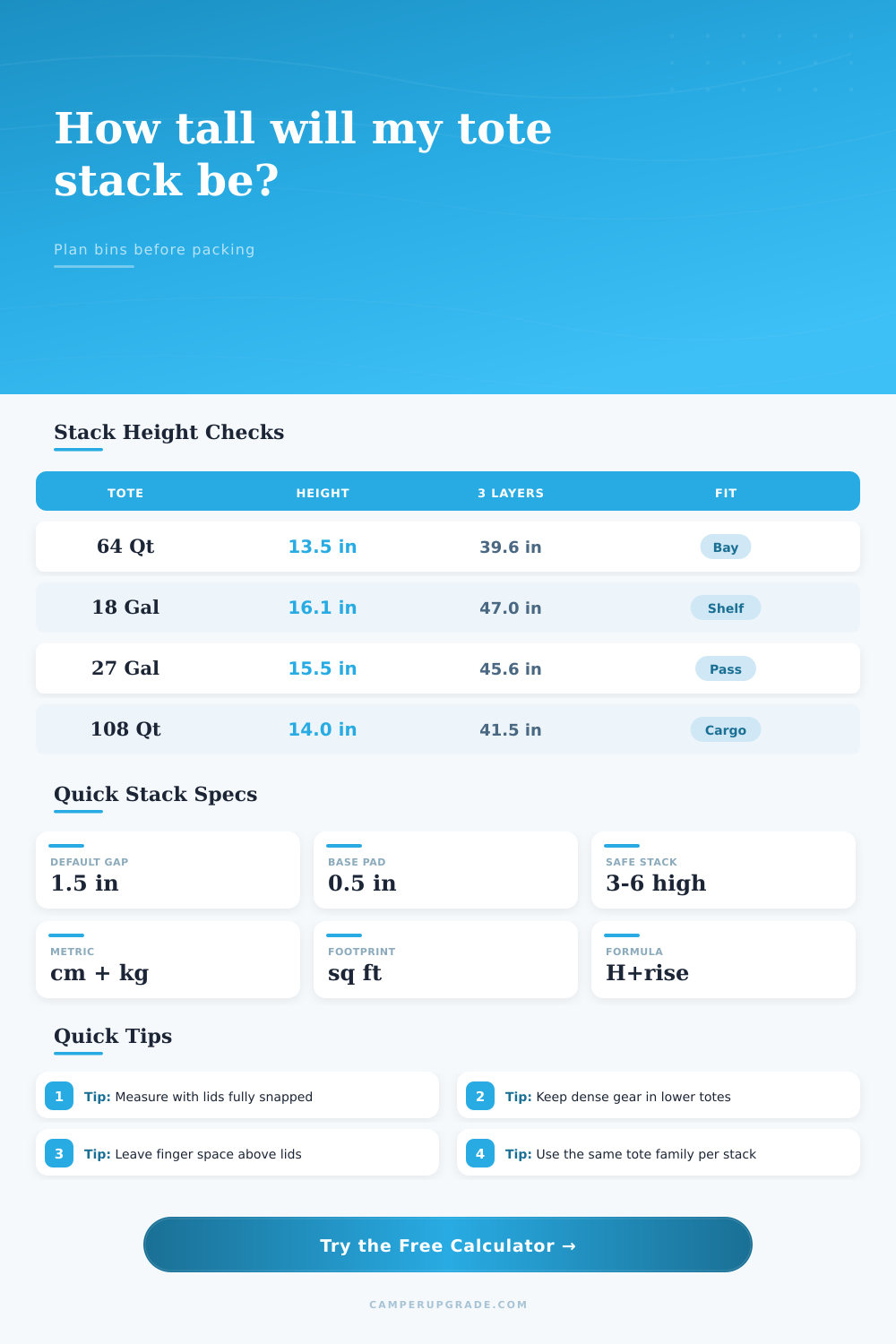
Storage Tote Stack Height Calculator
Estimate stacked tote height, clearance, columns, footprint, and loaded column weight for camper bays, garages, SUVs, and shelves.
Formula Breakdown
| Tote preset | Outside size L × W × H | Capacity class | Planning note |
|---|---|---|---|
| Sterilite 64 Qt Latching Box | 23.75 × 16.00 × 13.50 in | Medium clear latch | Good modular shelf footprint |
| Sterilite 18 Gal Tote | 23.50 × 18.38 × 16.13 in | Deep household tote | Tall; check lid clearance early |
| Sterilite 27 Gal Industrial | 28.50 × 19.63 × 15.50 in | Heavy-duty tote | Wide footprint for pass-through bays |
| Rubbermaid Roughneck 10 Gal | 23.88 × 15.88 × 8.88 in | Low profile tote | Useful when height is tight |
| Rubbermaid Roughneck 18 Gal | 23.88 × 15.88 × 16.38 in | Deep rugged tote | Limit layers with dense gear |
| IRIS WeatherPro 74 Qt | 23.60 × 17.75 × 14.50 in | Gasket latch tote | Small recess; allow a clean top gap |
| IRIS WeatherPro 103 Qt | 23.63 × 17.75 × 18.75 in | Large gasket tote | Often becomes a two-layer stack |
| Hefty Hi-Rise 72 Qt | 23.98 × 16.81 × 14.24 in | Raised-lid tote | Count the high lid in measured height |
| HDX 27 Gal Tough Tote | 28.50 × 19.60 × 15.20 in | Heavy-duty tote | Common garage and camper bay size |
| Plano Sportsman 108 Qt | 37.25 × 18.00 × 14.00 in | Long trunk tote | Long footprint may decide orientation |
| Tote height | 2 layers | 3 layers | 4 layers | 5 layers |
|---|---|---|---|---|
| 8.88 in low tote, 0.35 in recess | 17.40 in | 25.93 in | 34.45 in | 42.98 in |
| 13.50 in medium tote, 0.45 in recess | 26.55 in | 39.60 in | 52.65 in | 65.70 in |
| 14.50 in gasket tote, 0.30 in recess | 28.70 in | 42.90 in | 57.10 in | 71.30 in |
| 15.50 in rugged tote, 0.45 in recess | 30.55 in | 45.60 in | 60.65 in | 75.70 in |
| 16.38 in deep tote, 0.40 in recess | 32.35 in | 48.33 in | 64.30 in | 80.28 in |
| 18.75 in large tote, 0.30 in recess | 37.20 in | 55.65 in | 74.10 in | 92.55 in |
| Storage zone | Typical clear height | Suggested clearance | Height planning use |
|---|---|---|---|
| Camper pass-through bay | 22 to 36 in | 1.5 to 2.5 in | Usually one or two layers |
| Pickup bed under tonneau | 18 to 24 in | 1.0 to 2.0 in | Low totes or single tall totes |
| SUV cargo behind seats | 28 to 36 in | 2.0 to 3.0 in | Two layers with visibility check |
| Garage shelf bay | 36 to 72 in | 2.0 to 4.0 in | Use weight and reach limits too |
| Closet floor stack | 48 to 84 in | 3.0 to 6.0 in | Limit top-heavy stacks |
| Allowance | Conservative value | When to increase it | Formula role |
|---|---|---|---|
| Lid recess or compression | 0.25 to 0.55 in | Only after measuring a real stack | Reduces each added tote rise |
| Top clearance | 1.5 to 3.0 in | Sliding bays, handles, labels, fingers | Reserved space above the stack |
| Base mat or tray | 0.25 to 1.0 in | Rubber mat, drawer slide, cargo tray | Adds height below first tote |
| Personal layer cap | 3 to 6 layers | Soft lids, heavy contents, travel motion | Limits columns beyond pure height |
| Column weight limit | 100 to 250 lb | Plastic shelves or camper floors | Limits layers by loaded weight |
That’s what frequently happens: it gets full pretty quick in the corner of the garage or the back of pickup truck. Then all of a sudden you look around and there are three more boxes that need to go somewhere, and now you’re out of vertical room. It is time to forget about geometry and just throw some stuff around. That’s why it still works, gravity doesn’t follow your plan, and just wanting the container lid to flatten completely won’t make it happen.
And it’s usually never the size of the totes themselves. It is almost always the height of the stack. You can put two columns of bins side-by-side, but get off by 1/2″ with your vertical clearance and bam, the whole thing come crashing down.
Why Your Plastic Bins Do Not Stack Right
You run the math in the calculator above. How does it work? What does it calculate? Most folks think when they stack bins that it’s simply the height times the number of bins. Wrong. The height of a single bin is not the same than the height of your stack.
Why? Because totes is made to stack or nest. This means the top bin typically has a recess or connection, so its top is a bit lower than outside measurements suggest. For example, a Sterilite 64 Quart box may measure 13.5 inches high on the exterior. When you put a second bin on top, its lid will tuck into the bottom bin’s base. You get a height of less than 13.5 inches.
This is where the tool come into play. The difference is the difference between a bulging mess and a snug fit. So what’s up with this recess thing? Well, here’s something you need to know: Molding tolerance vary by manufacturer. Some brands may make a deep latch that increases lid height but also sits deeper in the box. This “lid recess” dimension is why the calculator prompts for it (so it can subtract it from each subsequent layer except the initial).
If you enter a default value, or just skip it, then you’ll get the wrong estimate. That’s where most folks screw-up. They measure a single box, times that number. Looks good enough. But that quarter-inch discrepancy accumulates as an inch-and-a-half over five layers. An inch-and-a-half is the distance between closing the tailgate versus not.
Weight is a big issue in storage planning. Six bins standing up? Great. Thirty pounds in each, though? That’s almost two-hundred pounds in the bottom bin. Plastic bends. Under load, plastic creeps and the corners crack. The calculator check if the weight is within a safe limit.
It’s more than just strength. It’s access. Sure, the stack may be stable, but do you really want to lift that fifty-pound bin down again? No, you’ll leave it right where it is for three years. Plan based off how dense the contents are, and realize that a smaller amount might not fill entire height of the space. Heavier items goes on the bottom. Old advice, but the only advice that matters.
A forgotten variable is clearance. You want to be able to open your lids without hitting anything above the top lid. You’ll want enough room to get your hands on handles too. Uneven flooring will require more space. Rubber floor liners and mats add a bit of height too, which can be easy to overlook. All those little allowances go in the tool. Altogether, they matter.
Every millimeter counts in a camper bay. It’s tight. That’s why the page has a reference table that lays it all out for common zones. How many layers from a standard shelf height? Use that as a guide, not a rule. You may have a slanted floor. Your lids may warp. Knowing where to stop stacking is the trick.
Even though a well thought out stack may look good on paper, it might be too much. Will it cause a hazard? Will it block access? Take a look. Is there clear space on all sides? (Negative clearance = problem) Is the weight close to capacity? You should of reduced the layers. Change the footprint. Shift some boxes into another column. It’s simple arithmetic. But judgment isn’t.
Close the lid. Measure with it closed. Make sure the heaviest stuff stay down low. Clear space for your hands. Stack ‘em up and then back off before trying to jam one more in.