Paracord Shelter Length Calculator
Estimate tarp ridgelines, guylines, knot tails, tree wraps, tensioner allowance, backup cord, spool size, and packed cord weight before heading out.
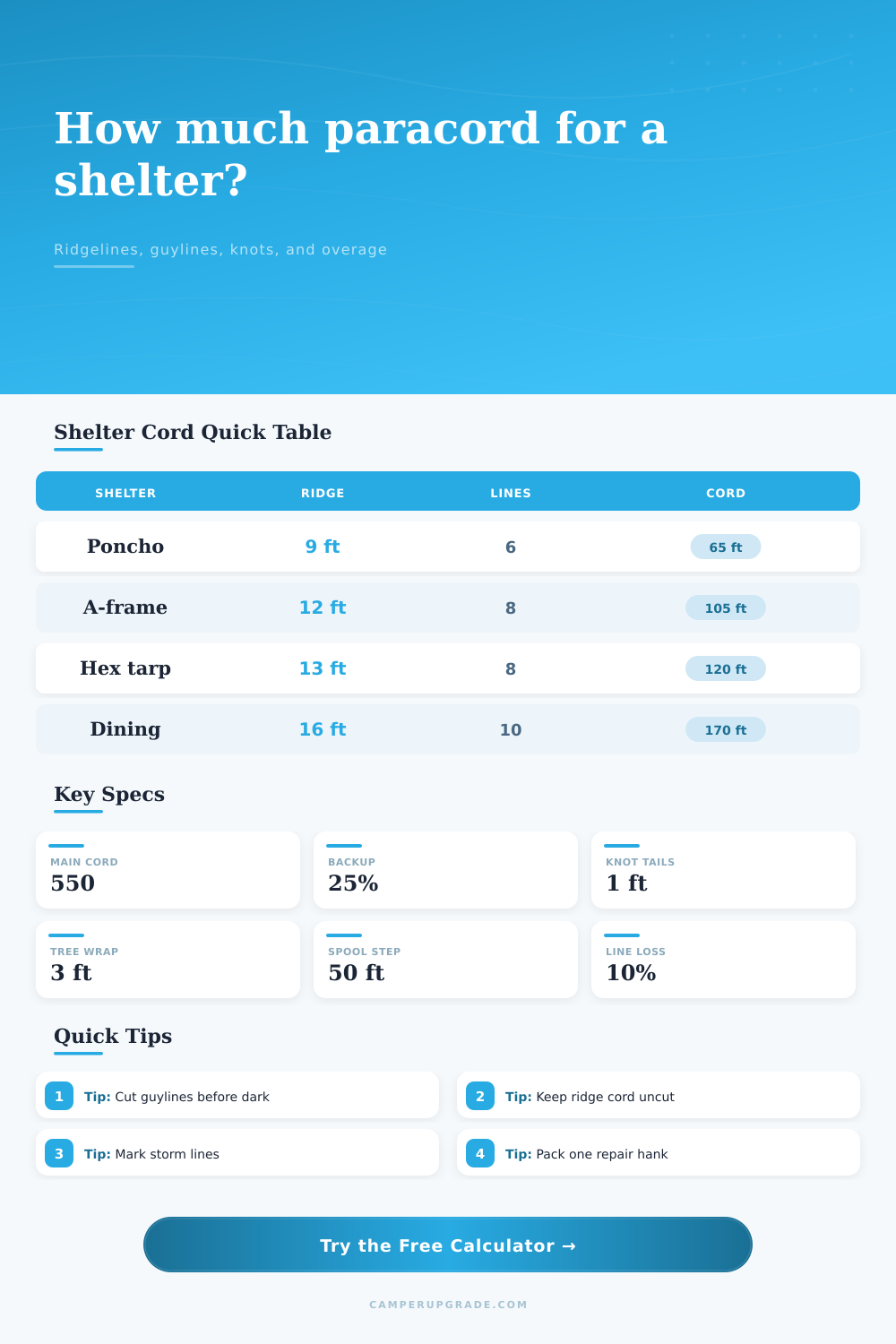
| Shelter | Typical Span | Normal Tie-Outs | Recommended Cord |
|---|---|---|---|
| Poncho diamond fly | 8 to 10 ft | 4 corners, 1 ridge | 55 to 75 ft |
| Solo 8 x 10 A-frame | 10 to 12 ft | 4 corners, 2 doors, ridge | 90 to 120 ft |
| Hammock hex tarp | 11 to 13 ft | 4 corners, 2 doors, continuous ridge | 105 to 140 ft |
| Lean-to wind shelter | 10 to 14 ft | 2 high, 4 low, side pulls | 85 to 130 ft |
| 12 x 12 dining fly | 14 to 18 ft | 8 perimeter, ridge or poles | 145 to 200 ft |
| Low winter A-frame | 10 to 12 ft | 6 low guylines, doors, ridge | 115 to 160 ft |
| Connection | Add Per End | Best Use | Calculator Setting |
|---|---|---|---|
| Bowline loop | 8 to 12 in | Fixed tarp corners | 0.7 to 1.0 ft |
| Taut-line hitch | 12 to 18 in | Adjustable stake end | 1.0 to 1.5 ft |
| Trucker's hitch | 18 to 30 in | High tension ridge | 1.5 to 2.5 ft |
| Prusik on ridgeline | 12 to 24 in | Sliding tarp tension | 1.0 to 2.0 ft |
| Line-loc adjuster | 6 to 12 in | Fast tarp guylines | 0.5 to 1.0 ft |
| Spool Size | Meters | Typical Shelter Fit | Cut Planning Note |
|---|---|---|---|
| 50 ft hank | 15.2 m | Emergency poncho or repairs | Short lines only |
| 100 ft hank | 30.5 m | Solo tarp with simple ridge | Common minimum |
| 250 ft spool | 76.2 m | Family tarp or two shelters | Enough for re-cuts |
| 500 ft spool | 152.4 m | Group camp and storm extras | Bulk camp kit |
| Part | Formula | What It Solves | When To Raise It |
|---|---|---|---|
| Corner guyline | sqrt(height² + setback²) + allowances | Diagonal stake run | High tarp pitch |
| Side pullout | sqrt((height x 0.55)² + setback²) + allowances | Lower wall tension | Windy broadside |
| End guyline | setback + height x 0.35 + allowances | Door or beak pull | Porch mode |
| Continuous ridge | 2 x span + 2 x wraps + 4 x knots | Full tree-to-tree line | Hammock tarp |
That’s the panic that sets in as you attempt to pitch a tarp in the fading daylight. The rain begins falling and you realize you have cut your ridgeline too short. That is the point where physics wins and your plan to cook dinner fails.
The problem is rarely the tarp itself; more often than not, the issue are the cordage. Most folks purchase a hank of string labeled ‘fifty feet’ and then proceed to cram that string into some complex shelter design that requires each and every inch, plus some spare for knot tying.
How to Choose the Right Rope for Your Tarp
The arithmetic isn’t complicated. The intuition can prove difficult. Think geometry; specifically the geometry of the tarp pitch prior to ever setting foot in the woods. Enter your anchor distances and type of shelter into the calculator (above) and it’ll crunch the numbers for you.
You will no longer have to guess how much space a trucker’s hitch actualy uses. But the true math is knowing what those variables are.
First, there is the ridgeline span. This is how far apart your shelter’s supports is, such as trees or poles. Measure this incorrectly and all bets is off.
The next topic is pitch height. In general, lower shelters like wintertime ones require little vertical space. This results in short corner guys. High summertime flies require more roof clearance, stretching out your corner lines considerably. It’s simple old-school trigonometry; nothing to solve for X here if you understand that bigger roofs requires more cordage.
Most folks miss this one. They forget it until it’s too late. A bowline eats about a foot of usable line. Depending on how much tension you put into a trucker’s hitch or a taut-line hitch it can eat another foot or even two feet of usable line. Cut a guyline exactly to the distance between the tarp and the stake and you won’t have any tail to make a secure knot.
It’s worth noting because the tool accounts for it automatically based on which style you select. But here is why. You are really measuring something beyond simple distance. You’re measuring how much tension and security you need to be able to create. Without that buffer, your knots slip, your stakes pull loose, and your shelter sags. Your shelter sags. Your stakes pull loose. And your knots slip.
Should you wrap the cord around a tree? That matters, too. More than you’d think. Your gear needs to stay off the bark, and wrapping the cord helps there (it also stays put better when wet). And less cord sliding all over saves another three feet per end; that adds up fast if you’ve got multiple anchor point. It’s a little weight, so it doesn’t add much (small money), but it will make a huge difference when it counts.
The chart on the page breaks it down by type of shelter. You’ll see that a simple diamond configuration (like a poncho) may only require sixty feet, whereas a dining fly could easily ask for well over one-hundred-fifty. These are not arbitrary numbers at all. All those knots, all those tie-outs, all that needed slack add up.
The other part of the puzzle is determining what size cord is best. For a minimalist solo trip, micro cord is light and packable. But it can be tricky to tie with gloves on. Standard five-fifty paracord is the work horse. It is thick, strong, and easy to handle.
If you expect high winds or are headed out into winter conditions you may choose something more heavy or reflective. Reflective cord can be a lifesaver when you need to get back to the kitchen area at night without tripping on a guy line.
You will notice the weight estimate change depending on the type of cord you choose so you can understand the trade off between ounces and strength. A couple grams here and there in the weight of cord isn’t a big price to pay for a shelter that holds up in a storm.
Don’t scrimp on the overage buffer. For regular circumstances, ten percent should of been plenty fine. But if your site has rough terrain, lots of trees, or you fear tying another knot in cold weather, go ahead and increase that to twenty percent. Better to have some rope left over than to have one saggy tarp.
This is also how you know if you want a spool of 50 feet or an extra-large roll. Even then, a hundred feet may not even be enough for a complicated multi-tarp structure, or a group camp.
Pitching a shelter is ultimately about preparation. It is about understanding in advance exactly what kind of rope is required so that when you reach the campsite you aren’t struggling with half-assed cords. You’re reveling in the scenery. Account for the knots, respect the geometry, plan the cordage and presto! Your shelter holds.
That’s the trick. Measure the trees. Sleep dry.