Charcoal Chimney Fill Calculator
Estimate how full to load a charcoal chimney from chimney dimensions, charcoal type, grill area, cooking style, target heat, and burn time.
Full Breakdown
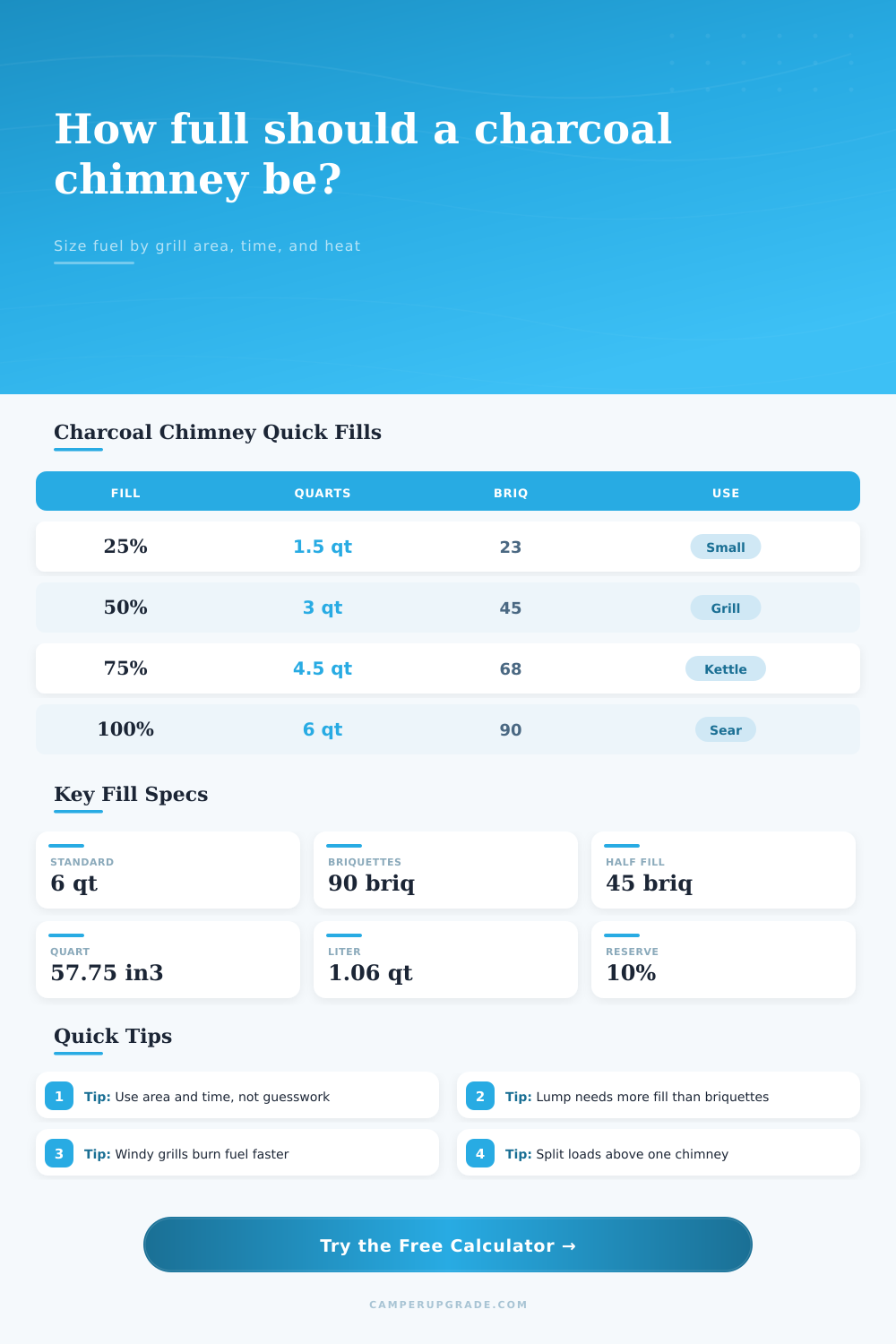
| Fill Level | 6 qt Chimney Volume | Approx Standard Briquettes | Typical Use |
|---|---|---|---|
| 25% fill | 1.5 qt / 1.4 L | 20 to 25 pieces | Small portable grill, quick sausages, or starter coals |
| 50% fill | 3.0 qt / 2.8 L | 40 to 50 pieces | Medium direct grilling or half a kettle coal bed |
| 75% fill | 4.5 qt / 4.3 L | 60 to 70 pieces | Full family grill load or indirect chicken cook |
| 100% fill | 6.0 qt / 5.7 L | 85 to 95 pieces | Hot sear, large grate, pizza launch, or long camp griddle load |
| Chimney Type | Inside Diameter | Usable Height | Calculated Capacity |
|---|---|---|---|
| Compact camping starter | 5.8 in / 14.7 cm | 8.7 in / 22.1 cm | 4.0 qt / 3.8 L |
| Standard kettle starter | 7.5 in / 19.1 cm | 9.4 in / 23.9 cm | 7.2 qt / 6.8 L by cylinder, commonly filled to about 6 qt |
| Large backyard starter | 8.0 in / 20.3 cm | 10.4 in / 26.4 cm | 9.1 qt / 8.6 L by cylinder, commonly filled to about 8 qt |
| Short square basket adapter | Use equivalent round diameter | Measure coal depth | Enter custom dimensions for exact fill height |
| Cooking Style | Base Rate | Base Time | Base Temp |
|---|---|---|---|
| Direct medium grill | 0.82 qt per 100 sq in | 40 min | 375°F |
| Direct high heat | 1.05 qt per 100 sq in | 35 min | 475°F |
| Very hot sear | 1.28 qt per 100 sq in | 25 min | 600°F |
| Two-zone indirect | 0.66 qt per 100 sq in | 60 min | 325°F |
| Low-and-slow starter bed | 0.24 qt per 100 sq in | 90 min | 250°F |
| Dutch oven coal set | 0.92 qt per 100 sq in | 45 min | 350°F |
| Cook Surface | Area | Metric Area | Half-Chimney Fit |
|---|---|---|---|
| 14 in portable round grate | 154 sq in | 994 sq cm | Good for direct medium heat |
| 18 in kettle round grate | 254 sq in | 1639 sq cm | Works for burgers or sausages |
| 22 in kettle round grate | 380 sq in | 2452 sq cm | Best for two-zone, not full sear |
| Large rectangular camp grill | 480 sq in | 3097 sq cm | Usually needs 75% to full chimney |
The charcoal chimney is a bit of a black box most of the time for backyard cooks: You put some paper in the bottom, load briquettes on top, light it, and go hang out until the coals has turned gray and covered themselves in ash. Sometimes they do (if you’re lucky) and sometimes you’re left with half-burnt charcoal and a cold dinner. Half the time it isn’t even the fault of the chimney, usually it’s because there was a failure to reckon exactly how many coals you realy need to get the job done.
Enter the charcoal calculator. It eliminates the guessing by connecting what kind of food you plan to cook and what size grill you intend to use to how much fuel you will need to make it all happen.
Why You Need a Charcoal Calculator
First things first: consider what’s under the meat. For example, a 22-inch diameter, full sized kettle will require more fuel compared to small portable grill. Why? Because the larger surface area rapidly disperses the heat being produced. Strong, high-level searing heat are required when attempting to sear steaks. Generating that kind of heat requires more fuel then maintaining a medium heat to cook a burger.
That’s where the style comes into play. The calculator accounts for that by using different levels of fuel consumption (burn rates) depending on your desired style. Direct high-heat cooking burns through fuel and oxygen faster than gentle, two-zone cooking. You’ll select your target temperature and time you anticipate spending actively cook, which tells the system how much heat it has available to maintain the cook.
Also important: Different types of charcoals has different densities, meaning that volume isn’t a very good indicator of how much charcoal you’re loading. Regular briquettes are pretty uniform and predictable, while lump is all lumpy and irregular, creating air pockets. Because of that, we’ve entered the density of each type of fuel into the calculator. This means that lump will often need a fuller chimney than briquettes to get equivalent amount of fuel. That’s where many folks go wrong. They load their chimneys up to the same level with both kinds of fuels and then wonder why the lump goes out faster. There’s nothing wrong with the lump… There’s something wrong with assuming that volume is equal to fire power. The calculator fixes this by counting pieces (as well as approximating total weight), rather than measuring only the height of the pile.
There’s one final component: grill design and weather. An open grill will lose heat out of the sides; a windy camp site will remove that heat from the coals at a quicker pace different than a covered porch. The vent and weather factor in the calculator adds a buffer for these things. More fuel is required to keep your temps up when you’re cooking in the wind, so the tool accounts for this heat loss by adding a percentage to the base calculation. It’s just a little tweak, but it keeps you from experiencing the dreaded mid-cook fuel crash.
Want a safety net? Add a reserve buffer. Tend to run low? Add a buffer there too. It spits out your suggested fill level. So if it’s saying seventy-five percent, you want to stop filling once your charcoal is up to that mark. There’s no reason to fill it all the way to the top (unless the numbers tell you to). Filling too high just means wasting charcoal and having an uneven fire bed, filling low means getting cold spots and having to deal with uneven cooking.
There’s some good standard fills provided by the tool in its reference tables: things like a quick sausage cook, or a full family grill load. Those are nice benchmarks and can help you imagine what a quarter-fill or a half-fill might look like in the real world. Use those to develop your own intuition over time. Soon enough, you’ll be able to kind of feel what a particular cook might require based off your charcoals, but until then, trust the numbers.
Sure, it sounds like overkill, using a calculator when you’re cooking with an analog tool like a grill, but being exact is the difference between being a good cook and being a great one. When you know exactly how many coals you need, you’ll use fewer, which makes you even more efficient. You’ll eliminate the guessing game of whether there are enough coals, and you won’t spend any time fighting with your fire to make it larger or smaller.
The actual magic happens before loading up the chimney (it’s all about planning the load). After you’ve dialed in the fill quantity, everything else fall into place. The heat stays consistent. The coals burn uniformly. Your meal cooks evenly. Turns out, the key to better grilling isn’t more heat; it’s the correct amount of heat.
You should of used this sooner.