Grill Grate Area Per Person Calculator
Estimate active cooking space for camp grills, portable grates, kettle grills, and group cookouts with room for turning, sides, and warming.
🔥 Named Cookout Presets
📏 Cook Space Inputs
🔧 Grate Spec and Material Grid
📊 Per-Person Menu Area Table
| Menu type | Base active area | Why it needs space | Good for |
|---|---|---|---|
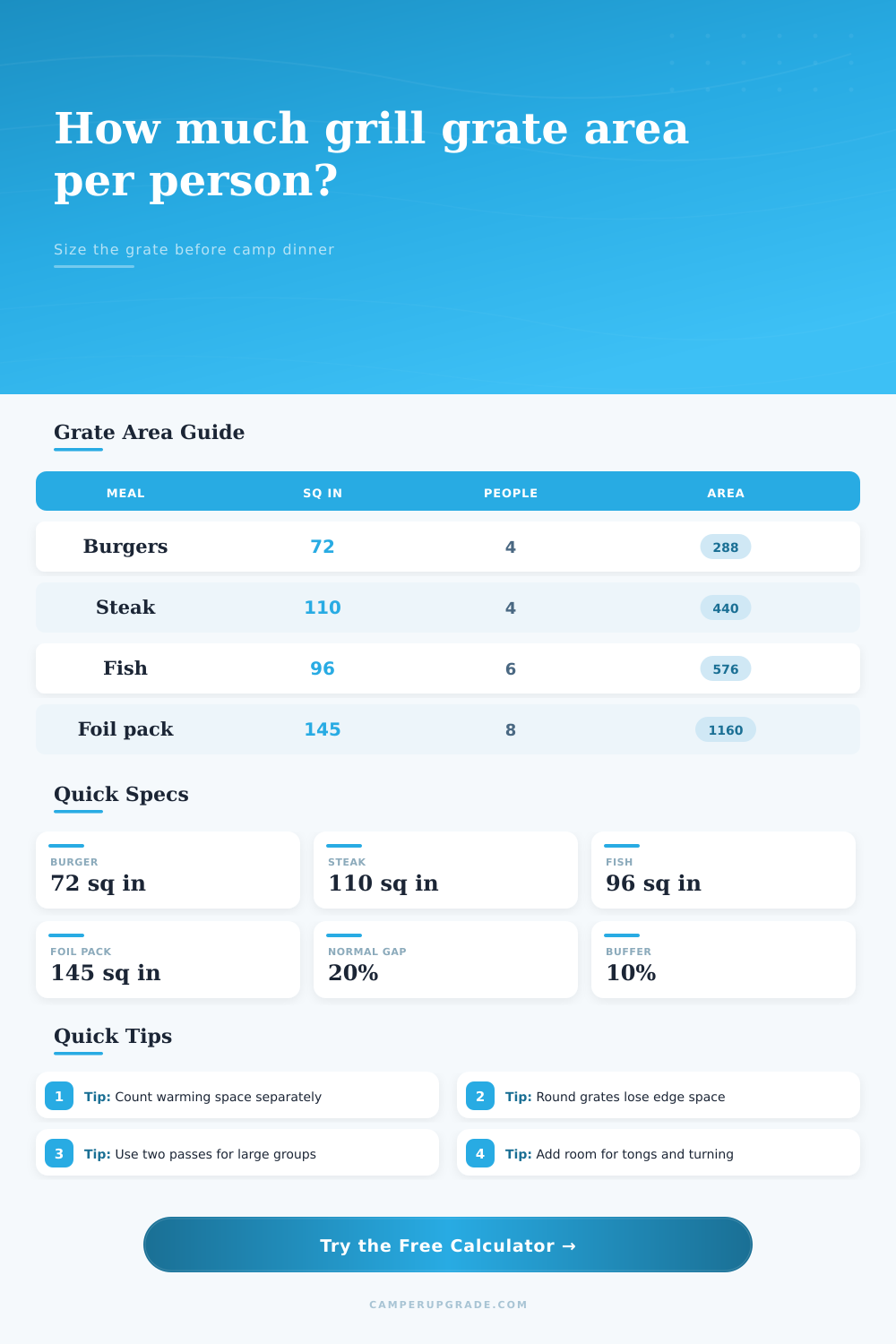
| Classic burgers | 72 sq in per person | Patty, bun toast, turning gap | Fast camp dinners |
| Hot dogs and buns | 48 sq in per person | Narrow food with easy rotation | Tailgate service lines |
| Steak or chops | 110 sq in per person | Large cuts need sear spacing | Small groups |
| Fish fillets | 96 sq in per person | Flat pieces need careful lifting | Lake campsite meals |
| Breakfast griddle items | 130 sq in per person | Eggs, bacon, toast, and pancakes | Morning camp service |
| Foil packs | 145 sq in per person | Bulky packets occupy full rectangles | Group prep meals |
| Skewers or kebabs | 90 sq in per person | Handles and turning clearance | Mixed vegetable nights |
| Mixed grill | 125 sq in per person | Different foods finish at different times | Longer relaxed cookouts |
🔥 Common Grate Size Reference
| Grill or grate style | Typical cooking surface | Raw grate area | Typical burger service |
|---|---|---|---|
| Small folding camp grill | 14 in × 10 in | 140 sq in | 1 to 2 people |
| Portable tabletop grill | 16 in × 12 in | 192 sq in | 2 people |
| Compact rectangle grate | 20 in × 14 in | 280 sq in | 3 people |
| 18.5 inch round kettle | 18.5 in diameter | 269 sq in | 3 people |
| Medium campsite grill | 24 in × 18 in | 432 sq in | 5 people |
| Large park grate | 32 in × 18 in | 576 sq in | 7 people |
| Group charcoal grill | 36 in × 24 in | 864 sq in | 10 people |
🧮 Batch Planning Reference
| Party size | One-pass burger area | Two-pass burger area | Three-pass burger area |
|---|---|---|---|
| 2 people | 228 sq in | 114 sq in | 76 sq in |
| 4 people | 456 sq in | 228 sq in | 152 sq in |
| 6 people | 684 sq in | 342 sq in | 228 sq in |
| 8 people | 912 sq in | 456 sq in | 304 sq in |
| 12 people | 1368 sq in | 684 sq in | 456 sq in |
📐 Usable Area Adjustment Table
| Adjustment | Typical allowance | Use it when | Calculator input |
|---|---|---|---|
| Turning clearance | 10% to 50% | Food needs tongs, flipping, or spacing | Spacing clearance |
| Side items | 18 to 48 sq in each | Buns, corn, peppers, toast, or vegetables share the grate | Side item space |
| Warming zone | 0% to 30% | Finished items stay on indirect heat | Reserved warming zone |
| Edge loss | 5% to 10% | Round grates, handles, rims, or cool corners reduce usable space | Usable percentage |
| Planning buffer | 5% to 20% | Food sizes vary or several foods finish together | Extra sizing buffer |
💡 Camp Grill Calculation Tips
The vast majority of home grilling fans think they are all set with a three-hundred-square-inch model (the size stated on the packaging). Three hundred! Sounds like plenty. But that’s accounting for dead zones in the corners, handle attachments, and around the edges of those rounded-off grids. In truth, the usable cooktop is always less than what the box describes. Because: math. And also: marketing.
An exclusive space estimator removes all that and just gives you the straight answer: How many burgers can I expect to fit without steaming my meat? Where should we start? First, how much does everyone eat? Each person takes up some space on the grate. More than that of the actual burger. You require space for the bun, room for the patty to cook, and some distance between it and the heat so you don’t burn your fingers when you go to turn it over. When most planning calculators come out with their numbers, they estimate about 72 square inches per serving for a basic meal. This is for the food plus the airspace around it.
How to Plan Your Grill Space
Steaks are a different animal altogether. Because of their large size, steaks must be cooked directly on the hot bars, which creates a crust. The problem arises when you crowd these bad boys together, they become an oven.
Secondly, what’s your strategy for serving? When should people eat? The calculator accounts for that too, finding the right balance of how much to cook versus waiting time. If you cook everything at once, you need a huge grate; most campers aren’t bringing a giant grill with them. Instead, divide people up into one or more groups; perhaps two, or three, where each batch goes in as another finishes their meal. With a smaller grate, you can still feed a crowd (as long as you keep the initial portion warm). That’s the core question: how big an apparatus do I bring, vs. How convenient would it be to split things up? The tool figures out those passes for you so you don’t have to try and do it in your head while juggling the charcoal.
Warming zone is also another key consideration. For good grilling, you want some direct heat as well as a spot that’s a bit cooler. This is where you can pull things from over the fire as they’re done, while finishing up other parts of the meal. If you don’t have it, folks waiting at the end gets cold food while those at the front are being fed too quickly. It may feel wasteful to dedicate 10-30% of your grill to this. You can toggle it on/off in the calculator to see what you lose in terms of active searing space. However, it’ll be the difference between a relaxing meal and a stressful one.
Turns out shape is important. A rectangular grate has almost all the surface area available to the fire. A round kettle throws away lots of space on curvy edges, where the temperature plummets and your food doesn’t cook well at all. This takes into account that geometric loss with the tool so your estimate isn’t based solely on the actual foot print of the cooking metal, but rather the usable heat.
You can also consider side items such as asparagus, peppers and even corn. Without it, your grate will be crowded, the burgers will cook and the rest will burn or get lost in the shuffle. That also affects how you handle that space depending on what material you use. You can get away with a little less space between things and still maintain good searing if you’re using cast iron (because it retains heat). If you’re in stainless steel, which cools down quickly when you open the lid, you’d want to have a bit more space so that everything keeps its temp.
The physical facts don’t change; the calculator doesn’t take the place of them. However, visualization helps you plan the layout ahead of time. This prevents the embarassing realization halfway through your cookoff that there is no room left for the remaining three steaks. Planning is really all about setting expectations, understanding what sort of menu you’ve committed yourself to and whether it will fit in your available space, or whether you’ll need to dial back on order complexity. Perhaps a complicated multi-protein dish becomes a more straightforward foil packet meal that doesn’t require as much precision. The tool makes these trade-offs explicit. Where once there was a nagging feeling of “will this work,” now there’s a plan.
From there it’s all about execution. With the numbers in hand, you know where that warming zone goes and how many batches you’ll run. You know whether to simplify your menu or get a larger grate. The trick isn’t maximizing every last inch of metal. It’s having enough space to cook well while still having breathing room on the grill so you don’t have the panic of a crowded grill. That clarity is worth far more then any extra square inches you may be able to eke out of the grill by packing it full of food. You’ll get less stressed and you’ll get better food. And that’s what cooking outdoors is supposed to be about.
The above calculator will do the math for you and turn those numbers into a confidence-filled gameplan for the day.