Dutch Oven Lid Coal Count Calculator
Estimate lid coals, bottom coals, total charcoal, and refresh timing for camp Dutch oven cooking.
Coal Count Results
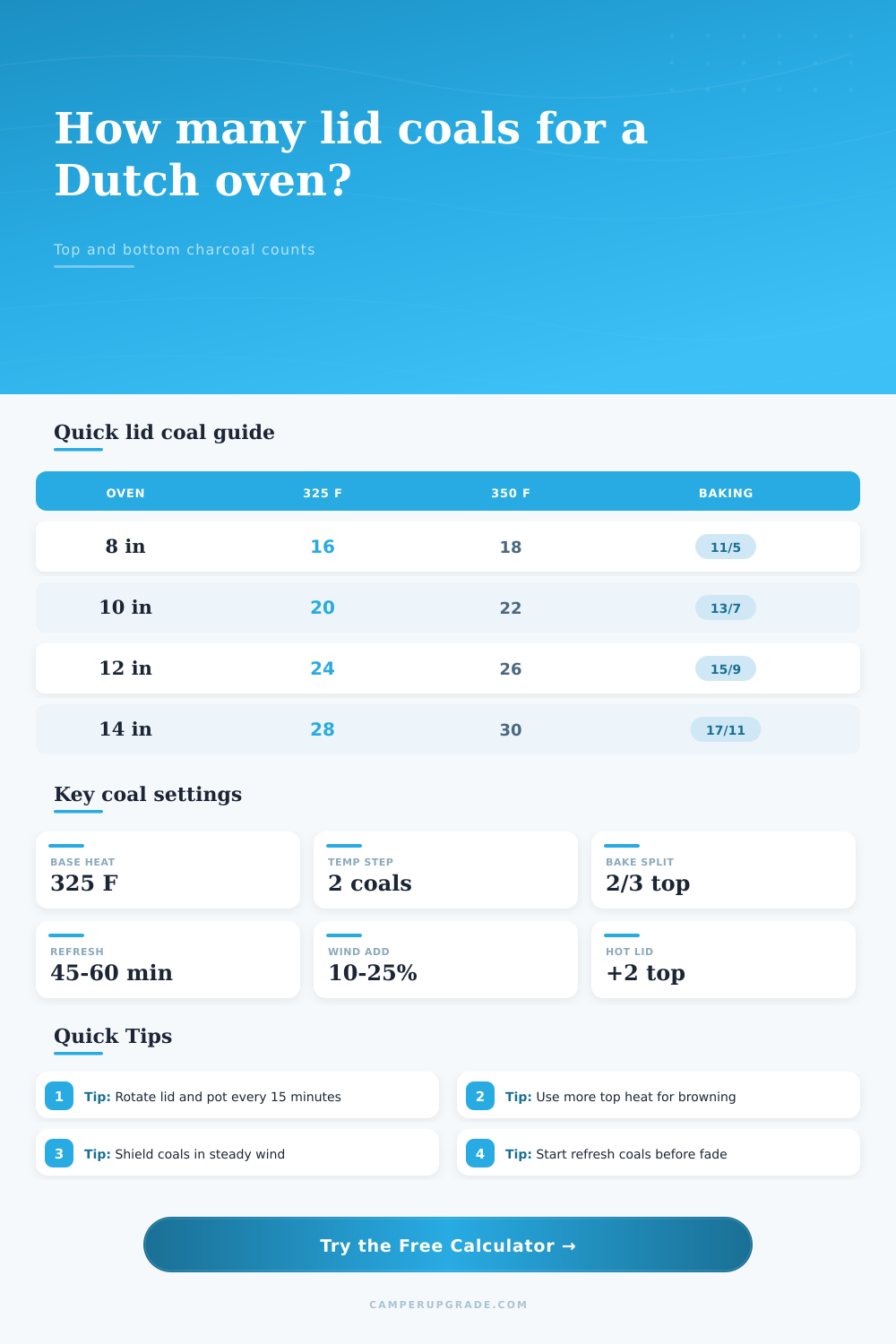
| Oven diameter | 325°F total | 350°F total | Baking split at 350°F |
|---|---|---|---|
| 8 inch camp oven | 16 coals | 18 coals | 12 lid / 6 bottom |
| 10 inch camp oven | 20 coals | 22 coals | 14 lid / 8 bottom |
| 12 inch camp oven | 24 coals | 26 coals | 17 lid / 9 bottom |
| 14 inch camp oven | 28 coals | 30 coals | 20 lid / 10 bottom |
| 16 inch camp oven | 32 coals | 34 coals | 23 lid / 11 bottom |
| Target heat | Coal formula | Typical use | Lid emphasis |
|---|---|---|---|
| 275°F | 2 x diameter - 4 | Gentle warming, delicate custards | Use light top heat |
| 300°F | 2 x diameter - 2 | Slow stews, beans, chili | Bottom heat leads |
| 325°F | 2 x diameter | Standard baking base | Diameter + 3 on lid |
| 350°F | 2 x diameter + 2 | Cobblers, cakes, casseroles | About two-thirds on lid |
| 400°F | 2 x diameter + 6 | Pizza, cornbread, crisp biscuits | Add lid coals first |
| 450°F | 2 x diameter + 10 | Bread spring and heavy browning | Watch the top closely |
| Method | Lid share | Bottom share | Best match |
|---|---|---|---|
| Bake or casserole | 65-70% | 30-35% | Biscuits, cake, cobbler, lasagna |
| Roast | 50-55% | 45-50% | Chicken, potatoes, dense vegetables |
| Stew or chili | 20-30% | 70-80% | Liquids, beans, soups, braises |
| Fry or saute | 10-20% | 80-90% | Bacon, onions, searing meat |
| Brown or broil | 80-90% | 10-20% | Melting cheese, crisp toppings |
| Preset | Oven | Target | Normal lid / bottom |
|---|---|---|---|
| Buttermilk biscuits | 10 inch | 425°F | 18 lid / 10 bottom |
| Peach cobbler | 12 inch | 350°F | 17 lid / 9 bottom |
| Crusty camp bread | 12 inch | 450°F | 24 lid / 10 bottom |
| Trail chili | 16 inch | 300°F | 8 lid / 22 bottom |
| Pineapple cake | 14 inch | 350°F | 20 lid / 10 bottom |
When you’re high in the mountains… Say, camped out at 10,000 feet, and your Dutch oven bread fails to rise, it’s enough to send you into a certain kind of panic. Is there something wrong with your fire? No. Something was wrong with the air. At elevation, the thin atmosphere make it harder to get things hot by slowing down heat transfer and also lowers temperature at which things boil off. This means those sea-level-calculated coals that were going to give you the oven-hot blast are now just a mild pre-warming.
That’s where the calculator comes in as your saving grace. It takes the ethereal science of wind and altitude and turns it into a solid, numeric count of how many briquets to use. It takes the guesswork out of the recipe, so you can think about food instead of thermodynamics.
How to Use the Dutch Oven Calculator
The mechanics of heating a Dutch oven are less cooking than they are learning to manipulate a mini-weather system. You’ve created an oven that traps heat between two pieces of metal, heated from below and above by energy of charcoals. Depending on which side has more coals, you’re going to get one kind of cook or another.
For biscuit baking (or cakes), you want fierce top-down heat: enough to crisp the crust and set the structure before the interior dries out. Depending on what you’re making. Cake or cobbler, the tool automatically shifts this balance for you. A cobbler needs a very hot top to brown it, while a stew need its bottom gently warmed. It’s the simplest kind of mechanical fact, but mess with the balance and everything falls flat-out into textural ruin.
Another factor that spoils a meal quicker different than a fire that is not full enough is wind, which will remove heat from the lid as quickly as the charcoal produces it. Adding extra coals won’t help (in fact, it usually causes burnt bottoms with pale tops). The calculator takes wind exposure into account and recommends slightly more overall fuel, though realy what’s required is physical protection. Dig a small trench for your coals, or create some sort of windbreak.
This one tells the fire what it should of do; the other one tells you how much fuel to burn. Most folks fail to consider what is beneath the surface under the pot. If the bottom coals is cooking on damp sand or bare ground, they’ll suck up heat and demand additional fuel to sustain the temperature. A dry coal table or a metal griddle reflects that heat back into the pot, and each briquette counts.
Perhaps the most important result from this tool is its ability to predict the refresh cycle. Your charcoal will only last so long. It doesn’t keep burning indefinitely; you’ll need to stage your fuel by having extra coals ready before the first batch dies. With standard briquettes, you know that they’ll last roughly fifty minutes. Light them all at one time? It is no good if you’re roasting something that takes three hours.
Stage your fuel. How do you know how many more coals to start to get you through until the initial ones expire? The calculator predicts that number. So it can maintain the temperature without risking a spike by having too few or dropping below your set point.
Imagine driving a car and refueling on-the-fly. You top off the tank before it runs dry, not when the engine sputters. Do not do it before then. Start those refresh coals earlier so the oven is less likely to dip below your target temp. This means your meat won’t go tough and your bread won’t stop rising.
Boiling point isn’t the only thing that altitude affects; all else is relative, including heat transfer. When you open the oven door, thinner air holds far less heat, so your oven will cool more rapidly. To account for that, the tool bumps up the base number of coals a little bit higher for elevated locations. It is a tiny tweak, but it is enough to transform a perfectly domed loaf into a sunken one.
Keep an eye on your fuel as well: Coconut briquets produce a steady flame over a longer period of time than other briquettes do, and lump charcoal does so even faster, at a higher temperature. The tool has a reference table that will help you see this difference so you can substitute to match without wrecking your recipe.
So what’s it all about? Dutch oven cooking realy comes down to consistency. There are variables like equipment quality, elevation, and weather; no two situations will ever be the same. But the heat management variables is fixed. Take the emotion out of it by using a calculated approach instead of intuition. Stop guessing if the lid got too hot, just bask in the scent of the bread baking over the fire. Let the tool do the math so you can tend to the fire while trusting the process.
That’s the part they get wrong. It isn’t the recipe that’s difficult. It’s learning how to control the environment.