Propane Consumption Per Appliance Calculator
Estimate propane use, tank runtime, reserve margin, and cylinder needs from real BTU ratings for one RV or campsite appliance at a time.
🎛Real RV appliance presets
🔧Appliance load inputs
📊Propane estimate
📐Propane energy specification grid
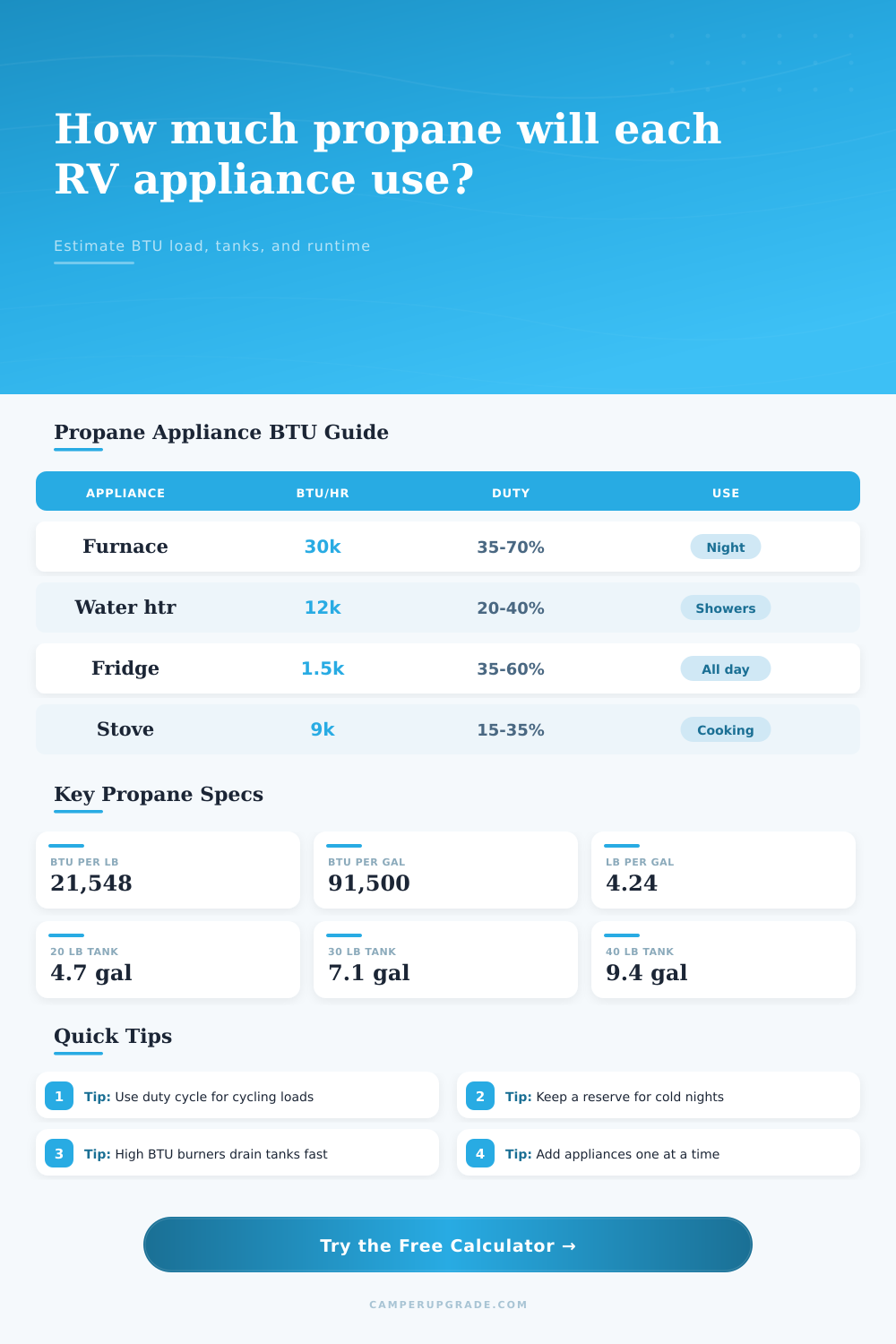
🔥Typical RV appliance propane inputs
| Appliance | Typical input | Common duty cycle | Propane at 100% load |
|---|---|---|---|
| Forced-air RV furnace | 20,000 to 40,000 BTU/hr | 25% to 75% in heating weather | 1.39 lb/hr at 30,000 BTU/hr |
| 6 gal tank water heater | 8,800 to 12,000 BTU/hr | 15% to 45% for recovery cycles | 0.56 lb/hr at 12,000 BTU/hr |
| Absorption refrigerator | 1,200 to 2,200 BTU/hr | 35% to 70% depending on ambient heat | 0.07 lb/hr at 1,500 BTU/hr |
| Range burner | 6,500 to 9,000 BTU/hr each | 15% to 100% while cooking | 0.42 lb/hr at 9,000 BTU/hr |
| RV oven | 12,000 to 18,000 BTU/hr | 35% to 75% once preheated | 0.74 lb/hr at 16,000 BTU/hr |
| Tankless water heater | 35,000 to 60,000 BTU/hr | 100% only while hot water flows | 1.95 lb/hr at 42,000 BTU/hr |
| Portable propane grill | 10,000 to 20,000 BTU/hr | 45% to 100% while grilling | 0.56 lb/hr at 12,000 BTU/hr |
| Propane generator | 40,000 to 80,000 BTU/hr | Varies with electrical load | 2.55 lb/hr at 55,000 BTU/hr |
🛢Cylinder capacity and usable reserve table
| Nominal cylinder | Propane capacity | Approx gallons | Usable with 15% reserve |
|---|---|---|---|
| 5 lb portable bottle | 5 lb / 2.27 kg | 1.18 gal / 4.47 L | 4.25 lb / 91,079 BTU |
| 11 lb compact cylinder | 11 lb / 4.99 kg | 2.59 gal / 9.82 L | 9.35 lb / 201,474 BTU |
| 20 lb barbecue cylinder | 20 lb / 9.07 kg | 4.72 gal / 17.86 L | 17.0 lb / 366,316 BTU |
| 30 lb RV cylinder | 30 lb / 13.61 kg | 7.08 gal / 26.79 L | 25.5 lb / 549,474 BTU |
| 40 lb RV cylinder | 40 lb / 18.14 kg | 9.43 gal / 35.71 L | 34.0 lb / 732,632 BTU |
| 100 lb stationary cylinder | 100 lb / 45.36 kg | 23.58 gal / 89.26 L | 85.0 lb / 1,831,580 BTU |
⏱Runtime at common appliance loads
| Steady appliance load | 5 lb cylinder | 20 lb cylinder | 30 lb cylinder |
|---|---|---|---|
| 1,500 BTU/hr fridge flame | 71.8 hr | 287.3 hr | 430.9 hr |
| 6,000 BTU/hr heater | 18.0 hr | 71.8 hr | 107.7 hr |
| 9,000 BTU/hr burner | 12.0 hr | 47.9 hr | 71.8 hr |
| 12,000 BTU/hr water heater | 9.0 hr | 35.9 hr | 53.9 hr |
| 30,000 BTU/hr furnace | 3.6 hr | 14.4 hr | 21.5 hr |
| 55,000 BTU/hr generator load | 2.0 hr | 7.8 hr | 11.8 hr |
🗂Preset comparison grid
| Scenario | Load model | Planning period | Propane estimate |
|---|---|---|---|
| Cold-night RV furnace | 30,000 BTU/hr at 65% | 10 hr/day for 3 days | 30.8 lb with 10% buffer |
| Absorption refrigerator | 1,500 BTU/hr at 50% | 24 hr/day for 5 days | 4.6 lb with 10% buffer |
| Two stove burners | 18,000 BTU/hr at 70% | 1 hr/day for 4 days | 2.6 lb with 10% buffer |
| Tankless water heater | 42,000 BTU/hr at 100% | 0.4 hr/day for 5 days | 4.3 lb with 10% buffer |
💡Propane planning tips
If you’ve ever run out of propane while camping (as in: three nights into a trip and the furnace clicks off one last time), you know what panic feels like. You’ll hear the instant silence, followed by creeping chill. How many gallons did you purchase? Who cares, your out.
Running out of fuel isn’t about math. It’s a survival strategy for comfort. That’s why gauging fuel consumption is more than a math problem. And most folks go by nothing but tank size. A bigger tank equals unending heat. Wrong. Assuming a big tank means endless warmth are dangerous because it ignores how appliances actualy behave.
How to Plan Your Propane Use
You’ll notice I’m talking about BTU’s. That’s short for British Thermal Units, and it’s an expression of energy output. Depending on what kind of RV you have, the furnace may be pull down 30,000 BTUs per hour. By comparison, a fridge runs somewhere around 1,500; the difference is enormous, and treating either as if they are equivalent will get your calculations completely wrong. The calculator will do the work converting those energy ratings into actual weights in gallons/pounds.
Compare rated capacity to real usage. The other thing about appliances: they cycle. Your furnace isn’t burning for eight hours straight. When it’s time to heat the air, it comes on and then shuts down. Then it comes on again and so on. This on and off is known as its duty cycle.
You have to calculate what fraction of every hour the burner is actually firing, and depending on how mild or snowy the weather is, that figure may only be a quarter. Or it might be three-quarters. Getting this figure wrong will cause biggest error in your fuel planning. The tool lets you set this rate and close the gap between theory and reality.
Another confusing factor is tank size. In run time logic, a twenty pound barbecue tank isn’t half of a forty pound RV cylinder. It holds more liquid but pressure changes can affect how much you actualy get out of it. But as the bigger cylinder empties, its regulator doesn’t perform as well and at the end of the tank, the lower pressure will impact flow rate.
This is where the reserve comes into play. You’re not only saving fuel for future needs but also preserving pressure right now. And you can set both the reserve and usable fill margins in the calculator’s fields (I chose 15% so I plan to stop with 15% left). That cushion ensures my furnace won’t stall out on the final half gallon, and my lights don’t start to dim.
Another variable to consider is weather. Wind strips it away faster. Cold air demand more heat. Cold air requires more heat. That inefficiency is explained by the buffer input on the regulator. It’s a little bit extra (a percent or two increase in your estimate) but it’s there as an insurance policy. If not, you’ll budget for 10 lbs of gas but end up needing 12. That 2 lb deficit could be the difference between sleeping cozy or chilly.
And when you understand what goes into those inputs, your packing changes; you don’t carry a random amount of fuel anymore, but a calculated one. You also learn that two long showers use more propane then cooking dinner on the oven. You also see that heating the living space for a week is only a small part of the propane used if you leave the fridge on propane while sleeping on a freezing night. The typical loads are all laid out in the reference table on this page… So that’s your baseline for comparison.
You don’t have to hoard propane, that’s not the point. Propane planning is all about eliminating doubt. When you do the work and you know the numbers, you can relax and sleep well at night. Enjoy the campfire. Trust the numbers. And the peace and quiet in the RV remains uninterrupted because of math. It is not luck.