Propane Appliance Total BTU Calculator
Estimate daily RV propane appliance demand, fuel use, tank run time, and simultaneous peak BTU load from real nameplate input ratings.
Propane BTU Results
| Fuel or unit | Conversion used | Formula role | Practical note |
|---|---|---|---|
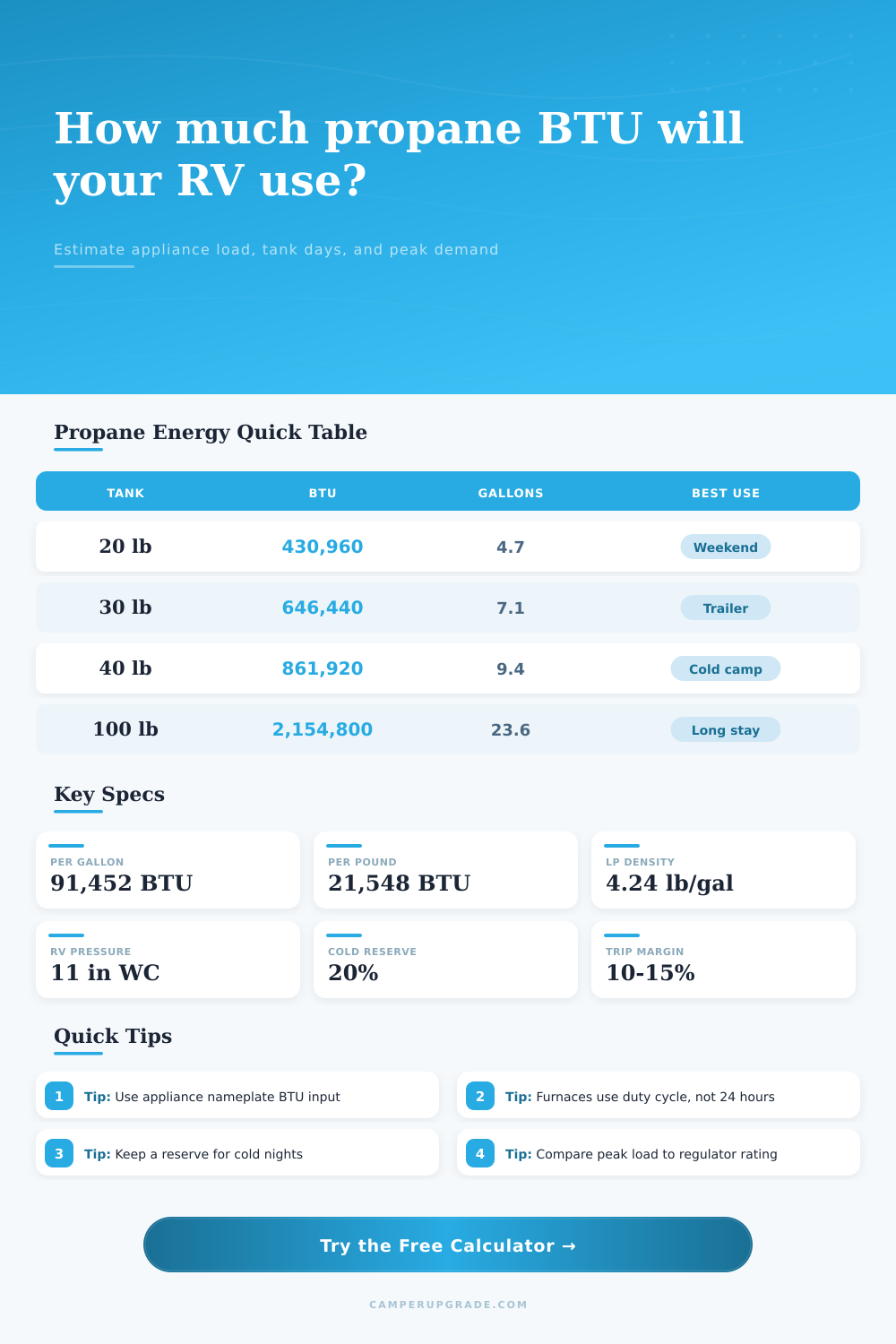
| Liquid propane gallon | 91,452 BTU/gal | BTU divided by 91,452 = gallons | Higher heating value used by EIA energy tables |
| Propane pound | 21,548 BTU/lb | BTU divided by 21,548 = pounds | Useful because RV cylinders are sold by propane pounds |
| Propane liquid density | About 4.24 lb/gal | Tank pounds divided by 4.24 = gallons | Actual density changes slightly with temperature |
| RV low-pressure LP | 11 in water column | Peak BTU must stay inside regulator capacity | Use nameplate and regulator ratings for final checks |
| Common RV appliance | Typical input range | Calculator field | How to enter it |
|---|---|---|---|
| Forced-air RV furnace | 16,000 to 40,000 BTU/hr | Furnace input rating | Use the furnace data plate, then estimate thermostat duty cycle |
| RV water heater burner | 8,800 to 12,000 BTU/hr | Water heater rating | Use burner-on hours, not the full day, unless left cycling |
| Range top burner | 5,200 to 9,000 BTU/hr each | Average burner rating | Multiply by active burners and flame-on duty |
| RV oven burner | 7,000 to 10,000 BTU/hr | Oven burner rating | Use baking time and cycling percentage |
| Absorption refrigerator | 1,200 to 2,200 BTU/hr | Refrigerator LP rating | Enter LP mode hours and expected burner duty |
| Portable grill or fire bowl | 10,000 to 58,000 BTU/hr | Outdoor appliance rating | Enter the label rating and realistic time at flame |
| LP generator | 38,000 to 85,000 BTU/hr | Outdoor appliance rating | Use partial-load duty or manufacturer fuel-use data |
| Cylinder or tank | Propane capacity | Approx gallons | Total stored BTU |
|---|---|---|---|
| Small camping cylinder | 1 lb | 0.24 gal | 21,548 BTU |
| Portable cylinder | 5 lb | 1.18 gal | 107,740 BTU |
| Common exchange cylinder | 20 lb | 4.72 gal | 430,960 BTU |
| Travel trailer cylinder | 30 lb | 7.08 gal | 646,440 BTU |
| Large towable cylinder | 40 lb | 9.43 gal | 861,920 BTU |
| Long-stay cylinder | 100 lb | 23.58 gal | 2,154,800 BTU |
| Use pattern | Duty cycle guide | Daily BTU method | Peak-load method |
|---|---|---|---|
| Mild furnace night | 20% to 35% | BTU/hr x sleep hours x duty | Include full furnace rating if it can fire with other loads |
| Cold furnace night | 40% to 65% | Increase duty before increasing run window | Compare furnace plus water heater plus range |
| Water heater recovery | 20% to 50% | Use actual burner-on recovery time | Usually checked with furnace and cooktop |
| Cooking burners | 50% to 100% | BTU/hr x burner count x cooking hours | Use number of burners that can be on together |
| Absorption fridge | 30% to 70% | Use 24 hours only when in LP mode all day | Small peak load but meaningful daily load |
| Generator or fire bowl | 40% to 100% | Use partial-load throttle or flame setting | Often dominates peak BTU demand |
When you’re down to a third of a propane tank with just 24 hours left on your camping trip, a certain panic kicks in. It’s not so much about comfort anymore. Suddenly, it becomes a matter of math: can I make it to the fill station, or am I going to be out of fuel? It is the math of turning off fridge to take hot showers or eating cold sandwiches. Until now, most RVers has been guessing the answer and then running out.
That’s where a propane appliance total BTU calculator comes in. It cuts through guesswork with real numbers. It tells you exactly what you have, how quickly you’re burning it, and if you’ll make it. All you do is plug in your appliances’ ratings and the calculator up top does the rest. This eliminates the guesswork on thermal conversions and even duty cycles, leaving you with real numbers.
How the Propane Calculator Works
So here’s the thing: BTUs aren’t fixed units. They’re a rate of consumption. Sure, your furnace may have a nameplate rating of thirty thousand BTUs per hour, but do you run it at full blast twenty-four hours a day? No! Of course not! Most folks forget that fact, they see the nameplate and assume continuous consumption. The truth is that your furnace cycle on/off as needed to keep the RV warm.
So what does this mean? It means that the tool allows you to enter a duty cycle for your furnace. Let’s say your thermostat only has the furnace come on thirty percent of the time while you’re sleeping. Then you’re using a fraction of maximum rated value. It’s an important distinction because it will completly change your fuel plan. You could have a high-rated appliance that’s only used a little bit, which could burn less propane than a more moddern heater running all the time.
Now consider concurrent demand. Concurrent demand is not usage. Usage tells you how long tank lasts. Concurrent demand means whether I has enough regulators to handle the load all at once without losing pressure. You turn on the furnace, someone boils a pot of pasta on stove, and the water heater kicks in. That’s the “peak” load, that momentary spike. Your regulator or hose should steers more than that without failure. Yellow flames, poor heat, or appliances just quitting mean there is too much on the line.
Look at the reference table on the page that shows average input range for various common RV items. That lets you sanity-check whether your settings are reasonable.
How much space do I need? It’s far less than you’d expect once you consider how packed it is. Four point two four pounds of propane equals one gallon of fuel. That means a hundred-pound tank hold the same amount of energy per pound as a small 20-pound tank. The only difference is the logistics of refilling your tanks. If you have several smaller cylinders, they’re easy to manage but you’ll run out sooner and have to fill up more often. A larger tank has more wiggle room; give yourself some extra for long trips or if the weather turns unexpectedly sour.
You can adjust this on the calculator for whatever level of “reserve” you like. Fifteen to twenty percent is a good range since it will keep your regulator from pulling back into the tank any liquid propane. Not only is this bad for warranty purposes, but it can destroy your system too.
There’s also altitude: thinner air means less-efficient combustion. The tool factors in this margin. It gives you a margin based off your camp elevation. That’s a slight adjustment, but one that could of be critical when every gallon counts. Do you need that extra five percent buffer? Is it better to carry a spare tank? The tool helps you get started by setting presets for typical trips, such as a winter ski vacation or a relaxing weekend.
Then it models out the depletion rates of each appliance. Typically the furnace is the large-scale user, but don’t forget about the fridge: Absorption fridges are quiet eaters. They run all night long while you sleep, chugging away at a large portion of your day’s allotment.
Planning isn’t perfection; planning is understanding yourself. Understanding how much fuel you have left in the RV and what the BTU load will be each day make this very easy. Will I need to conserve my heat? Should I cook less? Find a place to refuel? Or am I okay? Do I want to be stressed out without any gas or do I want to know exactly where I stand and adjust accordingly? And when you have the proper numbers, there is nothing but control.