Fan Runtime on Battery Calculator
Estimate how many hours an RV, camper, van, or tent fan can run from a battery bank after chemistry limits, state of charge, reserve, inverter losses, and cycling are included.
🎛Real camper fan presets
🔋Battery and fan inputs
Full runtime breakdown
⚙Fan spec comparison grid
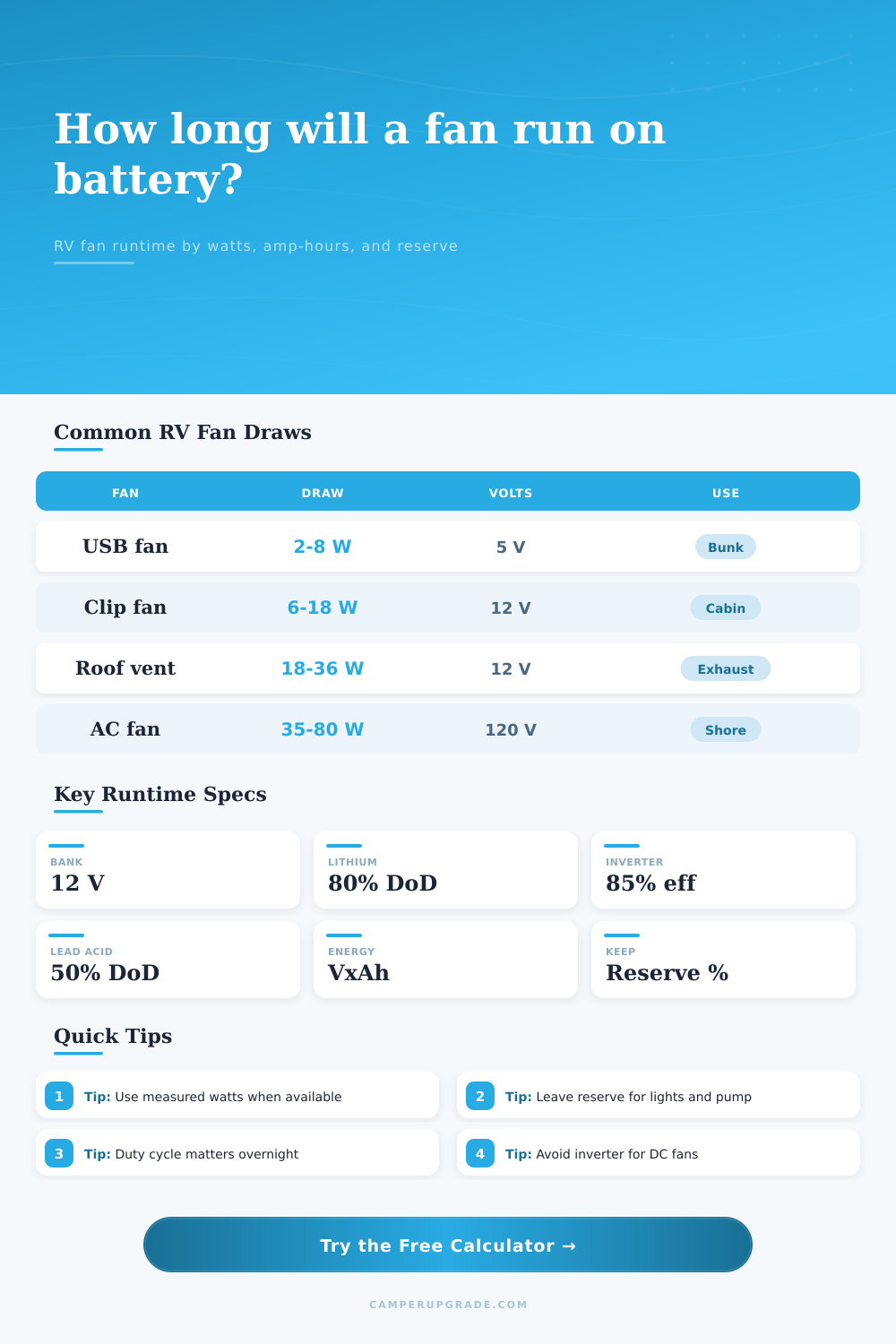
📊Common fan draw reference
| Fan type | Typical running draw | Best input mode | Runtime note |
|---|---|---|---|
| Small USB bunk fan | 2–8 W at 5 V USB | Watts from USB meter | Converter loss matters when fed from a 12 V battery. |
| Oscillating 12 V clip fan | 6–18 W, about 0.5–1.5 A at 12 V | Amps or watts | Good for bunk or dinette airflow with modest draw. |
| RV roof vent fan on low to medium | 18–30 W, about 1.5–2.5 A at 12 V | Amps from fan manual | Often runs all night for exhaust and cabin air exchange. |
| RV roof vent fan on high | 30–48 W, about 2.5–4 A at 12 V | Amps from fused circuit | High speed can use about twice the energy of low speed. |
| Portable 120 V table or box fan | 35–80 W before inverter losses | Watts from nameplate | Use inverter efficiency because DC battery energy is converted to AC. |
🔌Battery chemistry and power path factors
| Setting | Calculator factor | Formula role | Use when |
|---|---|---|---|
| Flooded, AGM, or gel lead-acid | 50% usable depth | Nominal Wh × 0.50 | You want to avoid routinely discharging lead-acid below half capacity. |
| LiFePO4 conservative | 80% usable depth | Nominal Wh × 0.80 | You want long battery life with a lithium house battery. |
| LiFePO4 maximum | 90% usable depth | Nominal Wh × 0.90 | You are planning near the battery management limit. |
| Direct DC wiring | 98% delivered | Usable Wh × 0.98 | The fan is wired to a fused DC circuit near the battery bank. |
| USB converter | 90% delivered | Usable Wh × 0.90 | A 5 V fan is powered from a 12 V-to-USB adapter. |
| 120 V inverter | 80–85% delivered | Usable Wh × inverter factor | An AC fan is powered from the RV battery through an inverter. |
⏱Runtime examples for common battery banks
| Battery bank | Usable delivered energy | 24 W roof fan | 8 W bunk fan |
|---|---|---|---|
| 12 V 50 Ah AGM, 50% usable, 95% DC path | 285 Wh | 11.9 hours | 35.6 hours |
| 12 V 100 Ah AGM, 50% usable, 95% DC path | 570 Wh | 23.8 hours | 71.3 hours |
| 12 V 100 Ah LiFePO4, 80% usable, 95% DC path | 912 Wh | 38.0 hours | 114.0 hours |
| 12 V 200 Ah LiFePO4, 80% usable, 95% DC path | 1,824 Wh | 76.0 hours | 228.0 hours |
| 5 V 20 Ah USB pack, 85% usable, 90% converter path | 76.5 Wh | 3.2 hours | 9.6 hours |
💨Duty cycle planning table
| Fan behavior | Duty cycle input | Average load formula | When it matches |
|---|---|---|---|
| Constant ventilation | 100% | Running watts × 1.00 | Fan stays on continuously overnight or all day. |
| Thermostat cycling | 60–80% | Running watts × 0.60 to 0.80 | Fan pauses when interior temperature drops. |
| Intermittent cabin refresh | 30–50% | Running watts × 0.30 to 0.50 | You run the fan in blocks during meals, showers, or cooking. |
| Short boost use | 10–25% | Running watts × 0.10 to 0.25 | High speed is used briefly, then the fan is switched off. |
💡Runtime tips
After twenty hours of the fan running, a dead silence follows when you go back to bed. You thought the fan would help with the heat so you settled down in bunk hoping for a cool breeze. Now instead of silence there’s nothing except the heat. What happened? Why doesn’t the fan work?
The answer lies beyond the number on the battery. It’s not just about not understanding what a capacity rating mean. It’s also about being confused by the term “hour” in relation to an amperage reading.
Why Your Fan Stops Working Early
Once you enter your information into the calculator, all of that math gets done for you. You will no longer have to guess which conversion factor to use or which coefficient to apply.
But knowing why it stopped goes beyond just reading label on your battery. Rated capacity is an idealized maximum, not something you could actualy use from the battery. If you expect your battery to last, don’t ever drain it completely down. Lead acid batteries (even heavy duty AGM) gets damaged by draining them too low, which decreases the amount of charge they can holds going forward. That is why the tool asks about chemistry type.
The tool then tacks the usable capacity way back, typically to half its rated capacity for lead acid chemistries. It is not about being a pessimist, but about preserving them. You are giving up a couple hours of run time now for a battery that lasts another season.
Lithium iron phosphate changes all of that. They can be discharged up to 80-90% without harm. It feels like they have unlimited juice and the limits is simply farther out.
Resistance exists everywhere: Every electron exiting the battery must pass over an obstacle. A direct connection of your 12 volt fan based off a fused bank circuit close to the bank result in little to no loss. Plugging your USB bunk fan into a converter or running a household box fan through an inverter results in paying an energy tax. Inverters at low loads is very inefficient and may use as much as twenty watts to remain operational. If your fan draws only fifteen watts, the system has to work harder to produce electricity then your fan working hard to create wind. Folks look at wattage of the fan and forget about the cost of converting it back.
The problem with most estimates is the duty cycle. Most fans is not a static load. If your roof vent draws a single amp on low speed, double or triple that number when you flip it up to high. If you have a thermostat-controlled fan, it will cycle on and off. To account for all of this, the calculator allows you to enter an average duty cycle so you can factor in how the fan actualy runs.
Eight hours of ventilation sounds good, until you realize that maybe the fan will only be drawing power for four of those hours because it’s cycling off as the cabin cools. It makes a big difference when you’re accounting for watt-hours out of a finite reserve. Intermittent burst vs constant flow matter. Calculate a safe reserve.
Regardless of your accuracy here, there should be some juice remaining in case something else needs power, like the fridge’s control board, the LED lights, the water pump, etc. Getting down to 0% on a battery results in a jump-start cable and dead silence. You should of had more juice.
Setting a reserve percentage on the tool ensures that whatever estimate it makes for fan runtime will still give you enough power for everything else in the van. A theoretical number becomes a practical plan. It keeps the air flowing without leaving you stranded. You take conversion losses into account and respect the chemistry. You work from there, translating that guess into a schedule.
Then you have a battery holding and the fan humming. You’ve got sleep. And it’s a small thing, but when the sun goes down, it matters.