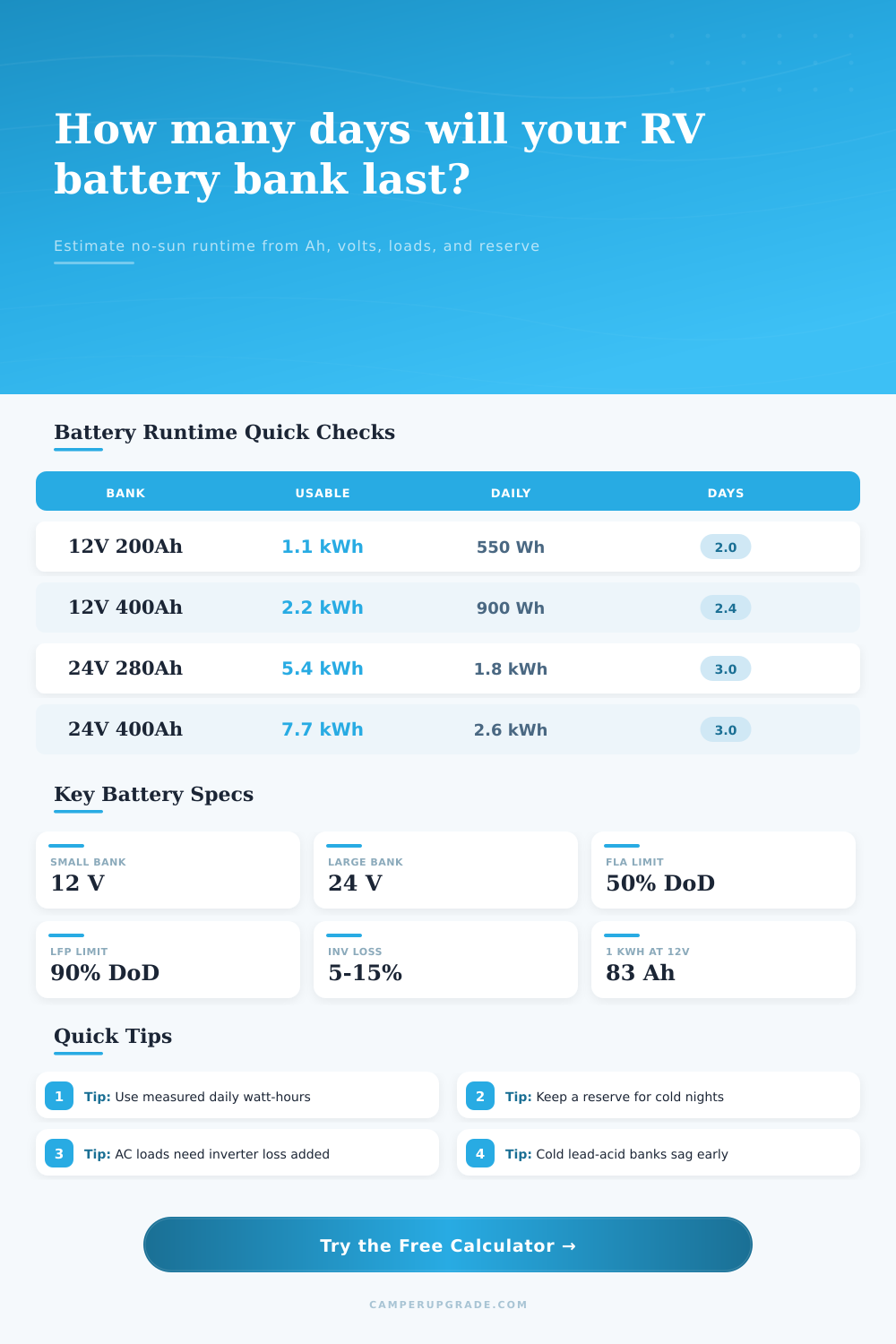
Battery Bank Days Without Sun Calculator
Estimate how many no-solar days your RV battery bank can cover after chemistry limits, reserve, inverter loss, cold/age derating, and real daily loads.
Calculation Breakdown
| Battery chemistry | Calculator DoD limit | Typical round-trip efficiency | Runtime planning note |
|---|---|---|---|
| Flooded lead-acid deep cycle | 50% | 75% to 85% | Voltage sag increases as state of charge falls; conservative reserve improves usable performance. |
| AGM lead-acid | 50% | 80% to 90% | Handles higher discharge current than flooded cells, but deep discharge still shortens service life. |
| Gel lead-acid | 50% | 80% to 90% | Best planned with gentle current and the same 50% depth limit used for other lead-acid banks. |
| LiFePO4 lithium | 90% | 92% to 98% | Flat voltage curve keeps loads stable, but leave reserve for BMS cutoff and cold-weather uncertainty. |
| Lithium titanate | 80% | 90% to 96% | Very tolerant of cycle depth and cold discharge, with lower energy density than LiFePO4. |
| Common RV load | Typical watts | Typical use | Daily energy |
|---|---|---|---|
| LED lighting group | 20 W | 5 hours | 100 Wh/day |
| Water pump | 60 W | 20 minutes | 20 Wh/day |
| Propane furnace blower | 80 W | 6 hours cycling equivalent | 480 Wh/day |
| 12 V compressor fridge | 45 W | 12 hours cycling equivalent | 540 Wh/day |
| CPAP on DC adapter | 35 W | 8 hours | 280 Wh/day |
| Laptop through inverter | 65 W | 6 hours | 390 Wh/day before inverter loss |
| Bank voltage | Ah for 1 kWh rated | Battery current at 500 W | Battery current at 1500 W |
|---|---|---|---|
| 12 V nominal | 83.3 Ah | 41.7 A | 125.0 A |
| 24 V nominal | 41.7 Ah | 20.8 A | 62.5 A |
| 48 V nominal | 20.8 Ah | 10.4 A | 31.3 A |
| Formula | Ah = Wh ÷ V | A = W ÷ V | A = W ÷ V |
| Temperature condition | Lead-acid planning capacity | LiFePO4 planning capacity | Calculator derate input |
|---|---|---|---|
| Warm compartment, about 77°F / 25°C | 100% | 100% | 95% to 100% |
| Cool nights, about 32°F / 0°C | About 80% | About 90% to 95% | 80% to 95% |
| Hard freeze, about 0°F / -18°C | About 55% to 65% | Often 80% to 90% while discharging | 60% to 90% |
| Aged bank with mixed cells | Use measured capacity if known | Use BMS or shunt history if known | 70% to 90% |
Everything’s buttoned up: you’ve hooked up solar controller, checked your tire pressure, and loaded up the van. It’s sunny, charge light is green, and life is good. And then it happens, three days of solid clouds. That’s when your battery bank go from a bunch of numbers on a spec sheet to the difference between warm and cold in a jacket.
When we ask most folks how long they think their battery bank will run them, they’ll tell us about how much total capacity they have, divided by how many amps they draw per day. What they neglect to mention is that batteries aren’t perfect buckets and inverter are hungry beasts. The difference between actual runtime and theoretical runtime is what cuts trips short.
Why Your Battery Runs Out Faster Than You Think
But what about the chemistry of your bank? Running flooded lead-acid or AGM batteries is like hauling around half your bank’s weight in unusable energy. You can’t discharge them more than fifty percent without damaging plates and reducing their lifespan. Once you know your exact chemistry, calculator above does the math for you (and spares you having to adjust manually for these brutal chemical constraints). That wasted half should of been treated as a longevity tax.
You still want a reserve, but it’s a lot broader with LiFePO4. You can pull off ninety percent of its stored energy without any such cost. That’s where most folks get tripped up when they look at amp-hour ratings side-by-side. That two hundred amp-hour lithium bank will last longer then many three hundred amp-hour lead-acid banks. Simply put: The usable fraction is just much bigger.
It’s also about voltage. It is both for efficiency and for storage. A higher voltage system such as forty-eight or twenty-four volts pushes less current for the same power load. That’s less loss in your wiring, less current, less heat. And that adds up over long stretches of boondocking. Every time you have electrons moving down a wire, you’re fighting disorder. The chart below from the page makes this clear, the same kilowatt hour equals some very different amp draws. It’s one of those little things that add up over time.
With the inverter, each time you plug something into an outlet in the van (a coffee maker, a laptop), you’re paying a tax. Inverters aren’t one hundred percent efficient. A good one will be somewhere in the high-nineties, but that means ten percent of the energy they pull from your batteries never makes its way to your devices; it just becomes waste heat. And then there’s the standby draw; keeping the inverter alive when nothing’s plugged in, but silently draining hundreds of watt-hours over a few days time. It is invisible until you’re out of power.
The other silent killer is temperature. All types of batteries work less well when cold. The lead-acid banks takes the biggest hit. Sometimes they will lose a quarter of their capacity at freezing temperatures. But even lithium derates. So if you’re camping in winter, don’t count on your summer numbers. Always account for the cold. Ten percent is good. Twenty percent is safer if you aren’t sure about the forecast.
Mostly, though, we’re not looking to limp by till sunrise. We want to know: When’s it safe? When’s it not? And how do I find that out? Run the numbers one time, honestly, your actual daily load, your realistic chemical limits, and you’ll know whether your rig fits your life. The calculator says you have two days of independence, but you plan to stay put in the rain for five? It is bad news before you even get onto driveway. Add storage; trim load; change plans. Know. Don’t guess.
This comes from Boondocking 2.0. Now take a look at yourself. How much do you realy consume? Not what’s on the boxes, but how many batteries did you run through? It’s called an insurance policy. And your battery bank is that insurance policy to keep the weather off of you. Is it in force?