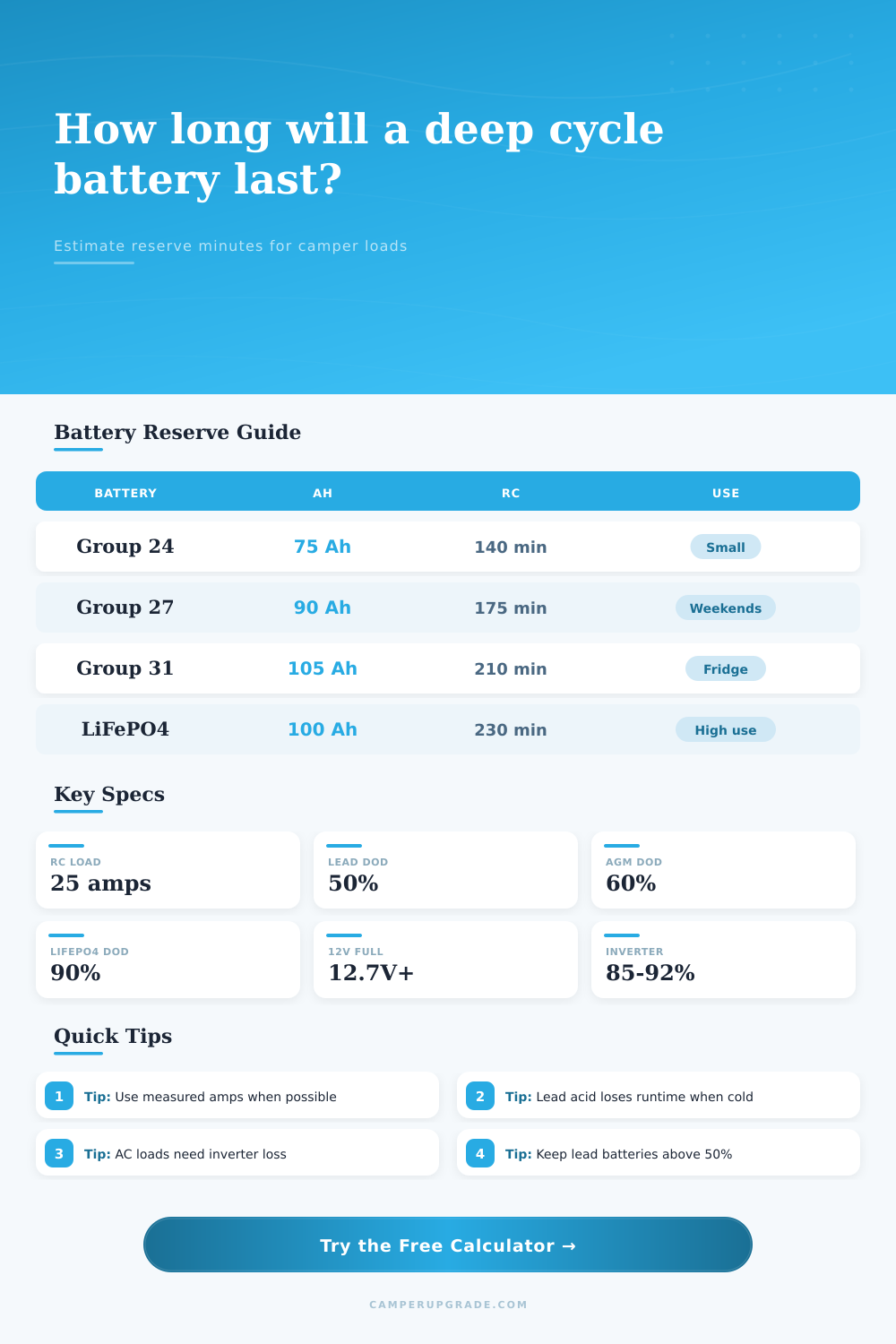
Deep Cycle Battery Reserve Minutes Calculator
Estimate camper battery reserve minutes from amp-hour rating, reserve-capacity rating, chemistry, load, inverter loss, depth of discharge, temperature, age, and bank size.
⚡Named camper battery presets
🔋Battery bank inputs
⚙Battery spec comparison grid
📊Reserve capacity and amp-hour reference
| Battery label | Typical Ah at 20 hr rate | Common RC at 25A | Approx stored energy at 12V |
|---|---|---|---|
| Group 24 flooded marine | 70 to 85 Ah | 120 to 160 min | 840 to 1020 Wh |
| Group 27 flooded or AGM | 85 to 100 Ah | 160 to 190 min | 1020 to 1200 Wh |
| Group 31 AGM deep cycle | 100 to 115 Ah | 190 to 230 min | 1200 to 1380 Wh |
| GC2 6V pair in series | 200 to 235 Ah at 12V | 380 to 470 min | 2400 to 2820 Wh |
| 100Ah LiFePO4 | 100 Ah | 220 to 250 min | 1280 Wh at 12.8V |
💡Common camper load table
| Load | Typical DC draw | Typical watts | Runtime impact |
|---|---|---|---|
| LED lights, several fixtures | 0.8 to 2.5 A | 10 to 30 W | Low continuous draw |
| 12V compressor fridge average | 2.0 to 5.0 A | 25 to 60 W | Depends on duty cycle |
| Diesel heater running | 0.8 to 3.0 A | 10 to 36 W | Startup surge not included |
| CPAP from 12V adapter | 2.0 to 5.0 A | 24 to 60 W | Humidifier raises draw |
| Laptop through inverter | 5.0 to 9.0 A | 60 to 100 W AC | Includes inverter loss |
| Small microwave through inverter | 90 to 140 A | 1000 to 1500 W AC | Short use only |
🌡Temperature and condition derating table
| Condition | Lead-acid capacity factor | LiFePO4 note | Calculator use |
|---|---|---|---|
| 77°F / 25°C | 1.00 | Normal rating point | Use 100% |
| 40°F / 4°C | 0.85 | Slight voltage sag | Use cold derate |
| 20°F / -7°C | 0.70 | Discharge okay, charging limited | Use strong derate |
| 0°F / -18°C | 0.55 | BMS may limit charge | Use severe derate |
| Older battery test result | 0.60 to 0.90 | Depends on cell health | Use condition derate |
📐Formula and chemistry comparison table
| Formula item | Lead-acid approach | LiFePO4 approach | Why it matters |
|---|---|---|---|
| Stored watt-hours | Ah x volts | Ah x volts | Base energy before limits |
| Usable watt-hours | Wh x DoD x derates | Wh x DoD x derates | Protects battery reserve |
| Peukert adjustment | Applied above 20 hr draw | Small correction | High amps reduce lead runtime |
| Reserve minutes | Runtime hours x 60 | Runtime hours x 60 | Main load runtime result |
| 25A equivalent RC | Usable Ah at 25A x 60 / 25 | Same equation | Compares with battery labels |
✅Calculation notes
But take away all the marketing hype and what’s left? A number. In this case, the amp-hour rating on the label. This doesn’t tell you anything about actualy performance in the real world. Reserve capacity give you a better sense of how much reserve a battery has; it indicates the ability to hold a charge for a given amount of time under certain loads.
When customers buy batteries, most considers either the peak surge current or group size. While those specs will tell you what it takes to crank an engine, neither tells you much about performance under prolonged, consistent load. Batteries that can sustains a continuous drain over time are rated as deep cycle batteries. Reserve capacity is standardized way of rating these batteries in terms of how long they can handle a 25 amp drain until the voltage collapses. It provides a definitive measurement instead of a blanket “it should of last a long time” claim.
How to Check Your Battery Performance
After entering both your battery type and a description of what you’ll be charging, the calculator will process the information. The most important thing here is that you have to enter your depth of discharge; most calculations don’t consider what part of your battery are usable. For example, if you frequently take a flooded lead acid battery down more than half way, it won’t last long. Just because it has power doesn’t mean you should treat all of it as usable.
With lithium iron phosphate batteries, however, you can go down to 90 percent and not hurt its longevity. That’s twice as much juice as you’d get with the same amount of lead-acid battery. Chemical reactions within the battery slow down as temperature drops. When you camp in the wintertime, temperatures can drop as low as forty degrees Fahrenheit. These lower temperatures reduces a lead-acid bank’s effective capacity. Cold also results in higher internal resistance: Your batteries will generate more heat then they do electricity to power your gadgets. The calculator corrects for this reduced performance in winter but you should plan for it ahead of time.
Many people don’t even think about this when they buy their units, only to find themselves disappointed by poor performance. The final hidden cost to your DC battery drain is the efficiency of the inverter. When running AC devices through an inverter, more DC power will be pulled from the battery than what the appliance wattage label says it is using. An 85% efficient inverter means that when a microwave with a rating of a thousand watts runs, the battery is actualy supplying about eleven hundred watts. Our calculator takes AC draw and shows the actual DC use so you can understand how much it is really doing to your battery bank. You will have no more unexpected voltage drops while you’re making dinner.
Sulphation builds up over time, reducing surface area available for chemical exchange. As batteries get older, they decreases their ability to hold a charge. Over time, flooded batteries will lose some of their surface area for chemical reactions and become less able to hold their charge. A 5-year-old flooded battery won’t hold a charge like it did when new. If you plan with old specs without adjusting for battery age, your runtimes will not account for that age. You will end up estimating wrong. Account for battery age so you’re estimating based off today’s performance instead of yesterday’s. Being underpowered is better than being left out in the dark.
These factors don’t affect LiFePO4 batteries as much due to low internal resistance at cold temperatures. These batteries has very little Peukert effect (they produce close to rated capacity at all discharge rates). And with high load requirements, lead acid batteries are greatly compromised while lithium holds steady and consistent. Going lithium isn’t just about reducing weight, it’s about having confidence while off-the-grid.
The page has reference tables that let you compare various battery groups against typical camper loads. Then, you can see how a Group 31 works out for a quiet night of LED lighting versus a weekend trip with a bunch of inverter use. Raw numbers become practical decisions based on context. The point is to learn how to effectively manage your power. This way, you can go to bed at night and sleep soundly knowing your phone batteries won’t drain at the same time as your RV batteries.