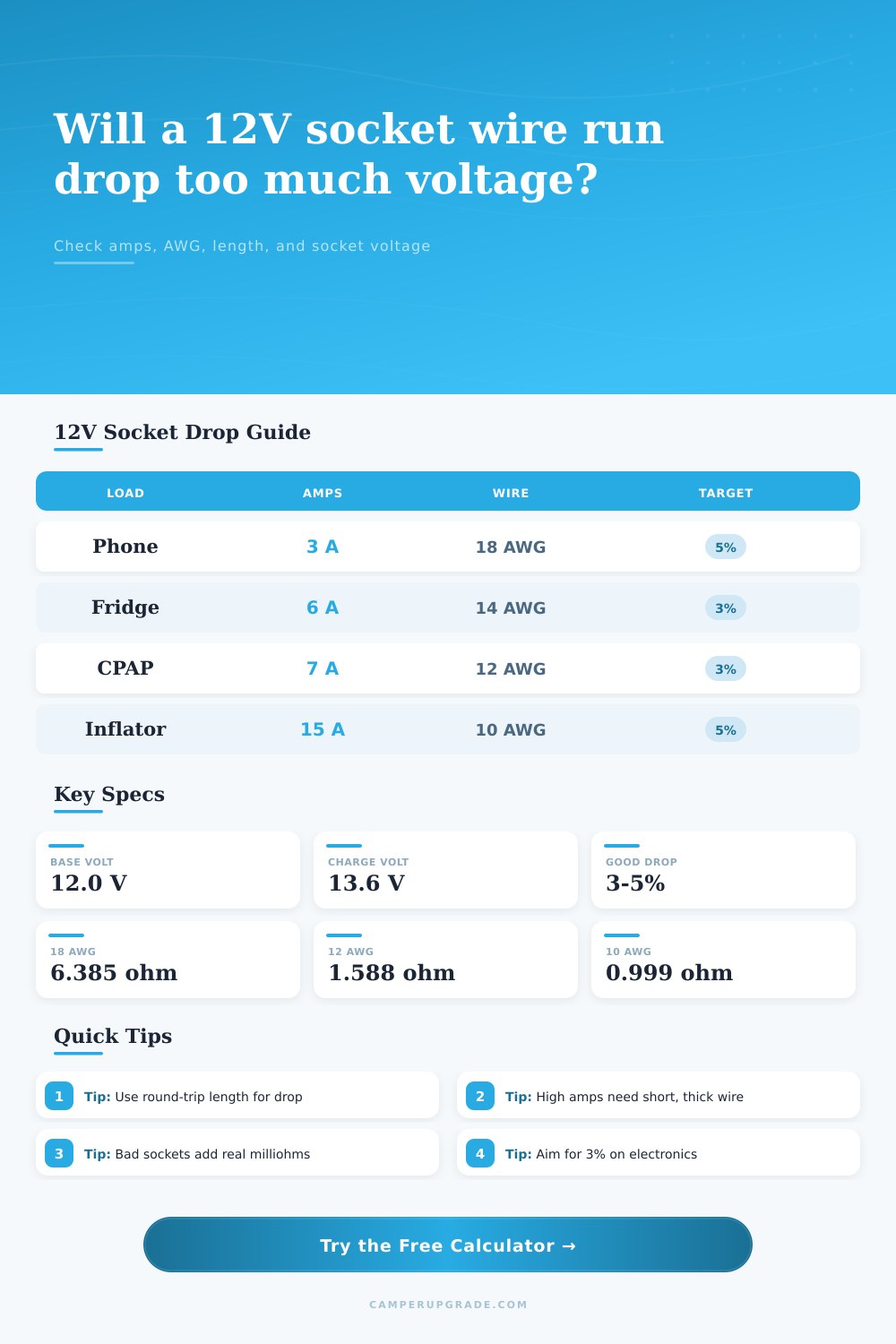
12V Socket Wire Length Drop Calculator
Estimate voltage at a camper cigarette-lighter style outlet using load current, one-way run length, wire size, conductor type, return path, socket resistance, and target drop.
12V Socket Drop Results
Baseline for AWG resistance tables; best default for camper accessory sockets.
Nearly copper-equivalent electrically, with better corrosion resistance at terminations.
Higher resistance for the same marked AWG; needs a larger size for long 12V runs.
Requires compatible lugs and a larger cross section; uncommon for small sockets.
Typical added resistance for good crimp terminals, fuse holder, plug, and socket contacts.
Loose spring contacts can dominate voltage drop even when the wire gauge is adequate.
Useful planning limit for fridges, CPAP machines, radios, and voltage-sensitive adapters.
Often acceptable for lights, chargers, small pumps, and tolerant accessory loads.
| Wire size | Copper ohms / 1000 ft | Approx area | Drop at 10 A over 20 ft one-way pair |
|---|---|---|---|
| 18 AWG | 6.385 Ω | 0.82 mm² | 2.55 V, 21.3% at 12.0 V |
| 16 AWG | 4.016 Ω | 1.31 mm² | 1.61 V, 13.4% at 12.0 V |
| 14 AWG | 2.525 Ω | 2.08 mm² | 1.01 V, 8.4% at 12.0 V |
| 12 AWG | 1.588 Ω | 3.31 mm² | 0.64 V, 5.3% at 12.0 V |
| 10 AWG | 0.999 Ω | 5.26 mm² | 0.40 V, 3.3% at 12.0 V |
| 8 AWG | 0.628 Ω | 8.37 mm² | 0.25 V, 2.1% at 12.0 V |
| 6 AWG | 0.395 Ω | 13.3 mm² | 0.16 V, 1.3% at 12.0 V |
| 4 AWG | 0.249 Ω | 21.2 mm² | 0.10 V, 0.8% at 12.0 V |
| Camper load | Typical amps | Drop target | Why it matters |
|---|---|---|---|
| Phone charger, GPS, camera battery | 1-4 A | 5% | Usually tolerant, but long dash runs can still sag under multiple USB ports. |
| Compressor fridge socket | 4-8 A running | 3% | Low voltage can trigger compressor cutout during startup or hot weather. |
| CPAP DC adapter | 5-8 A | 3% | Overnight medical comfort loads benefit from a dedicated low-drop feed. |
| Portable air compressor | 12-20 A | 5% | Short high-current use still heats weak plugs and undersized wire quickly. |
| Mobile radio accessory socket | 8-15 A transmit | 3% | Voltage sag can reduce transmit power and cause resets on voice peaks. |
| Heated blanket or pad | 4-8 A | 5% | Heating elements tolerate some sag, but connectors must remain cool. |
| Target | 12.0 V allowed drop | 13.6 V allowed drop | Best use |
|---|---|---|---|
| 2% | 0.24 V | 0.27 V | Sensitive electronics and very long always-on circuits. |
| 3% | 0.36 V | 0.41 V | Fridges, CPAP machines, radios, and DC power adapters. |
| 5% | 0.60 V | 0.68 V | General accessory sockets, LEDs, chargers, and small pumps. |
| 8% | 0.96 V | 1.09 V | Short-duration motors that tolerate slower speed or lower output. |
| 10% | 1.20 V | 1.36 V | Diagnostic limit, not a good design goal for new camper wiring. |
| Preset | One-way run | Load | Suggested starting point |
|---|---|---|---|
| Phone + GPS Dash Socket | 8 ft | 3 A | 18 AWG copper can work if contacts are clean and target is 5%. |
| Compressor Fridge Rear Socket | 22 ft | 6 A | 12 AWG copper keeps sag much lower than a thin factory accessory lead. |
| CPAP Overnight Bunk Socket | 16 ft | 7 A | 12 AWG with a 3% target gives better overnight voltage stability. |
| Starlink Mini DC Socket | 14 ft | 8 A | 12 AWG or 10 AWG depending on plug quality and battery voltage. |
| Tire Inflator Exterior Socket | 10 ft | 15 A | 10 AWG and a high-quality outlet reduce heat during short heavy draws. |
| High-Draw Galley Socket | 12 ft | 18 A | 10 AWG, strong fuse holder, and a socket rated above the real load. |
A two-wire camper socket normally drops voltage through both the positive and negative conductors. If the socket is 18 ft from the fuse block, the calculator models about 36 ft of copper before contact resistance.
At 15 A, only 50 mΩ of plug, fuse, and socket resistance drops 0.75 V and wastes 11.25 W. If the plug feels hot, reduce current, improve the outlet, or shorten the run.
You’ve installed a compressor fridge in your camper. When the battery voltage dips just a little bit, it won’t operate. The issue isn’t normaly the appliance; instead, it’s typically how much opposition longer wires creates for the current. If you don’t have enough voltage getting to your unit, expensive equipment becomes a waste of money.
Before completing the install, be sure to verify whether your wiring will provide enough voltage. What does that mean? The calculator will perform these calculations for you. No need to convert lengths or deal with resistance coefficients. It also accounts for the full loop needed for a circuit.
How to Choose the Right Wire Size for Your Camper
Just because your wire starts at the battery and goes 20′ to your socket doesn’t mean it’s 20′ long. The current flows to the socket and then returns back to the battery. So instead of 20′ of wire, there’s 40′ in this circuit. Double the distance equal double the resistance. More power gets lost to heat.
Wiring distance isn’t everything, yet. Light wires is suitable to hide under dashboards, so most accessory wiring comes in 18 AWG or 16 AWG gauges. It is great for a phone charger drawing two amps. It is not great when you want to plug in an air compressor that draws fifteen amps. A thin wire can’t carry that current without creating a substantial voltage drop. The voltage reading at the socket will drop, leaving the wire hot and the motor starving for power.
Other factors are less important but do matter. For instance, the material used will have some impact on performance. The baseline here is pure copper. Tinned copper offers little loss in electrical performance and great resistance to corrosion, so that’s an excellent choice for damp camper environments. Copper clad aluminum offers higher resistance than the same marked gauge. You might buy CCA wire because you think it is as good as copper. You’re actualy going to be carrying around thinner conductor.
The calculator accounts for these factors. Knowing what makes them different will help you make good buys.
Remember: The contact points count too You can have the ideal run of heavy wire, but if the fuse holders corrodes and their connections become poor or the plug/socket spring contacts is loose it’s all for naught. Small interfaces represent additional resistance that may exceed the resistance lost through cable size. On paper your math says you’ve got a safe drop, but the real-world device fights to make contact because the physical interface sucks. Upgrading to screw-terminal sockets, or cleaning contact points, will solve more problems then going up a wire size.
Keep it reasonable, This way you can stay within reach of your goal. In general, radios and other sensitive electronics such as CPAP machines should have no more than a 3% drop limit. Small pumps, fans, and lights is typically ok at 5%. Anything more than 8% will be a problem for both reliability and the lifespan of motors. The table above shows what level of drop can be tolerated in relation to system voltage.
You have to compromise between convenience and physics when dealing with voltage drop. Want to run long? Great, that’s convenient. Want to move appliances around? Also great, but physics says keep those runs short and use big fat cables because they deliver more juice efficienty. Go ahead and compromise where you can, then protect your critical loads. Measure it all (the entire loop), honor the contacts, and go by the numbers when selecting gauge size. Plan a bit up front to save yourself lots of troubleshooting later.