Soft Cooler Volume Calculator
Estimate the stated cooler size needed for cans, bottles, meal containers, loose food, ice reserve, liner space, and realistic soft-sided fill limits.
🧊 Named Soft Cooler Presets
⚙ Cooler And Load Inputs
🧵 Soft Cooler Material And Spec Comparison
📊 Reference Tables
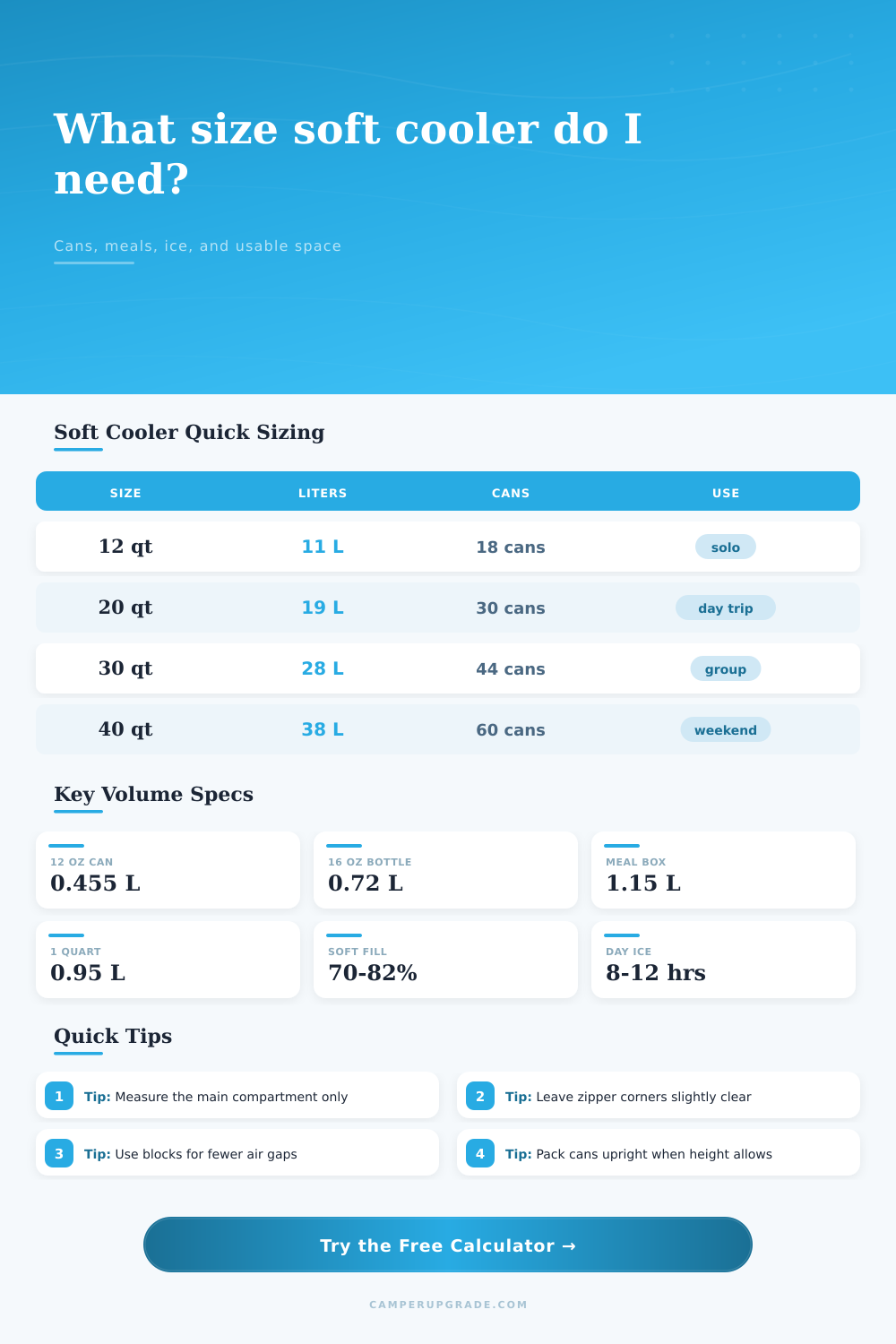
| Cooler Label Size | Liters | Usable at 75% | Usable at 80% | 12 oz Can Equivalent |
|---|---|---|---|---|
| 12 qt personal soft cooler | 11.4 L | 8.5 L | 9.1 L | 20 cans before ice |
| 20 qt day-trip tote | 18.9 L | 14.2 L | 15.1 L | 33 cans before ice |
| 30 qt group soft cooler | 28.4 L | 21.3 L | 22.7 L | 50 cans before ice |
| 40 qt weekend soft cooler | 37.9 L | 28.4 L | 30.3 L | 67 cans before ice |
| Packed Item | Calculator Envelope | Why It Is Larger Than Liquid | Weight Estimate |
|---|---|---|---|
| 12 oz aluminum can | 0.455 L / 0.48 qt | Cylinder diameter, rim, and small packing gaps | 0.81 lb each |
| 16-17 oz plastic bottle | 0.720 L / 0.76 qt | Tall bottle shoulder and cap space | 1.15 lb each |
| Rectangular meal box | 1.150 L / 1.22 qt | Container wall, lid, and corner clearance | 1.60 lb each |
| Loose food or produce | User-entered volume | Irregular shapes are adjusted by packing efficiency | 2.00 lb per L |
| Cold Reserve Style | Volume Formula | Style Factor | Best Calculator Use |
|---|---|---|---|
| Loose cube ice | Contents × selected ice % | 1.00 | General day trips and drink-heavy loads |
| Block ice | Contents × ice % × 0.85 | 0.85 | Longer trips with less meltwater surface area |
| Reusable gel packs | Pack count × volume per pack | Direct entry | Lunch, groceries, dry-pack organization |
| Frozen food as ice | Contents × ice % × 0.60 | 0.60 | Basecamp meals where frozen items count as contents |
| Common Soft Cooler Load | Contents Volume | Suggested Cold Reserve | Minimum Label Size at 80% |
|---|---|---|---|
| Solo lunch with 4 cans and 1 meal box | 3.0 L | 1.0-1.5 L | 5.5-6.5 qt |
| Two-person beach tote with 12 cans | 5.5 L | 2.0-3.0 L | 10-12 qt |
| Family picnic with drinks and four meals | 13.0 L | 4.5-6.5 L | 23-27 qt |
| Weekend basecamp food tote | 22.0 L | 9.0-12.0 L | 41-47 qt |
💡 Calculator Tips
Have you ever bought a soft cooler claiming to hold 20 cans but then could only stuff in 12 before giving up on the zipper? That’s because their advertised capacity doesn’t include space lost to bulky insulation walls or awkward rounded corners. These cooler features steals valuable volume from your ice and goodies. This calculator does the math for you so you can buy the right cooler with enough real space for your stuff. No more buying marketing specs; no more buyer’s remorse.
Soft coolers aren’t as efficient as their rigid cousins. Because the walls is so thin in proportion to what they’re holding, a hard sided box comes darn close to packing all the volume advertised. Soft coolers rely on multiple layers of insulation and thick fabric to do the same job. That eats at your capacity from inside-out. To account for this, the tool applies a fill percentage; typically somewhere in the range of 70-80%, based off how stiff those materials are. You pick a fold-flat liner? It’ll pack more volume since there isn’t as much insulation. Pick a welded TPU shell? It’ll have thicker walls, so less available space. You’re not guessing here. You’re accounting for the actual bag in front of you. And that make all the difference if you’re trying to cram a weekend’s worth of meals into a small area.
Why Soft Coolers Are Hard to Pack
Another factor that trips people up is packing efficiency. Rectangular meal boxes all neatly stacked together fit snugly and requires very few air spaces between them. But cans, odd-shaped snack bags, and curvy bottles creates a lot of empty space because of their shapes. To account for this, we’ve added a packing efficiency option to the calculator which lets you increase the volume based on how much wasted space you expect in your boxes. Before putting ice in it, it’ll ask how cleanly you expect to pack your load. If you’ve got a dozen matching soda cans, you’re going to be able to arrange them in nice grids with little waste. If you just dump loose fruits and vegetables into a tote, then you’re probably going to need a bit more room. Selecting the proper efficiency will help ensure that your final size recommendation doesn’t leave you short on space when things get crowded.
Because cold reserve is so large, we must consider ice management separately. The calculator allows you to select either frozen food, gel packs, block ice, or loose cubes. Each type of ice cools different and with a different density. For example, loose ice fits into gaps well but melts fast. Blocks last longer but create a lot of empty space around them. Gel packs are handy for organization but use a set amount of space that doesn’t scale with the shape of your box. If you’re taking a day trip in eighty-degree weather, you’ll need more ice then if you’re leaving a cooler at home in a air conditioned vehicle all afternoon. Because of this, the calculator accounts for the amount of cold mass needed to ensure safety, and scales up/down accordingly.
Sizing the cooler for drinks only is a common error. When planning a family outing with picnics or meals, remember that four meal boxes take up more than a quart. Unlike cans, they’re rigid and do not compress to fit with other containers; in fact, meal boxes can be bulky and consume lots of space. Simply enter number of beverages and enter meal container volume. You’ll have an accurate view of overall contents. The reference table on the page translates combined volumes into minimum label sizes at various fill rates. This illustrates why a twenty-quart cooler may seem crowded when holding only six items, especially if those items are big containers instead of slender cans.
Cooler packing is both a thermodynamic puzzle and a geometry problem. How do you maximize capacity for your supplies while minimizing exposure to air? How do you get enough ice to cool everything while accounting for how much space that ice actualy takes up? Getting the math right on how much stuff can fit into the cooler eliminates wasted space and the heartbreak of trying to zip up a cooler that just won’t cooperate. While the math provides the numbers, the execution relies heavily on your own packing plan. You should of planned ahead. First, put your big items in first then fill gaps with small items next, and finally store your ice reserve away from the food areas. Get the proper sized bag and organize your food and ice accordingly, and you’ll be fighting the zipper less and enjoying the trip more.