Cooler Capacity by Trip Days Calculator
Estimate rated cooler size from travelers, trip length, meals, drinks, produce, frozen food, ice style, opening frequency, cooler efficiency, and reserve space.
🏕 Named Camping Presets
🧊 Trip Load Inputs
Your Cooler Capacity Estimate
Formula Breakdown
⚙ Cooler Material and Spec Comparison
The calculator sizes by usable internal volume first, then converts to a rated cooler size after basket, lid, and gap loss.
📊 Trip Length Starter Table
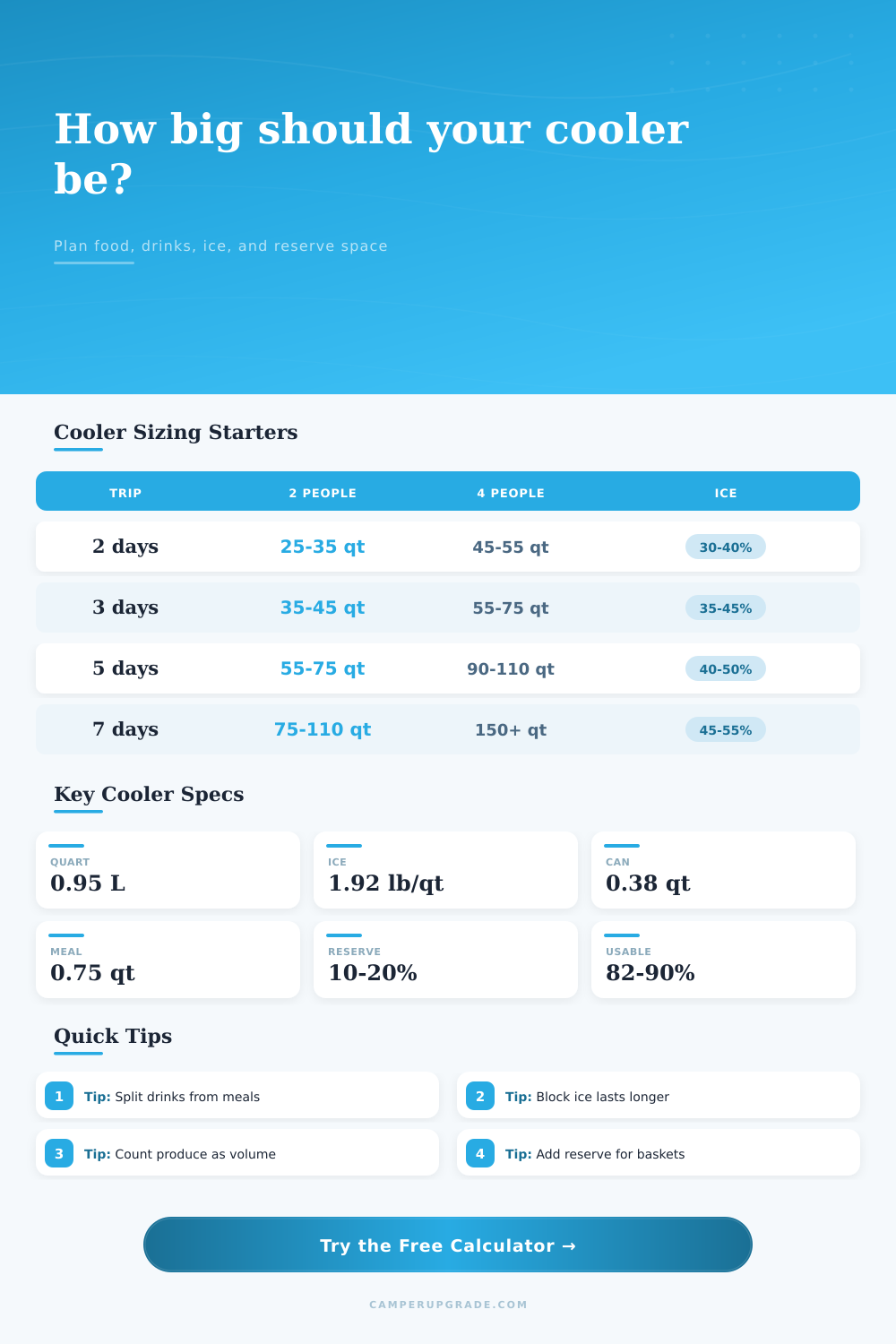
| Trip pattern | 2-person starter | 4-person starter | 6-person starter | Best use |
|---|---|---|---|---|
| Overnight or long day | 20-25 qt | 35-45 qt | 55-65 qt | Prechilled meals, modest drinks |
| 2-day weekend | 25-35 qt | 45-55 qt | 65-90 qt | Mixed meal and drink cooler |
| 3-day long weekend | 35-45 qt | 55-75 qt | 90-110 qt | Separate drinks recommended |
| 5-day basecamp | 55-75 qt | 90-110 qt | 150 qt or split | Plan block ice or powered storage |
| 7-day overland | 75-110 qt | 150 qt or split | Multiple coolers | Divide meals, drinks, and frozen load |
🥤 Food and Drink Volume Reference
| Item | Typical volume | Quart equivalent | Liter equivalent | Calculator input |
|---|---|---|---|---|
| 12 fl oz can | 12 fl oz | 0.38 qt | 0.35 L | Drink size |
| 16.9 fl oz bottle | 16.9 fl oz | 0.53 qt | 0.50 L | Drink size |
| Meal container | 24-32 fl oz | 0.75-1 qt | 0.7-0.95 L | Meal volume |
| Sandwich stack bag | 16-24 fl oz | 0.5-0.75 qt | 0.47-0.71 L | Meal volume |
| Loose produce serving | 8-16 fl oz | 0.25-0.5 qt | 0.24-0.47 L | Produce volume |
| Frozen dinner block | 32-64 fl oz | 1-2 qt | 0.95-1.9 L | Frozen food |
❄ Ice Strategy Reference
| Ice strategy | Base ice ratio | Best fit | Calculator behavior | Pack note |
|---|---|---|---|---|
| Cube ice | 0.60 qt per load qt | Drink access and air gaps | Highest wet-ice volume | Fills voids well |
| Block ice | 0.45 qt per load qt | Longer hold with fewer openings | Lower volume, slower melt | Use along cooler bottom |
| Mixed ice | 0.52 qt per load qt | Balanced food and drink cooler | Default camping estimate | Block below, cubes above |
| Frozen jugs | 0.42 qt per load qt | Dry food and clean meltwater | Lower melt mess estimate | Needs rectangular space |
| Reusable packs | 0.34 qt per load qt | Short trips and lunch coolers | Lowest passive cold mass | Pre-freeze fully |
| Powered cooler | 0.08 qt per load qt | Vehicle or RV power available | Emergency cold mass only | Leave airflow clearance |
🧰 Cooler Size and Usable Volume Table
| Rated size | Approx usable hard cooler | Approx liters | Typical packed use | Split-cooler cue |
|---|---|---|---|---|
| 20 qt | 17-18 qt | 19 L | Solo overnight or drinks | No split needed |
| 35 qt | 30-31 qt | 33 L | Two-person weekend | Split drinks in heat |
| 55 qt | 48-49 qt | 52 L | Family weekend | Useful drink cooler size |
| 75 qt | 66 qt | 71 L | Long weekend food cooler | Split for frequent access |
| 110 qt | 96-97 qt | 104 L | Basecamp food and ice | Heavy when full |
| 150 qt | 132 qt | 142 L | Group food cooler | Often better as two coolers |
📝 Common Scenario Cross-Check
| Scenario | People | Days | Food load | Likely cooler range |
|---|---|---|---|---|
| Couple state park weekend | 2 | 2 | Light meals, some drinks | 25-45 qt |
| Family campground long weekend | 4 | 3 | Meals, produce, drinks | 55-75 qt |
| Desert site with frequent opens | 4 | 4 | High drink share | 90-110 qt |
| Overland week with frozen meals | 3 | 7 | Dense meal boxes | 90-150 qt |
| Group food-only cooler | 10 | 2 | No drink storage | 110-150 qt |
💡 Cooler Sizing Tips
Camping season is upon us and there’s a certain type of panic that comes over you when you grab a cold beverage only to find nothing but ice slush. That’s because of volume displacement and packing inefficiency. But it wasn’t for lack of a good cooler, it was because of the volume the items inside displace. And most folks purchases their coolers by how many quarts is printed on the lid.
That’s not a real number. It’s a marketing number. It assumes you can fit perfectly round holes into a rectangular shape. That never happen.
How To Choose The Right Cooler Size
After plugging in your trip length and number of guest, the calculator does the rest (above). No more guesswork about whether or not three cans of soda will take up 3 quarts. No more wondering if you have enough room for food, drinks, and ice.
When you choose your meal volume per person, that is the baseline load. That means half a quart if it’s just a sandwich bag. If it’s a prepped meal box, it is a full quart. And that difference add up fast over course of a week long trip.
The tool also accounts for drinks, the silent space hogs of outdoor cooking. You think about drinks as bottles or cans. But coolers aren’t made with bottles or cans in mind. The tool turns them into fluid ounces and from there into quarts. They are made that way. Each person drinking three sixteen ounce drinks per day requires almost six liters of drink-only space. This happens before you even consider lunch.
And that is where people makes a mistake. They think ice will fill in all the gaps around their food and not cost any real estate. But ice is bulky and weighs a lot. Depending on your ice strategy, this calculator will adjust amount of ice needed. More block ice will require less total weight but melt slower then cubes. So it will keep things cool over three days.
And so we arrive at the reserve space. The lids on real coolers has gaskets which add to the vertical dimension. Those same coolers have interior baskets that provide areas in which items simply won’t fit. Some moddern models lose fifteen percent of their rated capacity to structural inefficiencies alone. Pack your cooler to its absolute stamped maximum and the lid won’t even shut. Reserving ten to twenty percent of space is not wasteful. It’s the difference between a cooler you can pick up versus having to carry it with two people.
The length of time your cold mass remains cold will depend on both temperature and how often it’s being accessed. If you’re opening your cooler an hour to grab snacks, it will lose its cool exponentially slower than if you’re accessing it just for main meals. That’s why many veteran camper will have one cooler for their high-access food (drinks) and another for low-access food (meat). Carrying all the weight in a single unit will change the math significantly.
The dynamic changes at longer trip lengths. Ambient heat will go further into the insulating layer, resulting in creeping ice consumption after three days. That’s where frozen food can be helpful; it thaws slowly and serves as its own cold source. But it also takes up space.
General sizing guidelines is laid out in the reference tables on the page. The calculator adjusts this based off your particular combination of frozen and fresh produce items. First, it determines the volume that is actualy usable inside the cooler. Then it works backward to determine what sized cooler you should of buy (the rated cooler size).
So how do you size a cooler? Sizing is more about managing volume displacement and density than just counting items. The closer things are together, the better they’ll stay cool. Less air inside means it will warm up more slowly, and the ice will take longer to melt. So if you know what foods take up in a cooler, you can fill ’em tight. You won’t need as much ice and the lid will be able to close more.
And that’s all logistic stuff. That is just another word for peace of mind.