Resupply Days Between Towns Calculator
Estimate trail days, food carry weight, meal count, calorie load, and arrival reserve for the gap between two resupply towns.
📍Named Trail Gap Presets
🎒Trip Inputs
Formula: adjusted daily distance = planned daily distance / (1 + slowdown). Food days = adjusted travel days + zero or nero days + buffer + arrival reserve.
Resupply Plan
⚖Food Packing Spec Comparison
Higher water content, better for short town exits and first-night meals.
Common planning density for mixed bars, dinners, tortillas, nuts, and snacks.
High-fat and dehydrated menu for long carries where pack weight matters most.
Nut butter, olive oil, hard cheese, and similar calorie boosters.
🗺Reference Table: Named Trail Gap Presets
| Preset | Planning distance | Default pace | Why buffer matters |
|---|---|---|---|
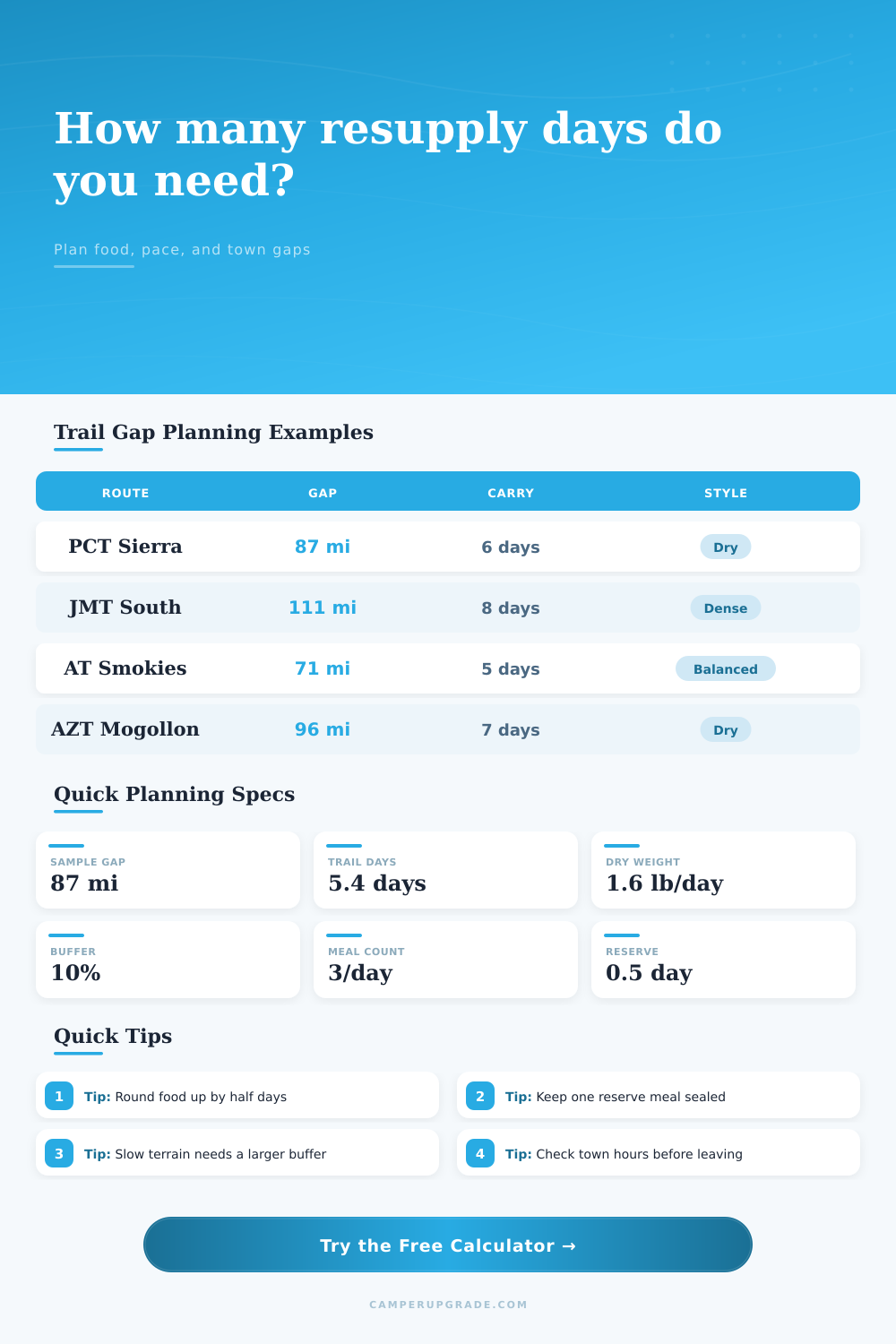
| PCT: Kennedy Meadows South to Kearsarge Pass exit | 87 mi / 140 km | 17 mi/day | Altitude, snow timing, and long climbs can slow moving days. |
| JMT: Muir Trail Ranch to Whitney Portal | 111 mi / 179 km | 14 mi/day | Remote terrain leaves few simple bailout options. |
| AT: Fontana Dam to Hot Springs | 71 mi / 114 km | 15 mi/day | Shelter spacing and climbs often create uneven daily mileage. |
| CDT: Grants to Cuba | 116 mi / 187 km | 22 mi/day | Dry stretches and navigation choices can change daily output. |
| Arizona Trail: Pine to Flagstaff | 96 mi / 154 km | 18 mi/day | Mogollon Rim weather and water spacing reward a reserve. |
| Colorado Trail: Silverton to Durango | 74 mi / 119 km | 15 mi/day | High elevation climbs can make pace estimates optimistic. |
🏃Reference Table: Pace To Food Days
| Town gap | 12 mi/day | 16 mi/day | 20 mi/day | 24 mi/day |
|---|---|---|---|---|
| 50 miles | 4.2 days | 3.1 days | 2.5 days | 2.1 days |
| 75 miles | 6.3 days | 4.7 days | 3.8 days | 3.1 days |
| 100 miles | 8.3 days | 6.3 days | 5.0 days | 4.2 days |
| 125 miles | 10.4 days | 7.8 days | 6.3 days | 5.2 days |
| 150 miles | 12.5 days | 9.4 days | 7.5 days | 6.3 days |
🍲Reference Table: Food Weight By Carry Length
| Food days | 1.35 lb/day | 1.65 lb/day | 1.90 lb/day | 2.20 lb/day |
|---|---|---|---|---|
| 3 days | 4.1 lb / 1.8 kg | 5.0 lb / 2.2 kg | 5.7 lb / 2.6 kg | 6.6 lb / 3.0 kg |
| 5 days | 6.8 lb / 3.1 kg | 8.3 lb / 3.7 kg | 9.5 lb / 4.3 kg | 11.0 lb / 5.0 kg |
| 7 days | 9.5 lb / 4.3 kg | 11.6 lb / 5.2 kg | 13.3 lb / 6.0 kg | 15.4 lb / 7.0 kg |
| 9 days | 12.2 lb / 5.5 kg | 14.9 lb / 6.7 kg | 17.1 lb / 7.8 kg | 19.8 lb / 9.0 kg |
| 11 days | 14.9 lb / 6.7 kg | 18.2 lb / 8.2 kg | 20.9 lb / 9.5 kg | 24.2 lb / 11.0 kg |
🧭Reference Table: Buffer And Reserve Targets
| Route condition | Slowdown input | Food buffer | Arrival reserve |
|---|---|---|---|
| Graded rail trail or flat canal path | 0% to 5% | 0% to 5% | 0.25 day |
| Typical maintained long trail | 5% to 15% | 10% | 0.5 day |
| High altitude passes or rough tread | 15% to 30% | 15% to 20% | 0.75 day |
| Remote route with water or navigation uncertainty | 25% to 45% | 20% to 25% | 1 day |
📦Reference Table: Meal Block Planning
| Daily structure | Blocks/day | 5-day carry | 8-day carry |
|---|---|---|---|
| Breakfast, lunch, dinner | 3 | 15 blocks | 24 blocks |
| Three meals plus two snack bags | 5 | 25 blocks | 40 blocks |
| Grazing-heavy hiking day | 6 | 30 blocks | 48 blocks |
| High-mileage appetite plan | 7 | 35 blocks | 56 blocks |
💡Resupply Calculation Notes
Pack by the limiting day. If terrain makes one stretch slower than the rest, use that slower expected pace for the whole town gap rather than averaging in easier days from a different section.
Separate reserve food. Keep the arrival reserve in its own bag or pouch so it does not disappear into normal snacks before the last climb or road walk into town.
Hiking math works out neatly on paper, but messily in practice: there’s this distance you need to cross, and some meals you must eat. But the trail doesn’t always cooperate with either measurement. This calculator break down the gap between your pack’s capacity and your itinerary into meal blocks, reserve amounts, carry weight, and food days. This makes your plan match your reality instead of your optimism.
The first thing to do is examine stretch from resupply point to resupply point. From there, you learn nothing of time on trail. Next, set your baseline pace by entering your planned moving miles per day into the tool. Then, enter what percent slower you expect to move while hiking over that terrain. Most plans fail here. You might hike twenty miles on flat ground without thinking, but add steep grades, high altitude, or poor visibility, and that same mileage take significantly longer. Entering this lowers your daily output in the calculator to match, since you still have to eat on slow days. It is a small tweak in the equation that keeps you from starving yourself at mile eighty-five.
How to Plan Food for Your Hike
Another variable, which varies from trip to trip, is food weight. Ultralight meals are denser than fresh ones. A pound of casseroles take up much more room than a pound of freeze-dried entrees. This means you’ll carry fewer ounces of food for more calories if you’re cooking ultralight meal. On the other hand, those who crave their fresh fruit will see their packs filling out quickly. To compare, caloric density chart on the page shows that ultralight menus falls roughly at one hundred thirty-five calories per ounce while fresh foods drop to below ninety-five. That difference in caloric density adds up over a week-long carry.
The calculator multiplies your expected days on trail by your desired daily food weight to find your overall load. It also lets you account for any food already in your bag, which comes in handy if you’re mid-trip and only want to top off. When planning zeros (zero days), or any other days of rest, serious hikers plan for them. Sure, burning supply will be balanced by not breaking your bank account on a half-day rest here or there. But having these allowance day built right into your food count is an extra benefit.
The other question is what do you want to have remaining as you enter town? This is your arrival reserve. Half a day is a good estimate. This ensures you don’t get to town tired and hungry, only to find the store is closed and you are out of luck with empty pockets. Your reserve is your insurance policy for a wrong turn, or bad weather. We should all remember: a buffer is not additional calories (it’s freedom from worry). Ten percent provides a buffer for unexpected setbacks, and twenty-five percent might be needed for a remote trail with tricky navigation or uncertain water supplies. And the table at the bottom breaks down where buffer goes (more buffer recommended for high passes or rough tread) which makes sense, right? Because buffer is more than just calories… Buffer is options.
Enter your own personal slow-down/buffer numbers in the calculator and it totals up your food-days-to-go in one easy number. It rounds up by half-days, because nobody packs a half-meal anyhow. Pushing hard isn’t as important than pacing yourself. Hiking too fast to reduce your pack weight can leaves you tired, making you prone to bad decisions regarding navigation or rest. You’ll be able to visualize the tradeoff using this tool. By hiking slower each day, you’ll have more trail days, but also possibly lower your need for calories each day if you’re getting worn out. There is a balance of logistics vs. Endurance. Most hikers discovers they do best with a steady moderate pace versus erratic sprints leading to burnout.
Resupply planning is less about precise arithmetic and more about managing risk. How do I know? Cause I’m not good at that part either. Many factors matter, such as weight conversions, buffer time, and adjusting for terrain. The calculator does all this complicated math for you while you manage the risk. When you head out of town, you’ll have full knowledge of every meal in your pack and how long it will get you. Knowing these things means you know how many days of food you have left and it lets you hike with confidence.
Good hiking isn’t just about putting one foot in front of the other. It’s about putting one foot in front of the other with enough energy to keep going. Until you actualy need those numbers, they look boring. But when you do need them, they’re the difference between a great trip and a survival story. Pack some extras, trust the math, and have fun on the trail (without any worry).