Group Ration Split Calculator
Estimate shared camping food weight, calories, buffers, containers, and fair pack shares before the group leaves the trailhead.
Ration Split Results
| Ration Style | Adult Calories/Day | Typical Density | Best Fit |
|---|---|---|---|
| Ultralight backpacking | 2,400-3,000 | 140-160 cal/oz | Long carries, low fresh food |
| Standard trail camp | 2,600-3,200 | 115-135 cal/oz | Balanced shared meals |
| Basecamp comfort | 2,800-3,400 | 100-125 cal/oz | Coolers, group kitchen bins |
| Cold weather high output | 3,400-4,500 | 130-160 cal/oz | Winter, climbing, heavy exertion |
| Youth group mixed meals | 2,100-2,800 | 105-125 cal/oz | Patrol boxes and supervised menus |
| Emergency reserve ration | 1,500-2,000 | 120-150 cal/oz | Separate backup calories |
| Meal Block | Calories Share | Weight Share | Field Check |
|---|---|---|---|
| Breakfast | 20-25% | Light to medium | Fast start, hot drink allowance |
| Trail lunch | 25-30% | Dense and no-cook | Split into pocket portions |
| Dinner | 30-35% | Largest shared bag | Keep fuel and recipe together |
| Snacks | 15-25% | High density | Distribute daily, not all at once |
| Reserve | 5-15% | Dense and sealed | Mark separately from normal meals |
| Container | Usable Volume | Typical Food Load | Split Use |
|---|---|---|---|
| 10 L soft food sack | 10 L | 10-16 lb dry food | One backpacker share |
| 11 L bear canister | 11 L | 12-18 lb dense food | Regulated bear areas |
| 20 L dry bag | 20 L | 20-32 lb dry food | Canoe, raft, group carry |
| 45 qt cooler | 42.6 L | 35-60 lb fresh food | RV or basecamp cold storage |
| 27 gal camp tote | 102 L | 80-140 lb pantry food | Vehicle camp kitchen |
| Scenario | Adult-Equivalent Days | Food Weight | Average Split |
|---|---|---|---|
| 2 adults, 2 days, standard | 4.0 | 6-8 lb | 3-4 lb each |
| 6 adults, 2 youth, 3 days | 22.5 | 34-45 lb | 6-8 lb across 6 carriers |
| 5 adults, 4 winter days | 20.0 | 55-75 lb | 11-15 lb each |
| 8 adults, 5 canoe days | 40.0 | 70-95 lb | 18-24 lb per dry bag |
| 10 mixed RV campers, 3 days | 27.0 | 55-85 lb | By cooler and pantry bin |
| Formula Piece | Calculation | Use | Watch Point |
|---|---|---|---|
| Adult-equivalent people | Adults + youth x factor | Fair appetite count | Raise teens toward 0.90x |
| Adult-equivalent days | People x days x meal factor | Meal demand | Partial meal plans lower this |
| Base calories | AE days x calories/day | Energy target | Cold trips need more |
| Base weight | Calories / cal per oz | Food mass | Fresh food lowers density |
| Final weight | Base + buffer + reserve | Packing total | Keep reserve labeled |
When you’re going group camping, carefuly plan your food (imbalanced packs can ruin it for all involved). Some packers ends up carrying too much weight while others carry hardly anything. It isn’t an adventure; it becomes a logistical nightmare.
The solution is technology. You no longer has to starve yourself or strain your back by relying on guesswork. The calculator above do the math for you after you input calories targeted per person and how many people are in your group. No more having to convert and fiddle with coefficients by hand; just throw in your information and let the calculator does its thing.
Why You Need a Food Calculator for Camping
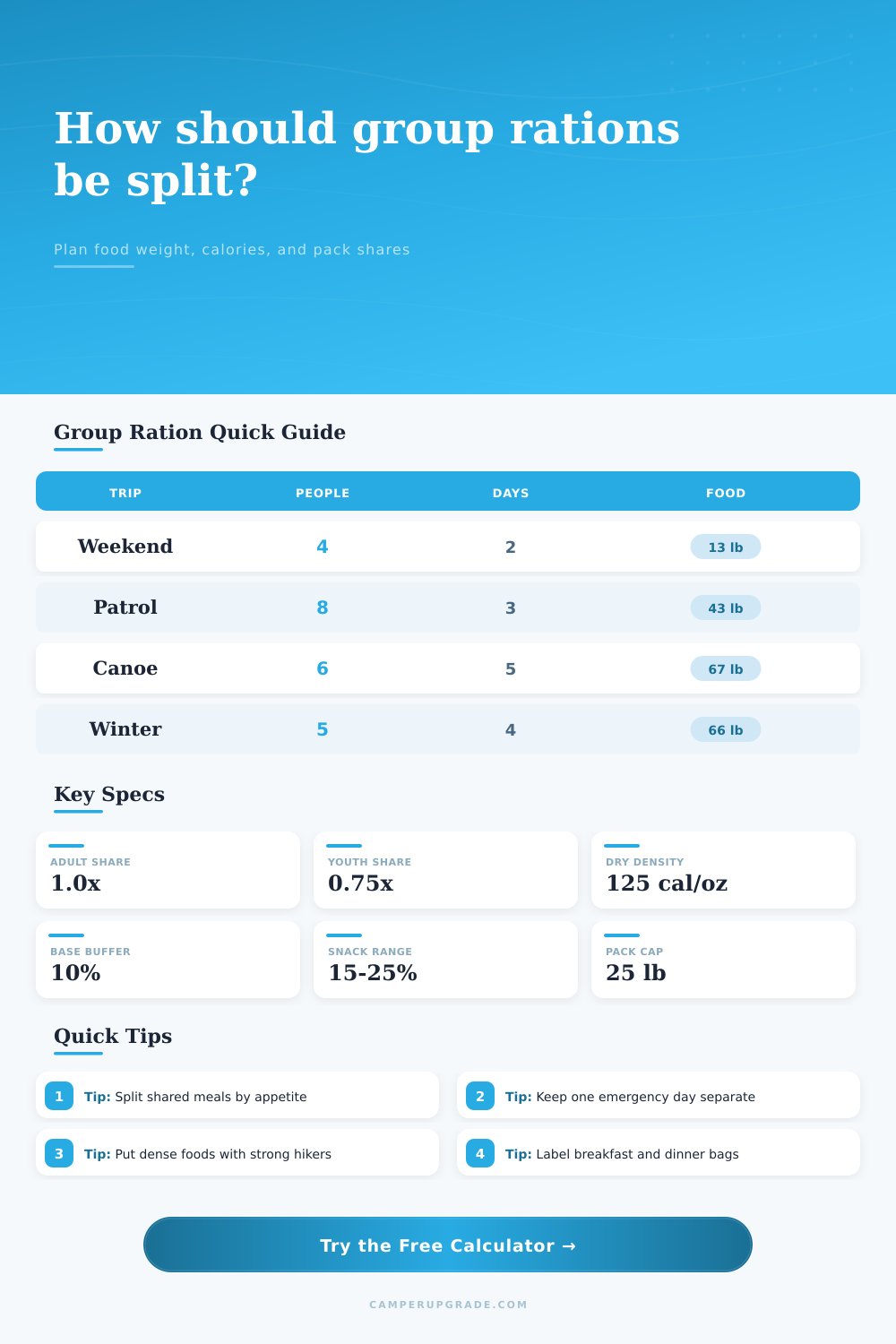
The key is knowing how many “adult equivalent days” there is when combining various appetites. Just because you’re hiking with teenagers doesn’t mean they eats like a group of overworked grownups hiking up steep grades. Until they realize there’s still pasta left in the cooler on the last night, most hikers overlooks this factor. To account for youth appetite (biologically and financially), the tool reduce their allotment to about three quarters of an adult serving. It is a small detail but important if you’re managing pack weight for six carrier.
There’s also the fact that caloric density is a huge factor in how many calories something weighs relative to its volume. While fresh fruits and veggies is delicious at base camp, they’re also approximately 3x heavier per calorie different than dense trail mixes or other dried goods. Water also doesn’t provide any calories. While that apple might have 100 calories, it’ll add bulk to your bag as well. Since fresh fruits and veggie have lots of water, the weight realy increases when you eat tons of fresh stuff. The caloric density chart on the page shows this comparison between various types of ration.
For example, if you want to shave some serious weight off your back for a long haul, you can go with higher-calorie options; however, if you’re going car camping for the weekend and don’t care about carrying all those pounds, load up on more fresh fruits/veggies! The key here is that adding a little bit of a buffer can make all the difference between rationing rice on the last day and finishing strong. A 10% increase in food allow for unexpected delays and sudden hunger pangs while exerting themselves.
Most importantly, human appetite expands in presence of nature. Consider your emergency reserves as a whole different bag than your daily food rations so no one accidentally eats their safety net on the first night when they’re all tired and hungry after getting set up. Having reserve bags set apart help avoid that slow bleed of resources that leaves a group without backup energy when it’s too late.
Fairly dividing food among a group means looking beyond just simple equal division. Carrying bulky fresh produce are not the same as carrying dense calorie bars, so you can’t divide by equal weights. Rather, the stronger hiker should of carry the heavy, space-efficient stuff and the weaker hiker with more pack space should carry light, bulky stuff. This approach ensures that physical load match physical capacity, as opposed to splitting things arbitrarily according to numbers. Numbers don’t account for variations in humans.
Newcomers should know: How you carry it matter more than you might think. Soft sacks give you a little wiggle room (as long as you really squeeze everything in). And bear cans are super limiting, they only holds so much. You’ll learn to figure out exactly how much dry food you can fit before hitting the physical limit set by your gear versus your appetite.
Everyone should leave happy. You don’t want anyone to go hungry before their final meal, and you don’t want them lugging around a backpack so heavy it drags them down in tears. By planning out meals beforehand, you eliminate any guess work in the kitchen and can sit back and enjoy the scenery instead of stressing over if there will be enough food or peanut butter for tomorrow. The right meal plan allow you to split your rations smoothly and effortlessy, keeping everyone’s stomachs full and morale high the whole trip.