Powdered Egg Reconstitution Calculator
Convert powdered whole eggs, whites, yolks, and camp scramble mixes into recipe-ready liquid egg amounts with water, volume, and batch-yield checks.
⛺Camp Kitchen Presets
🥚Reconstitution Inputs
Powdered Egg Batch Results
📊Powder Type Spec Comparison
📘Reference Ratio Table
| Powder type | Typical powder per equivalent | Typical water per equivalent | Common camp use |
|---|---|---|---|
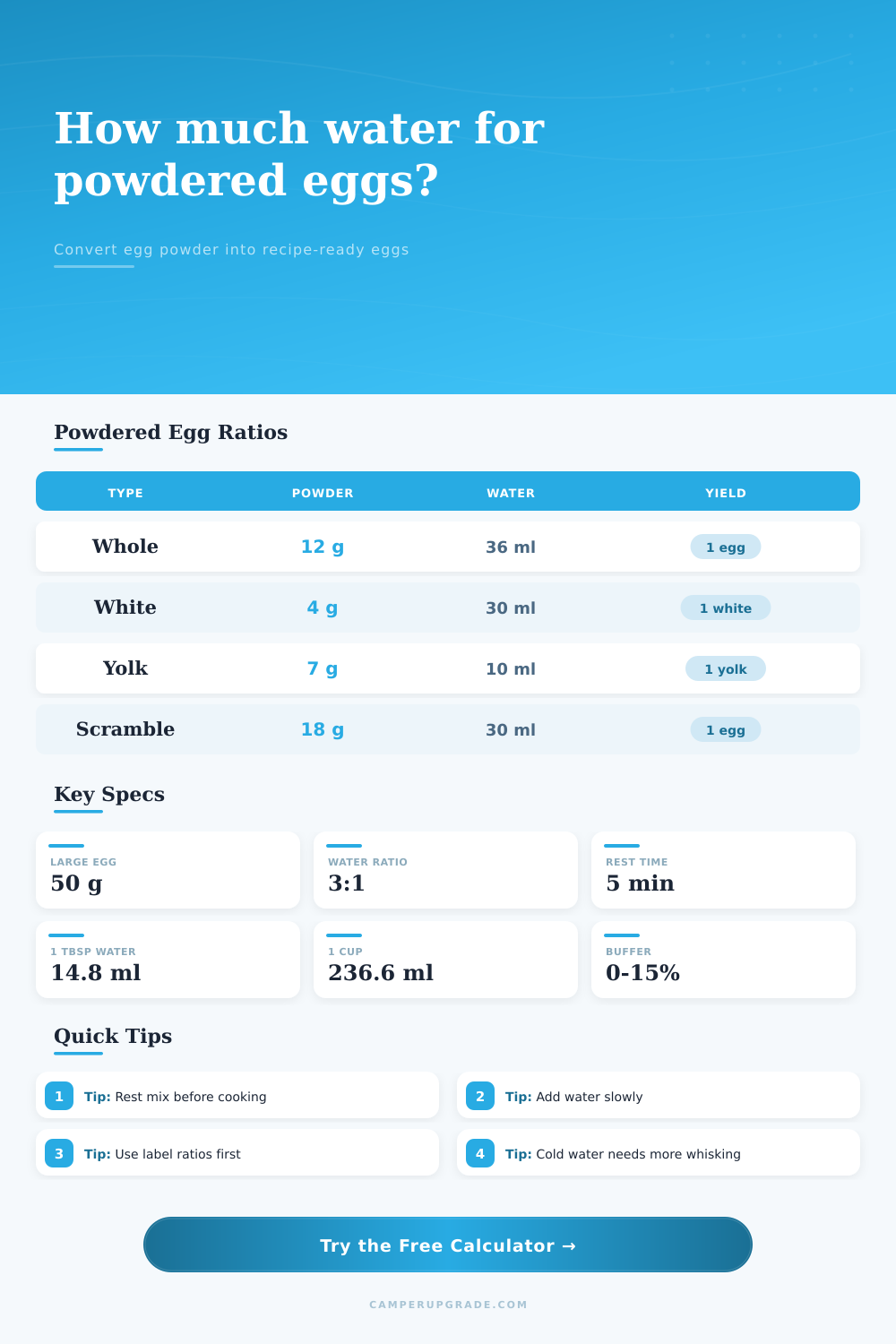
| Whole egg powder | 12 g, about 2 tbsp | 36 ml, about 2 tbsp plus 1 tsp | Scrambles, skillet eggs, pancakes, muffins |
| Egg white powder | 4 g, about 1 tbsp | 30 ml, about 2 tbsp | Omelets, protein additions, meringue-style foam |
| Egg yolk powder | 7 g, about 1 tbsp | 10 ml, about 2 tsp | Custard, sauces, enriched camp bread |
| Powdered scramble mix | 18 g, about 3 tbsp | 30 ml, about 2 tbsp | Seasoned breakfast bowls and burritos |
| Bakery whole egg blend | 13 g, about 2 tbsp | 34 ml, about 2 tbsp plus 1 tsp | Repeatable binding in dry baking mixes |
| High-protein egg mix | 16 g, about 2.5 tbsp | 38 ml, about 2.5 tbsp | Dense breakfast bowls and recovery meals |
Powder density varies by grind and brand, so grams are more repeatable than spoon volume. Use your package label when it differs from these planning values.
🍳Egg Size Conversion Table
| Egg size | Liquid egg without shell | Large-egg multiplier | Best calculator use |
|---|---|---|---|
| Small | 43 g, about 41 ml | 0.86 | Fine-texture baking where egg size is specified |
| Medium | 44 g, about 42 ml | 0.88 | Older recipes or smaller camp portions |
| Large | 50 g, about 48 ml | 1.00 | Default for most US recipes |
| Extra-large | 56 g, about 53 ml | 1.12 | Rich skillet eggs and larger baking batches |
| Jumbo | 63 g, about 60 ml | 1.26 | Only when the recipe clearly calls for jumbo eggs |
🧮Kitchen Volume Conversion Table
| Measure | Metric volume | Tablespoon equivalent | Use in this calculator |
|---|---|---|---|
| 1 teaspoon | 4.93 ml | 0.33 tbsp | Small water corrections and yolk powder batches |
| 1 tablespoon | 14.79 ml | 1 tbsp | Common field measure for water and powder volume |
| 1 fluid ounce | 29.57 ml | 2 tbsp | Fast water measuring from marked bottles |
| 1 US cup | 236.59 ml | 16 tbsp | Batch yield and pancake-batter planning |
| 1 liter | 1000 ml | 67.63 tbsp | Group breakfast water staging |
🏕Common Camp Batch Table
| Camp meal | Egg equivalents | Whole egg powder | Water for standard mix |
|---|---|---|---|
| Solo skillet breakfast | 2 large eggs | 24 g, about 4 tbsp | 72 ml, about 5 tbsp |
| Two-person burritos | 4 large eggs | 48 g, about 8 tbsp | 144 ml, about 10 tbsp |
| Pancakes for four | 3 large eggs | 36 g, about 6 tbsp | 108 ml, about 7 tbsp |
| French toast loaf batch | 6 large eggs | 72 g, about 12 tbsp | 216 ml, about 0.9 cup |
| Patrol breakfast scramble | 12 large eggs | 144 g, about 1.5 cups | 432 ml, about 1.8 cups |
💡Field Measuring Tips
Powdered eggs are a lightweight compromise. Most people see them as something they will use when reducing pack weight, but otherwise an acceptable substitution for those on the trail. Not true. Powdered eggs is a legit culinary tool. With a bit of knowledge about their hydration, they behave very differently from shell eggs. If you take some time to learn how they work with water, your powdered eggs won’t be clumps of rubbery crap.
When you do pour water on that stuff and put a lid down on top of it…you’re doing it wrong. The way powdered eggs reconstitute makes sense in concept. In practice, it’s very easy to mess up, especially while on the trail. Don’t think of powdered eggs as a liquid replacement; think of them as a thickening agent.
How to Use Powdered Eggs
That is where this tool here comes in. It replace guesswork with exact numbers. You tell it how many eggs you want, and it calculates exactly how much of what. Less math for you, less worrying about what’s going on, just cooking.
Most whole egg powders are meant to replace a large shell egg when mixed at three parts water to one part powdered eggs (by volume). That translates to about 36 milliliters of water to every 12 grams of powdered eggs. In other words, if you wanted to make an equivalent of a single egg worth of something, you’d want around 3 ounces/36mL of water to 1 ounce/12g of powder. Those are the average values on which the calculator operates.
Different brands may be slightly finer/coarser. And not all recipes use whole eggs. Some call for just egg whites, while others call for lean protein omelet mixtures or some meringue-like things. These all have different densities and need differing amounts of water to get to the right consistency. The tool gives you input options to choose whether it’s whole eggs, whites, or something else, and then adjusts accordingly. It’s designed to give you results based off what you actualy have on hand.
One thing to keep in mind when mixing these powders is that yolk powder is rich in fat and emulsifiers, while white powder is primarily protein structure. Even if you use an equal ratio of each, the texture will be very different. Often, there are other ingredients mixed in, like seasoning blends or dried dairy, that completely change the rate of hydration. Depending on what product you choose, the calculator adjust how much water to add accordingly.
Also, it takes into account what kind of cooking method you want to use. Pancakes require a thinner batter than eggs going straight onto a skillet. If you choose to make batter, the tool will increase the amount of water so the finished mix pours easily over dry ingredients. This ensures that you won’t accidentally make pancake batter too thick by mistake (because you’re used to sticking to a scramble ratio).
The other huge factor in powder’s ability to re-hydrate properly is storage conditions. To maximize shelf life, almost all packages are sealed very tight to prevent moisture from getting inside. Ideally, once you open it, try to mix the powder quickly so it isn’t exposed to air for too long.
The buffer setting built into the calculator accounts for leftover residue/powder in measuring cups/spoons etc after use. For example, in most camp kitchen situations, there’s no such thing as a perfectly clean environment. There will be some powder lost to the bowl and spoon. This waste ensures that the amount of eggs you calculate matches the number of eggs you intended to make. Otherwise, it could be 3.5 eggs instead of four (which wouldn’t work for any recipe calling for four).
There is one thing the calculator won’t do for you: The rest time. Once you mix the water with the powder, walk away. Let it sit for five minutes to allow for absorption. During this break, the protein granules have plenty of time to suck up all the water and expand. They go from a bunch of separate dry particles to a gooey liquid similar to fresh eggs (both whites and yolks).
Cooking heat doesn’t hydrate them quickly by itself; that requires resting. But if you don’t wait, you’ll have moist-looking eggs in the bowl yet an uncooked middle. A few are still grainy while others turn rubbery. Waiting those five minutes is the single biggest upgrade you can make to your camp breakfast quality and texture. A tiny bit of waiting means getting the correct consistency each and every time.
Another place that precision pays off is when converting between different egg sizes. Older recipes were often written under the assumption that all eggs was large, but this wasn’t stated explicitly. When using an old cookbook, choosing “large egg” from the tool ensures that whatever other measurements you make will be according to standard US measurements. Using a larger or smaller egg means the total amount of liquid needed to match it will change. This tool takes care of those adjustments and scales them automatically (you don’t need to do mental math while standing at the propane stove). It converts the idea of equivalent eggs into real-world grams and milliliters that you can measure confidently.
In the end, it’s all about convenience and control over taste, not need. Powdered eggs enable you to make something that tastes like real eggs when there’s no fridge around. Knowing the hydration ratio and patiently waiting for the rest time turns a survival ration into a meal you actualy enjoy. Numbers come from the calculator; texture comes from patient mixing. Get that right and you’ll never waste another egg on a shell again.