Drink Mix Ratio Calculator
Scale powder, stick packs, tablets, scoops, or liquid concentrate for bottles, hydration bladders, camp jugs, and cooler batches.
Mix results
mix needed = final volume / label volume × label mix amount × strength
water now = final volume - expected ice melt - liquid concentrate volume
servings = final drink volume / selected serving size
per serving = total nutrient from mix / serving count
| Preset | Base ratio used | Default unit weight | Useful campsite scale |
|---|---|---|---|
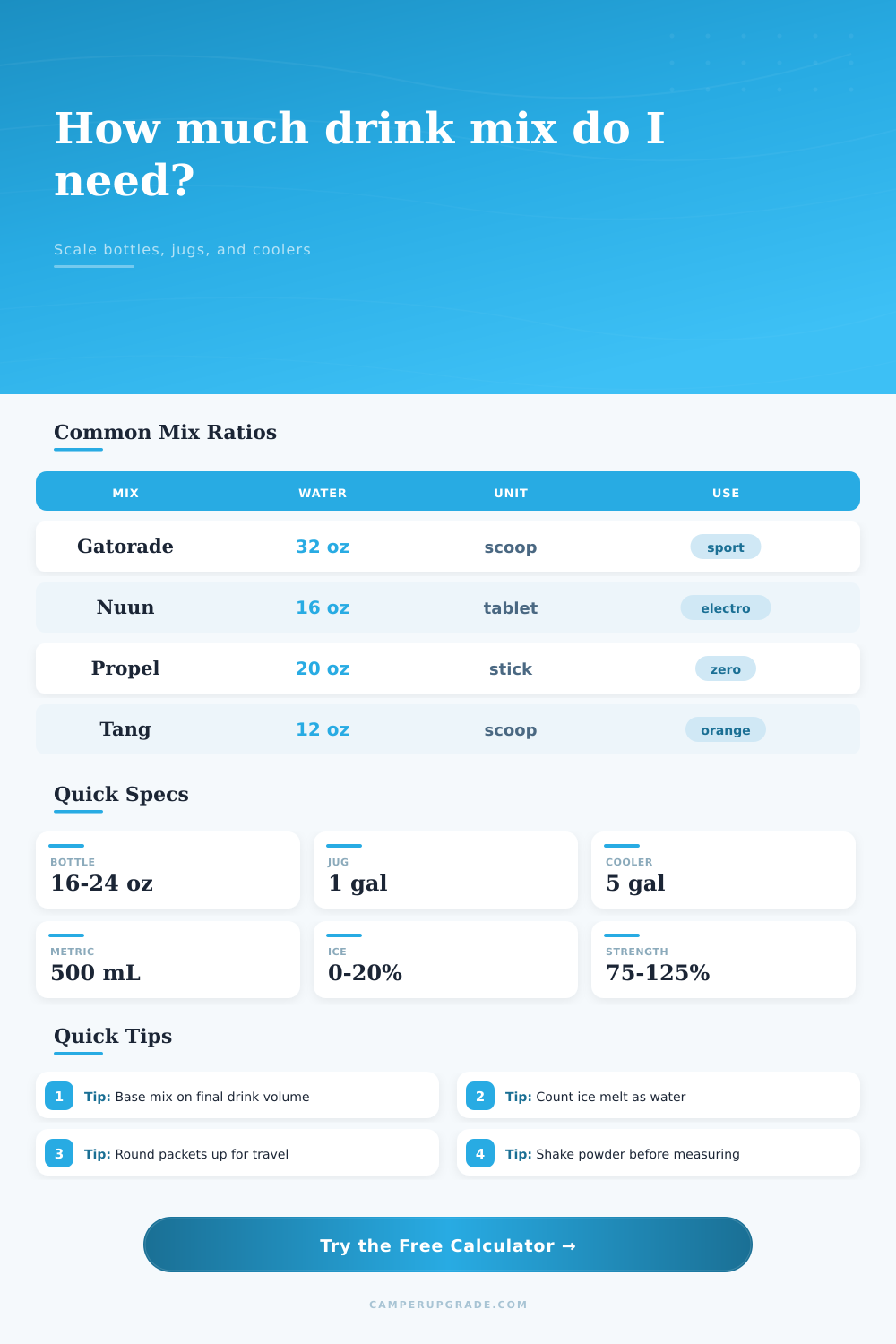
| Gatorade Powder Scoop | 1 scoop per 32 fl oz water | 47 g per scoop | 4 scoops per gallon |
| Gatorade Stick Pack | 1 packet per 20 fl oz water | 35 g per packet | About 6.4 packets per gallon |
| Liquid I.V. Hydration Multiplier | 1 stick per 16 fl oz water | 16 g per stick | 8 sticks per gallon |
| LMNT Stick Pack | 1 stick per 16 to 32 fl oz water | 6 g per stick | 4 to 8 sticks per gallon |
| Nuun Sport Tablet | 1 tablet per 16 fl oz water | 5.4 g per tablet | 8 tablets per gallon |
| Skratch Sport Scoop | 1 scoop per 16 fl oz water | 22 g per scoop | 8 scoops per gallon |
| Tailwind Endurance Fuel | 2 scoops per 24 fl oz water | 27 g per scoop | About 10.7 scoops per gallon |
| Propel Powder Stick | 1 stick per 20 fl oz water | 3 g per stick | About 6.4 sticks per gallon |
| Country Time Lemonade | 2 scoops per 1 quart water | 26 g per scoop | 8 scoops per gallon |
| Tang Orange Mix | 1 scoop per 12 fl oz water | 24 g per scoop | About 10.7 scoops per gallon |
| Container | US volume | Metric volume | 16 fl oz servings |
|---|---|---|---|
| Standard bottle | 16.9 fl oz | 500 mL | 1.1 servings |
| Bike bottle | 24 fl oz | 710 mL | 1.5 servings |
| Small hydration bladder | 50.7 fl oz | 1.5 L | 3.2 servings |
| Large hydration bladder | 101.4 fl oz | 3 L | 6.3 servings |
| One gallon jug | 128 fl oz | 3.79 L | 8 servings |
| Five gallon cooler | 640 fl oz | 18.93 L | 40 servings |
| Setting | Ratio multiplier | Best use | Water note |
|---|---|---|---|
| 50% light | 0.50× | Low flavor or light electrolytes | Same final volume |
| 75% light | 0.75× | Hot days with frequent sipping | Same final volume |
| 100% label | 1.00× | Follow package direction | Subtract expected ice melt |
| 125% strong | 1.25× | Strong flavor or heavy sweat | Check sodium and caffeine |
| 200% concentrate | 2.00× | Make a dense base to dilute later | Mark the container clearly |
| Base ratio | 24 fl oz bottle | 1 gallon jug | 5 gallon cooler |
|---|---|---|---|
| 1 unit per 16 fl oz | 1.5 units | 8 units | 40 units |
| 1 unit per 20 fl oz | 1.2 units | 6.4 units | 32 units |
| 1 unit per 24 fl oz | 1 unit | 5.3 units | 26.7 units |
| 1 unit per 32 fl oz | 0.75 units | 4 units | 20 units |
| 2 units per 1 quart | 1.5 units | 8 units | 40 units |
We’ve all been there; you’re standing over a cooler, staring into a tub of powder wondering if two scoop is going to be a chemical sludge or lemonade. The instructions say one scoop for every thirty-two ounces. But you have an odd-shaped jug, the ice has started to melt, and you need some water NOW. Getting ratio incorrect means wasting cash and completely ruining the hydration experience. Too weak and you have warm tap water with a splash of regret. Too strong and you have a syrupy slap-in-the-face experience that will make you wish you never went outside.
The calculator above does the scaling math for you so you can stop doing arithmetic in the hot sun and just keep yourself cool. But there’s an even easier piece of math at work here, and one most people don’t realize, but still screw up as their first attempt at mixing. Specifically, the amount you’re measuring should be based off the final volume of liquid in the container, not just whatever water (or other liquid) you plan to pour into the container initially.
Why Ice Melt Matters for Your Drink
Why? Because the ice will melt. And when you go to the trouble of packing a cool box full of frozen H2O chunks for a tailgate or a hike, you generally do so knowing that that ice will become part of the drink. Pouring in all that cold tap water right now, and only taking that into account in calculating the mix, means that once those cubes have melted away, resulting beverage will be more dilute then what you’d calculated. So this tool allows you to guesstimate how much of your final volume comes from melted ice, then subtracts that amount from liquid you need to pour in immediately. That is really the whole point. What you’re doing is mixing something for later; something whose taste will be enjoyed over a period of time, not just the instant when you snap the lid shut.
Beyond the flavor option, there is also an extra degree of control via their strength options. For instance, dialing back to seventy-five percent may appear as money saving move, but it significantly alters electrolytes themselves. The sports drink industry designs products with set concentrations that help absorption. If you drop them below that level, they becomes hypotonic/hypertonic, which actualy hinders absorption when pushing hard. Then again, you can crank it all the way up to two-hundred percent to get a super concentrated solution. This is great for having a few ounces of juice when you’re out on a long trail, but only if you specifically label the bottle so it doesn’t get confused with something else. Swigging electrolyte paste straight isn’t really a thing. That just leads to an upset stomach.
This is laid out on the page with reference tables that show how various formats scales across standard container sizes. For example, there’s a difference between a tablet dissolved in sixteen ounces and one designed for use in thirty-two ounces. There’s also the difference between a convenience like stick packs, which often carry higher cost per ounce of hydration, and a bulk tub. Individually packed means you’re paying a lot to feed a bunch of people quickly, especially when you’re doing so as part of a group. For ultralight backpackers who weigh their food, you can input the dry weight of whatever you portion your mix into and it’ll help keep things accurate down to the last gram. Not only can you track how much sugar or sodium makes its way into each serve, but you won’t guess wrong on your second pitch and double your caffeine intake.
Ice melt and strength isn’t about exact amounts, but it’s about intention. Is this going to be a light refresher for sipping while sitting by a campfire? Or do I need something with enough kick to power me up a ridge? And then there are the messy details in field conditions; a tool that helps bridge the gap between those idealized directions on the back of the box and the real world. Instead of guessing based off a faint taste on your tongue, you will finally know if the powder expired last month or if you simply under-mixed it. Your drink tastes how it said it would. It is a perfect scale. It is not too weak swill. It does not have too much syrup. Every drop work perfectly, from the first sip to the final melt.