Snack Bar Calorie Per Ounce Calculator
Compare trail bars by calorie density, total packed calories, carry weight, trip coverage, and bars needed for a hiking or camping snack plan.
| Preset | Calories | Weight | Cal/oz | Best planning use |
|---|---|---|---|---|
| CLIF Bar Chocolate Chip | 250 Cal | 2.40 oz / 68 g | 104 | Balanced day-hike energy |
| KIND Dark Chocolate Nuts and Sea Salt | 200 Cal | 1.40 oz / 40 g | 143 | Compact calorie-dense snack |
| RXBAR Chocolate Sea Salt | 200 Cal | 1.83 oz / 52 g | 109 | Protein-forward snack stop |
| LARABAR Peanut Butter Chocolate Chip | 210 Cal | 1.59 oz / 45 g | 132 | Fruit and nut trail calories |
| Nature Valley Oats and Honey | 190 Cal | 1.48 oz / 42 g | 128 | Crunchy shared snack packs |
| Quest Chocolate Chip Cookie Dough | 190 Cal | 2.12 oz / 60 g | 90 | High-protein recovery bar |
| Honey Stinger Honey Waffle | 150 Cal | 1.06 oz / 30 g | 142 | Quick fuel before climbs |
| PROBAR Meal Old School PB&J | 370 Cal | 3.00 oz / 85 g | 123 | Meal-size backup calories |
| Kate's Real Food Lemon Coconut | 150 Cal | 1.09 oz / 31 g | 138 | Smaller oat-and-nut snack |
| That's it Apple + Mango | 100 Cal | 1.23 oz / 35 g | 81 | Fruit snack variety |
| Density band | Cal/oz | Cal/g | Meaning for pack planning |
|---|---|---|---|
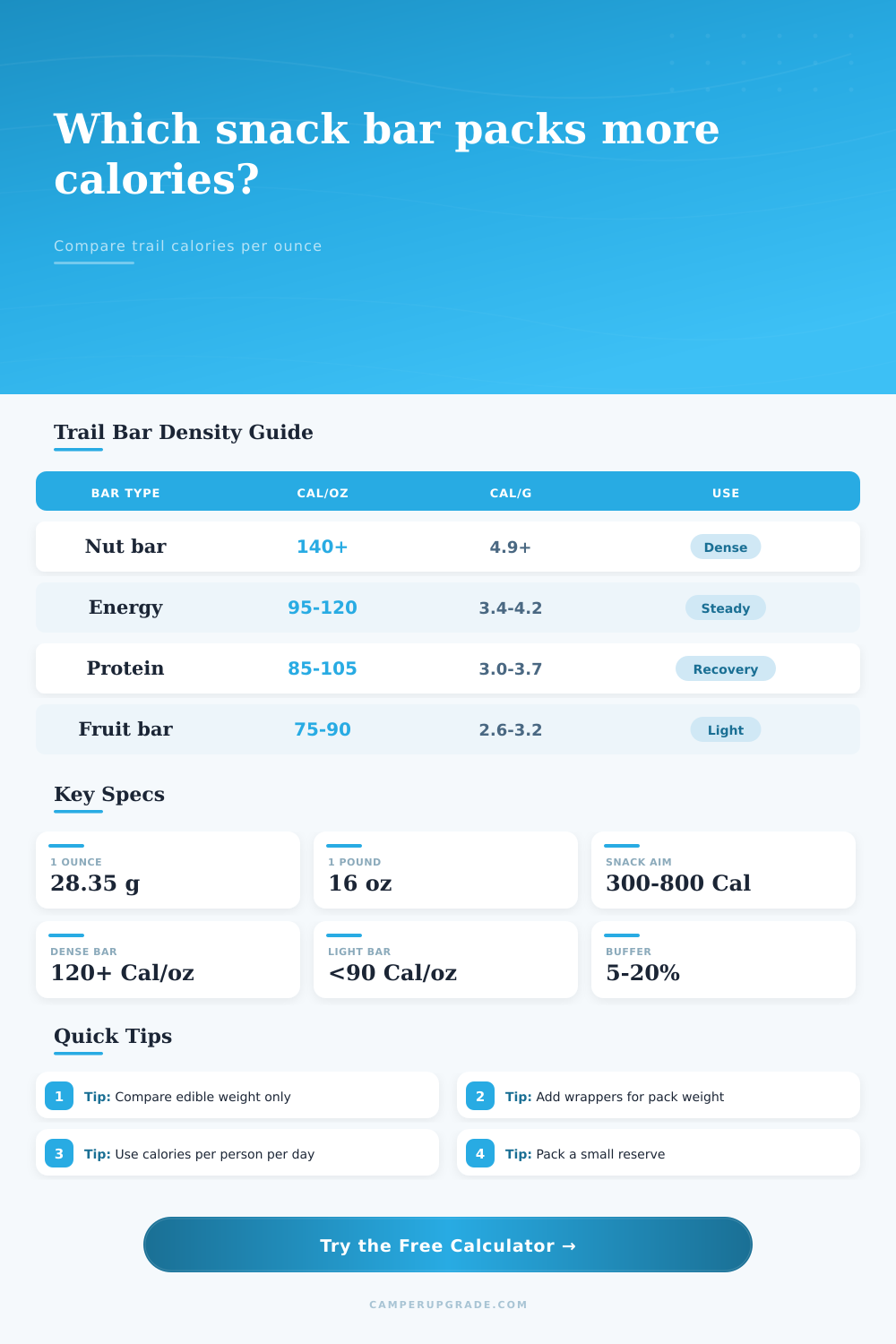
| Very light density | Under 80 | Under 2.8 | Often fruit-forward or airier snacks; good for variety, less efficient for calories. |
| Moderate density | 80 to 105 | 2.8 to 3.7 | Works for short trips when snack weight is not the main limiter. |
| High density | 106 to 130 | 3.7 to 4.6 | Strong all-around range for hiking, car camping, and long travel days. |
| Very high density | Over 130 | Over 4.6 | Usually nut, seed, oil, or waffle-heavy bars; efficient when pack weight matters. |
| Trip plan | People | Snack target | Bars at 200 Cal | Bars at 250 Cal |
|---|---|---|---|---|
| Solo overnight | 1 x 2 days | 500 Cal/day | 5 bars | 4 bars |
| Weekend pair | 2 x 3 days | 600 Cal/day | 18 bars | 15 bars |
| Family campsite | 4 x 2 days | 400 Cal/day | 16 bars | 13 bars |
| Long trail stretch | 1 x 5 days | 800 Cal/day | 20 bars | 16 bars |
| Group travel day | 3 x 1 day | 700 Cal/day | 11 bars | 9 bars |
| Bars packed | 1.4 oz bars | 2.1 oz bars | 2.4 oz bars | 3.0 oz bars |
|---|---|---|---|---|
| 6 bars | 0.53 lb | 0.79 lb | 0.90 lb | 1.13 lb |
| 12 bars | 1.05 lb | 1.58 lb | 1.80 lb | 2.25 lb |
| 18 bars | 1.58 lb | 2.36 lb | 2.70 lb | 3.38 lb |
| 24 bars | 2.10 lb | 3.15 lb | 3.60 lb | 4.50 lb |
| 36 bars | 3.15 lb | 4.73 lb | 5.40 lb | 6.75 lb |
By the end of the 3rd day on the trail your tummy is upset and your legs hurt from lack of fuel. Out of desperation you grab a snack bar, hoping it will give you some energy. Instead the snack bar help you keep going but never provides any actualy energy.
Why? The answer is in caloric density. It’s less about how many bars you pack and more about how many calories you can cram into an ounce. On the trail, every ounce equals a few grams and ounces equal weight; that’s why weight matter. Knowing the calorie per ounce ratio affect your meal planning.
Why Weight Matters for Your Snacks
The problem is most folks see the calories listed on the wrapper and they stop there. Calories don’t tell you anything about efficiency. You might be able to get two hundred calories from a bar weighing three ounces, or you may only has to take a bar that’s one point four ounces to achieve those same two hundred calories. That means you’ll have more space in your pack for other things and the lighter bar will give you an equal amount of energy while being easier to carry.
When you compare the caloric value by the ounce, you strip out all marketing claims and you can see what you’re getting for weight you need to carry. That’s where the calculator comes into play (above). Plug in the information about your bars and it does all the work for you.
Enter the actual weight of the edible part of your bar. This should not include the wrapper; remember, wrappers is zero calorie with some additional carry weight. So they need to be subtracted out off the equation. But later on, if you’re planning how much weight to bring along in your pack then yes, the wrapper matters again. The tool takes care of this difference for you. It will show the difference between actual food efficiency and dead weight of the package itself.
Different types of bars can serve different purposes during your trip. For example, seed/nut bars is super dense. Fat has over double the caloric value per gram compared to carbohydrate/protein. These are great if weight is an issue and you’re out hiking all day. On the other hand fruit bars are low-density, with fast-acting sugars. They will quickly give you some fuel while also breaking up the monotony of pure fat bar. A combination of both allows for a balanced diet while keeping you full. Do you really want to be eating just nuts for five days?
The equation has another layer when planning for a group. Snacks should of be enough for the longest stretches between towns (long flats, steep climbs) but not so much that you are over packed. The trail can become more challenging or the weather can change more than you expect so having some wiggle room is smart. Your appetite will vary even more then you anticipate. Ten percent more is a good buffer to account for these surprises without packing in excess weight. Better to have excess than none at all.
On the page, there are also reference tables that compare various popular bars side by side. This lets you know at a glance which ones gives you the best value if you are counting ounces and grams. For example some of these bars are like a meal replacement. They have three or four hundred calories stuffed into one bar. Others are lighter food designed to get you through to your next big meal. That’s an important distinction so you know what to put in your hip belt pockets vs. The main pack.
Snacks you want to keep accessible need to be hearty enough to count while not being so heavy they bounce around. Eating well in the backcountry is a practice in optimizing. You want maximum energy, minimal weight, and the most fun possible. Get the calories-per-pound ratio correct, and you won’t find yourself hungry when you reach camp.
You’ll be fueled-up for another day of hiking. And your feet will have enough juice to continue going uphill. Take a second look at those numbers before zipping up that bag. Make smart choices today and you’ll feel good about it on day three.