Jerry Can Water Weight Calculator
Calculate water weight, container tare, filled carry weight, usable reserve, and trip splits for RV, camper, overland, and campsite water cans.
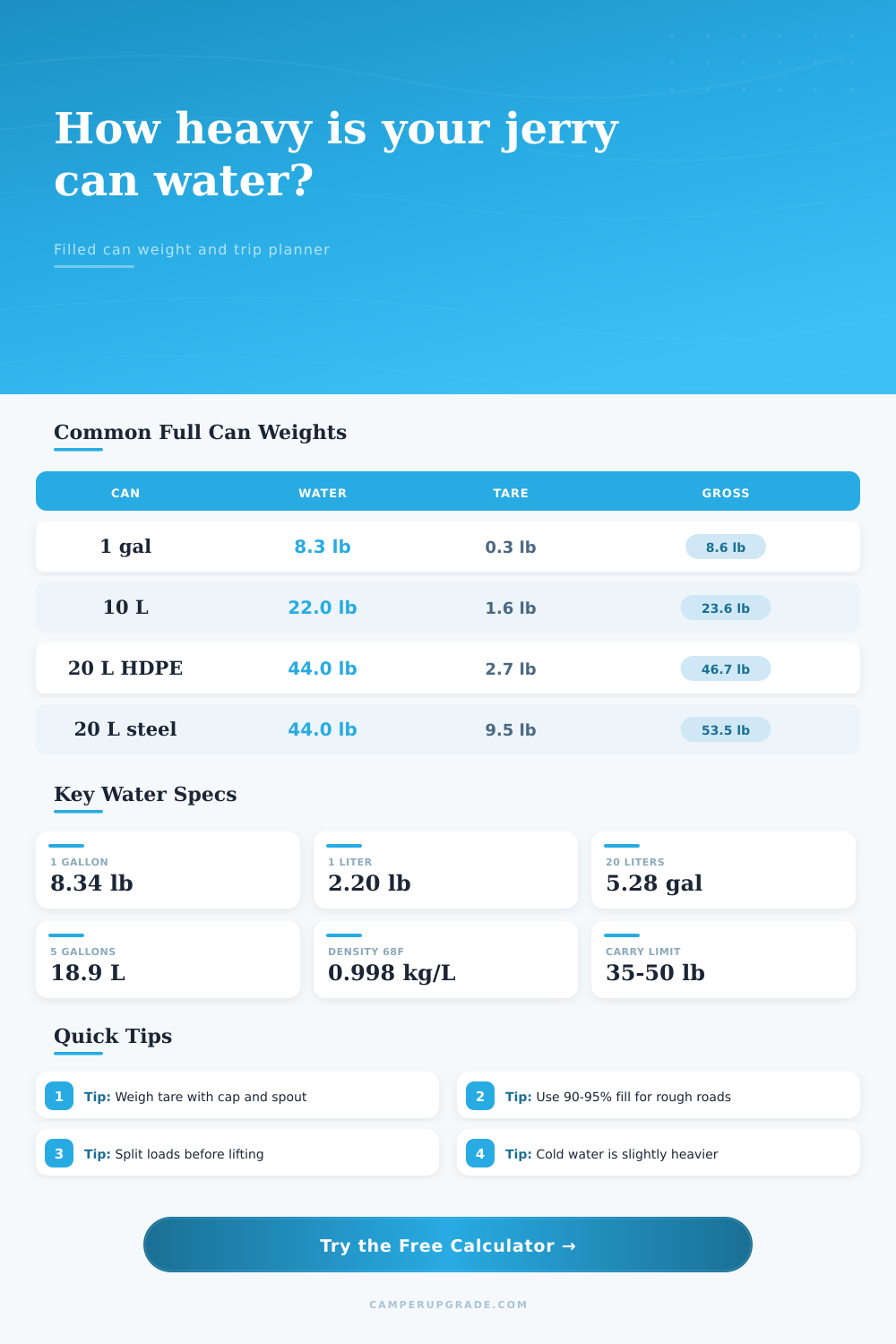
| Can size | Water volume | Water weight at 68°F | Typical tare | Approx loaded weight |
|---|---|---|---|---|
| 1 gal emergency jug | 1.0 gal / 3.8 L | 8.3 lb / 3.8 kg | 0.3 lb / 0.1 kg | 8.6 lb / 3.9 kg |
| 2.5 gal flat can | 2.5 gal / 9.5 L | 20.8 lb / 9.5 kg | 2.4 lb / 1.1 kg | 23.2 lb / 10.5 kg |
| 10 L compact can | 2.64 gal / 10 L | 22.0 lb / 10.0 kg | 1.6 lb / 0.7 kg | 23.6 lb / 10.7 kg |
| 5 gal utility can | 5.0 gal / 18.9 L | 41.6 lb / 18.9 kg | 2.5 lb / 1.1 kg | 44.1 lb / 20.0 kg |
| 20 L HDPE can | 5.28 gal / 20 L | 44.0 lb / 20.0 kg | 2.7 lb / 1.2 kg | 46.7 lb / 21.2 kg |
| 20 L steel can | 5.28 gal / 20 L | 44.0 lb / 20.0 kg | 9.5 lb / 4.3 kg | 53.5 lb / 24.3 kg |
| 6 gal RV top-up | 6.0 gal / 22.7 L | 50.0 lb / 22.7 kg | 3.0 lb / 1.4 kg | 53.0 lb / 24.1 kg |
| 7 gal water cube | 7.0 gal / 26.5 L | 58.3 lb / 26.5 kg | 2.2 lb / 1.0 kg | 60.5 lb / 27.4 kg |
| Water temperature | Density used | 1 gallon weighs | 20 L weighs | Planning note |
|---|---|---|---|---|
| 32°F / 0°C | 0.9998 kg/L | 8.344 lb | 44.09 lb | Near maximum weight |
| 50°F / 10°C | 0.9997 kg/L | 8.343 lb | 44.08 lb | Cold mountain fill |
| 68°F / 20°C | 0.9982 kg/L | 8.330 lb | 44.01 lb | Common reference point |
| 86°F / 30°C | 0.9957 kg/L | 8.309 lb | 43.90 lb | Warm campsite water |
| 104°F / 40°C | 0.9922 kg/L | 8.280 lb | 43.75 lb | Hot stored water |
| Nominal capacity | Liters | US gallons | Water weight | 95% fill weight |
|---|---|---|---|---|
| 1 quart bottle | 0.95 L | 0.25 gal | 2.1 lb / 0.9 kg | 2.0 lb / 0.9 kg |
| 1 gallon jug | 3.79 L | 1.00 gal | 8.3 lb / 3.8 kg | 7.9 lb / 3.6 kg |
| 10 liter can | 10.00 L | 2.64 gal | 22.0 lb / 10.0 kg | 20.9 lb / 9.5 kg |
| 5 gallon can | 18.93 L | 5.00 gal | 41.6 lb / 18.9 kg | 39.6 lb / 17.9 kg |
| 20 liter can | 20.00 L | 5.28 gal | 44.0 lb / 20.0 kg | 41.8 lb / 19.0 kg |
| 7 gallon cube | 26.50 L | 7.00 gal | 58.3 lb / 26.5 kg | 55.4 lb / 25.1 kg |
| Loaded weight band | Typical single-hand lift | Suggested split | Example can load | Trip planning note |
|---|---|---|---|---|
| Under 25 lb / 11 kg | Easy for many adults | One can per hand if balanced | 2.5 gal flat can | Good for short walks |
| 25-45 lb / 11-20 kg | Moderate lift | One can at a time | 5 gal utility can | Use controlled handles |
| 45-60 lb / 20-27 kg | Heavy lift | Two-person or cart preferred | 20 L steel or 7 gal cube | Avoid awkward tailgate lifts |
| 60-100 lb / 27-45 kg | Not a casual hand carry | Split into smaller cans | Two full 20 L cans | Plan multiple trips |
| Over 100 lb / 45 kg | Bulk load | Use vehicle, dolly, or hose | Four-can rack | Check rack and axle limits |
On an overland trip, carrying water makes gravity more relevant. Looking at a blue plastic canister from the back of your truck, it seems so harmless. Yet it is a heavy anchor on your roof rack. When you calculate the amount of fuel required by engine, did you forget about how much that same volume of water weighs in terms of axle load? Everything from stopping distance to tire pressure change. Water may be wet but it’s also heavy. For example, one gallon of water weigh about eight and a third pounds.
That doesn’t sound like much until you think about stacking five gallons. Now you’ve got more than 40 pounds of sloshing fluid to carry around. Fortunately, there’s an online calculator that do all the math for you (this site). All you have to do is enter the dimensions of your cans and it’ll tell you how many trips it’ll take to haul the load.
The Hidden Weight of Water on Your Trip
But the true takeaway isn’t just the math. It’s learning the difference between gross weight and tare weight. When most folks buy a container, they simply figure that what they bought is equal to what it holds. They fail to account for the weight of the steel or plastic container itself. Sure, an empty twenty-liter HDPE may only weigh slightly less than three pounds, while its steel counterpart (the NATO version) weigh almost seven more before you fill it with water. When you have to manhandle it up on that high tailgate, every pound counts.
So what about the material? Material choice determine the weight, durability, and handling of the materials. Plastic is inexpensive and lightweight. However, it is not great for protecting stuff from sun exposure, as UV light breaks down plastic. It is also not good for flexing when pressure are applied. Steel will guard your goods from both physical impact and UV damage, but requires more power to push around. That extra tare weight quickly accumulates into a lot of work after doing it 20 times and split loading among two person or shuffling loads multiple times around camp. You could of saved five pounds with this container initially but end up expending double the effort getting it from place to place.
And finally there’s temperature, though its impact isn’t as obvious as one might think. Warm tap water coming out of a city station in the desert is less thick than cold water coming out of a mountain stream. Again, the difference in ounces are small, but it matters. It will also make your can more full than it needs to be… at least realisticly speaking, since thermal expansion is something else you don’t want to have happen. You’ll leave yourself some air space (ten percent or so), because you sure don’t want the sun beating down on your parked truck and causing the cap to blow off. Filling up a bit too much looks like a good idea, but usually ends in waste, both of water and slipperiness on deck surfaces.
Once you’re loading up with multiples, the geometry matters: One twenty-liter can is doable for an individual. Having two full cans side-by-side will change your center of gravity and force you to hold them steady with both hands, this leaves you with little room for brakes and balance while crossing any kind of uneven surface. Splitting up that bulk into smaller portions is not only safer in terms of avoiding injuries and fatigue, it’s also going to be far more effective than getting another solid helper. Think about keeping that load near your core and consider the distance from your body.
The math help answer this question: Is the way I store water in or on my vehicle within the weight limit of my gear? If so, then great, you’re good to go. But the numbers won’t tell you whether moving all those jugs up three flights of stairs in some remote cabin is going to leave you feeling like a total goner. It will help prevent you from finding yourself looking down at the bottom of a ravine, realizing too late that nobody can carry a single jug to safety. Knowing what the weight is before you strap it onto your vehicle ensures you don’t wreck your back while also keeping your adventure humming along just fine.