Mug Volume by Drink Calculator
Estimate usable mug capacity for coffee, tea, cocoa, lattes, and camp drinks using inside dimensions, rim space, foam, add-ins, and drink serving size.
⚡Named Drink Presets
🧮Mug and Drink Inputs
Mug Volume Results
📐Core Formulas Used
Frustum volume = pi x h / 3 x (R2 + Rr + r2), then cubic inches x 0.554113 = fl oz.
Rim loss = top surface area x clearance height x 0.554113, adjusted by shape factor.
Usable pour = capacity - rim clearance volume - foam allowance.
Fit margin = usable pour - (drink serving + milk, syrup, or powder volume).
🛠Mug Material and Spec Comparison
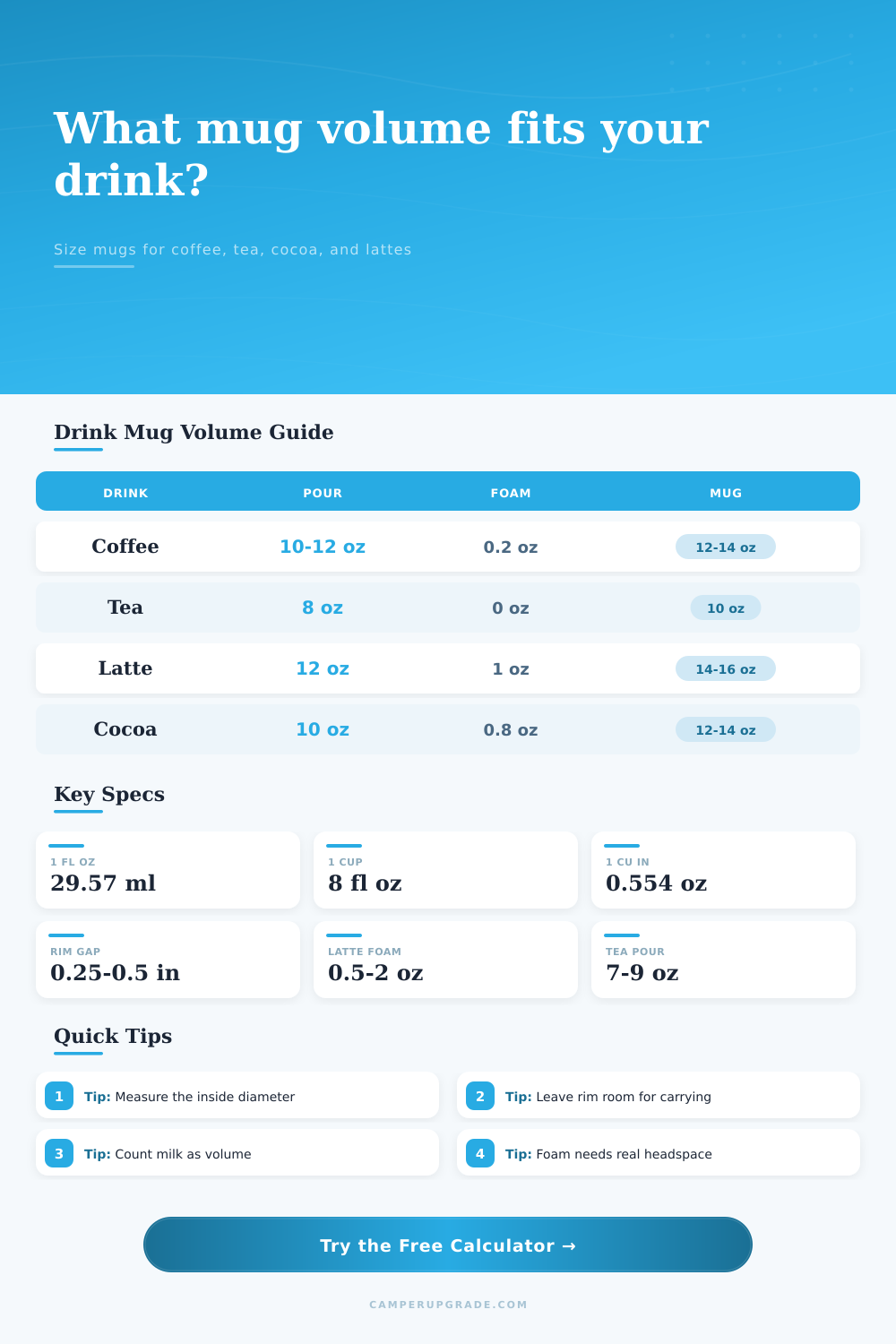
☕Typical Drink Pour Volumes
| Drink | Typical drink pour | Common mug capacity | Allowance to include |
|---|---|---|---|
| Camp coffee or drip coffee | 10 to 12 fl oz / 296 to 355 ml | 12 to 14 fl oz | 0.25 to 0.50 in rim clearance |
| Black, green, or herbal tea | 7 to 9 fl oz / 207 to 266 ml | 10 to 12 fl oz | Leave room for steeping movement |
| Pour over coffee | 8 to 12 fl oz / 237 to 355 ml | 12 to 15 fl oz | Use finished drink volume, not brew water |
| Cappuccino | 5 to 6 fl oz / 148 to 177 ml | 6 to 8 fl oz | 0.5 to 1.5 fl oz foam allowance |
| Latte | 10 to 16 fl oz / 296 to 473 ml | 12 to 20 fl oz | Milk is part of the drink volume |
| Hot cocoa | 10 to 12 fl oz / 296 to 355 ml | 12 to 16 fl oz | Powder, marshmallow foam, or cream |
| Instant chai | 8 to 12 fl oz / 237 to 355 ml | 10 to 14 fl oz | Count milk powder or concentrate volume |
| Matcha | 5 to 8 fl oz / 148 to 237 ml | 7 to 10 fl oz | Whisking needs extra headspace |
📏Shape Formula Reference
| Shape setting | When to use it | Formula basis | Shape factor |
|---|---|---|---|
| Straight cylinder | Same width from base to rim | pi x radius squared x height | 1.00 |
| Tapered frustum | Rim and base diameters differ | pi x h / 3 x (R2 + Rr + r2) | 1.00 |
| Rounded belly mug | Middle is wider than rim/base | Frustum estimate plus belly allowance | 1.06 |
| Travel mug liner | Curved bottom or narrowed lid area | Frustum estimate minus liner loss | 0.97 |
🧪Headspace and Foam Reference
| Allowance | Use for | Typical value | Calculator input |
|---|---|---|---|
| Careful full pour | Stationary mug on a flat surface | 0.10 to 0.20 in rim gap | Select careful full pour |
| Seated sipping | Desk, picnic table, or camp chair | 0.20 to 0.35 in rim gap | Select seated sipping |
| Carry from stove | Walking with a hot mug | 0.35 to 0.60 in rim gap | Select carry from stove |
| Foamy drink | Cocoa, cappuccino, latte, matcha | 0.5 to 2.0 fl oz foam | Enter foam allowance |
🔁Volume Conversion Table
| Measurement | US volume | Metric volume | Use in calculator |
|---|---|---|---|
| 1 cubic inch of mug space | 0.554113 fl oz | 16.387 ml | Geometry output |
| 1 US fluid ounce | 1 fl oz | 29.5735 ml | Drink volume |
| 1 US cup | 8 fl oz | 236.588 ml | Coffee and tea serving check |
| 1 liter | 33.814 fl oz | 1000 ml | Large travel mugs and bottles |
💡Practical Calculation Tips
If you’ve purchased a mug labeled sixteen ounces, you’ve likely found yourself pouring less than twelve ounces into said “sixteen-ounce” cup. The problem? Marked capacity is based off filling the thing to the absolute brim. In practice, this doesn’t work when I’m hauling steaming hot coffee across an uneven floor.
To get real-world sizing, you need to account for volume of milk/foam/etc., which displaces your drink, plus some wiggle room (for safety) at the top of your vessel. On this site they has a calculator that converts inches of your mug’s interior into actual fluid ounces. Knowing what goes into those numbers will alter your approach when purchasing ceramics.
How to Measure Your Mug’s Real Size
The single biggest error are to measure the exterior of the mug. Thicker ceramic containers gobble up 1/2 an inch in diameter on either end of the container. This means you lose a few ounces just on size alone. For insulated mugs or those with rolled rims, the outside dimensions does not matter. What’s needed is the interior dimensions.
Measure it by drawing straight down from the interior rim to the bottom of the mug…… That’s what you’re drinking out of. That’s the volume of the mug. From there calculations start. Capacity is also dependent upon shape. Most home mugs are either rounded on their bellies or tapered slightly, which is easy enough to estimate until you get into the math of it all.
That’s where the tool come in… You can choose your inside shape and adjust volume estimate based off that. For example, a tapered mug will contain fewer ounces then a cylinder with the same diameter at its widest point (at the top). It is narrower towards its bottom. A rounded belly mug might be larger because it bulges in the middle, so it could actualy end up containing more than expected. So size isn’t just a matter of how wide and tall something is. It is about how that space is distributed between those two measurement.
Next up, account for margin of error. I call it rim clearance/headspace. When seated at the table, maybe there’s just a quarter inch of empty space in that mug. But what about while carrying it back and forth from the stove to the couch? Physics require more. A half-inch buffer ensures no sloshing onto your knuckles as you screech to a halt. Use the calculator to change amount of this clearance depending on how you handle things.
So finally, we have a real-world number, not an ideal one. Beverages aren’t all watery Flat black coffee displaces precisely as much liquid as you has served yourself. But what about a latte? That’s a mix of steamed milk and espresso! Each one of those thing has a volume. The same goes for cappuccino (with some extra foam, largely air but still something to account for). How about hot cocoa with marshmallows? What about a powder that expand?
You can enter these extras into the tool individually. Then you know exactly how much space they take up out of total capacity. If you overfill the capacity with the combination of what you want to serve + milk + foam, then guess where: You’re going to spill before you even get a drink.
The same is true with volume; material makes a difference, but not as much as you’d expect. Thin walled titanium camping cups exist. Their marked volume is actualy closer to their actual capacity than heavy stoneware. But thick double walled insulated mugs masks their true liner sizes behind large amounts of empty, vacuum-filled space. Don’t believe the mug’s label. Measure the actual liner yourself.
It’s not about math here as much as it’s about peace of mind. Knowing how much liquid your mug can actually hold helps make this more of a science and less of a crapshoot. If you know the interior dimensions, the foam allowance, and the rim clearance, you can finally tell if your favorite mug is going to hold your morning brew.
Go grab one of those mugs out of your cabinet and take a peek at its interior the next time you purchase a fresh cup. Turns out your twelve-ounce latte needs a fourteen-ounce cup all along.