Gear Weight Budget by Body Weight Calculator
Estimate a practical pack weight ceiling from body weight, trip length, water carry, food, shared gear, and route difficulty.
Pack Weight Budget Results
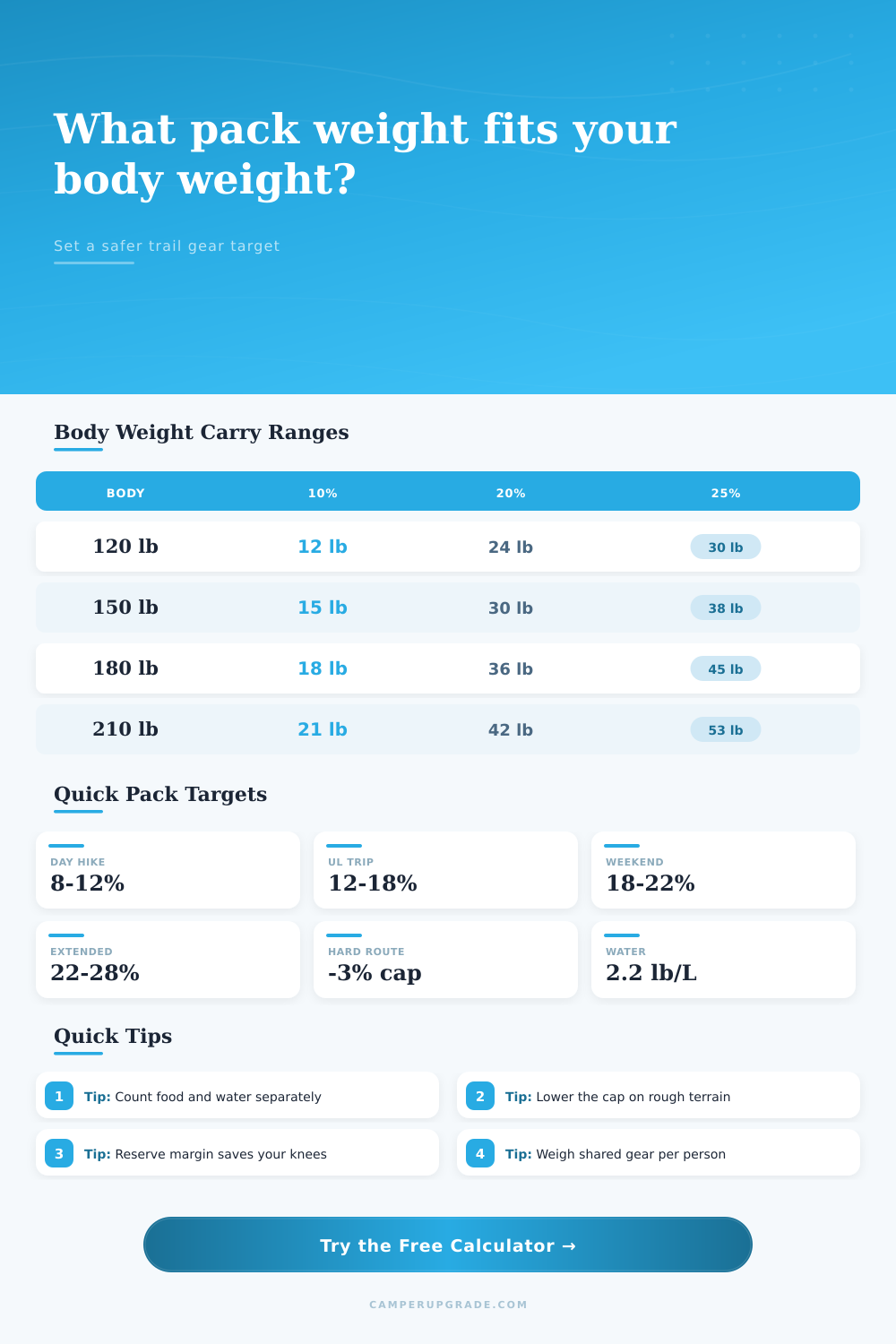
| Use case | Suggested body-weight range | Best fit | Adjustment note |
|---|---|---|---|
| Short day hike | 8% to 12% | Water, shell, first aid, navigation | Use lower end in heat. |
| Fastpack or ultralight overnight | 12% to 18% | Low base weight and short food carry | Check shoulder comfort. |
| Standard weekend backpacking | 18% to 22% | Two to three nights with normal shelter kit | Good default for fit adults. |
| Extended backcountry carry | 22% to 28% | Long food carry, cold gear, limited water sources | Needs careful pack fit. |
| Expedition or group gear load | 28% to 30% | Specialized trips with bulky shared gear | Avoid for casual mileage. |
| Consumable | Planning factor | Metric equivalent | Calculator use |
|---|---|---|---|
| Water | 2.20462 lb per liter | 1.0 kg per liter | Multiplies entered liters carried. |
| Food, lean menu | 1.4 to 1.6 lb per day | 0.64 to 0.73 kg per day | Works for short or calorie-dense menus. |
| Food, standard menu | 1.7 to 2.0 lb per day | 0.77 to 0.91 kg per day | Good normal backpacking estimate. |
| Food, high-output menu | 2.1 to 2.4 lb per day | 0.95 to 1.09 kg per day | Use for cold, long, or strenuous days. |
| Fuel allowance | 0.3 to 1.5 lb total | 0.14 to 0.68 kg total | Entered separately from food. |
| Base weight class | Pounds before consumables | Kilograms before consumables | Typical notes |
|---|---|---|---|
| Super ultralight | Under 5 lb | Under 2.3 kg | Specialized and very minimal. |
| Ultralight | 5 to 10 lb | 2.3 to 4.5 kg | Compact shelter and sleep system. |
| Lightweight | 10 to 15 lb | 4.5 to 6.8 kg | Common modern trail target. |
| Traditional | 15 to 25 lb | 6.8 to 11.3 kg | Durable gear and comfort items. |
| Heavy or winter | 25 lb and up | 11.3 kg and up | Cold-weather or group equipment. |
| Scenario | Inputs assumed | Start load | Fits body weight near |
|---|---|---|---|
| Blue Ridge Day Hike | 8 lb base, 1.5 L water, 0.8 lb food | 12.1 lb | 120 lb at 10% |
| Ultralight Weekend | 9 lb base, 2 days, 2 L water | 19.2 lb | 128 lb at 15% |
| PCT Section Carry | 13 lb base, 4 days, 2.5 L water | 30.5 lb | 153 lb at 20% |
| Desert Water Push | 12 lb base, 2 days, 5.5 L water | 31.1 lb | 183 lb at 17% |
| Winter Snowshoe Day | 16 lb base, 1 day, 2 L water | 23.8 lb | 159 lb at 15% |
Somewhere along every backpacking trip, the trail transitions from scenic to arithmetic. A switchback feels as if it takes longer then yesterday’s. That rock we missed three miles ago have our knees hurting. That last protein bar seem more like a stone. That’s when base weight shifts from an abstract idea to something very real.
A lot of folks pack using a shopping list mindset. We tick off the list without considering cumulative impact on us. Once you know your body weight and your specific trip details, the calculator does the math for you. In other words, it removes the guesswork from determining whether or not your gear decisions will handle the trail conditions awaiting you.
How to Pack Smart for Backpacking
It’s a percentage, and the percentage is: How much of your bodyweight does it end up being on your shoulders? Because when that number go up, so does leverage working against you. For instance, maybe you’re really heavy and carrying 20 pounds is no problem for you at all. But if you were light, that would of be crushing.
Many hikers, however, think about pack weight in absolute terms instead of relative ones. With the tool, you can set a limit by percentage. Then it will factor for things like altitude or heat that make anything feel heavier. When those conditions gets harsh, simply lower that cap and save your joints. You don’t need to remove any must-have items from the list.
The other part of the equation is base weight, what you need in order to get out there, before adding any food or water. That’s all of your electronics, clothes, sleep system, shelter… it’s your fixed costs. If you’ve got a big base weight, then no matter how well you trim down your consumable goods, it won’t be enough to make your overall load manageable over long distances.
On the page I have a table that shows this in terms of classes. How much more do you has capacity after you stuff your pack with all of your gear? This gives you an idea of where you fall on the spectrum, so you can know if you should get a lighter tent, or simply carry less food.
What sways the most? That’s right, water. Water weighs more than two pounds per liter. And if you’re carrying several liters for a long dry section, then you could be doubling your entire pack weight from a trip where you have regular stream crossings. There is no way around this. You need that water or risk getting dehydrated.
So the math will make you face this trade off. When the numbers come out and you realize you’ve gone too far overweight on the water carry, don’t just assume a lighter stove will solve all your problems. Maybe you’ll need to accept a heavier pack during that section. Or maybe you’ll plan your resupplies better. This is why the calculator allows you to input what water volume you expect to carry in addition to base gear.
A pound a day isn’t too bad. Two pounds if you’re eating a lot, but it piles up silently. That is ten pounds in five days of travel. It is literal fuel for your body. And it’s one of the most common places we’ll hear hikers skimping out. Instead of choosing nutrient-dense food, they switch to lighter foods like energy bars that don’t fill them up and leave them feeling colder.
That’s why there is a buffer built into the plan. Because the scale will lie and your stomach will have heartache when you’re on mile twenty. Having a cushion ensures you won’t freak out half way through being overburdened and underfed.
The second part: Gear sharing gets even more complicated. On paper, it’s efficient for hikers to split their tent weight and stove fuel with their partner. In reality, however, things don’t always go smoothly. The larger sleeping pad goes to one person; the cook kit goes to the other. With this tool, you can enter shared weights separately. That way, no partner is caught off-guard with an unequal burden. It prompts them to have the “fairness” discussion ahead of time… Before any packing begins.
So at the end of the day, how do you pack? How do you decide what stays in and what doesn’t? Ultimately, it’s a game of give-and-take: comfort vs. Capability. I’d like to carry enough to feel comfortabley (sleeping, eating hot meals) but not too much that my journey turns into misery. And the numbers help frame this decision. They make intuitive decisions more data driven.
Once you hit the trail with the confidence that you’ve packed optimally based off both the route and your body weight, the arithmetic dissapears. What’s left is just the trail. You are unshackled by the mental math of what you’re carrying.