Duffel Bag Liter Size Calculator
Estimate true duffel capacity from measured length, width, height, shape, seam loss, pockets, and usable packing fill.
🧳Real Duffel Presets
📏Bag Measurements
Duffel Capacity Results
Airline limits vary by carrier and route. This calculator compares common linear-inch benchmarks only; always verify the current rule for your actual flight.
🧵Material / Spec Comparison Grid
📊Duffel Liter Reference Tables
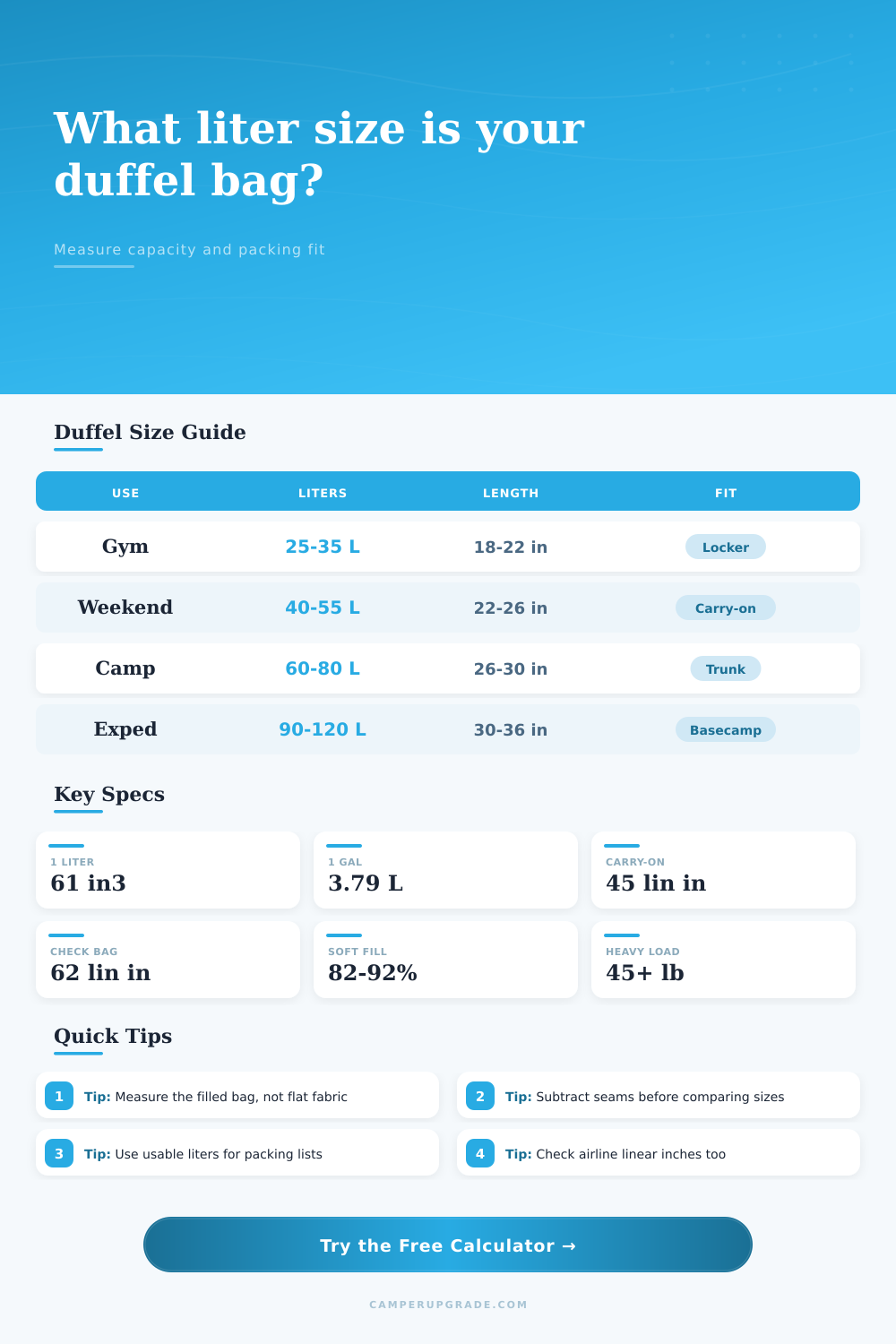
| Named Duffel Size | Typical Liters | Common Outside Size | Best Fit | Linear Size |
|---|---|---|---|---|
| Gym locker duffel | 25 to 35 L | 18 x 10 x 10 in | Shoes, towel, clothes | 38 in |
| Overnight duffel | 35 to 45 L | 21 x 11 x 11 in | One to two nights | 43 in |
| Carry-on duffel | 40 to 55 L | 22 x 12 x 11 in | Cabin travel | 45 in |
| Weekend camp duffel | 55 to 70 L | 26 x 13 x 13 in | Clothes and camp kit | 52 in |
| Gear hauler | 70 to 90 L | 30 x 14 x 14 in | Bulky outdoor gear | 58 in |
| Base camp duffel | 95 to 120 L | 34 x 16 x 16 in | Expedition packing | 66 in |
| Shape Formula | When To Use | Base Calculation | Adjustment |
|---|---|---|---|
| Rectangular duffel | Boxy travel bags | L x W x H | Subtract seam allowance first |
| Round barrel duffel | Cylindrical gym bags | L x pi x r squared | Width is treated as diameter |
| Tapered end duffel | Soft bags with narrow ends | L x W x H | Apply selected taper loss |
| Rounded-corner duffel | Stuffed fabric rectangles | L x W x H | Apply corner loss after seams |
| Known stated capacity | Manufacturer listed liters | Published liters | Apply usable fill only |
| Liter Size | Cubic Inches | US Gallons | Clothing Days | Typical Load Weight |
|---|---|---|---|---|
| 30 L | 1,831 cu in | 7.9 gal | 1 to 2 days | 8 to 15 lb |
| 45 L | 2,746 cu in | 11.9 gal | 2 to 4 days | 12 to 25 lb |
| 60 L | 3,661 cu in | 15.9 gal | 4 to 6 days | 18 to 35 lb |
| 75 L | 4,577 cu in | 19.8 gal | 5 to 8 days | 25 to 45 lb |
| 90 L | 5,492 cu in | 23.8 gal | Group gear | 35 to 55 lb |
| 120 L | 7,323 cu in | 31.7 gal | Base camp | 45 to 75 lb |
| Fabric / Build | Approx Shell Weight | Water Handling | Shape Stability | Capacity Note |
|---|---|---|---|---|
| 210D ripstop nylon | Light | Coating dependent | Very soft | Packs full but bulges |
| 420D nylon | Medium light | Good with PU layer | Moderate | Good travel baseline |
| 600D polyester | Medium | Good abrasion face | Moderate | Common gym and camp bags |
| 900D TPU polyester | Medium heavy | Strong wet handling | Firm | Seams reduce usable liters |
| 1000D nylon | Heavy | Coating dependent | Firm | Stable shape under load |
| Waxed canvas | Heavy | Sheds light moisture | Structured | Less stretch at corners |
💡Packing Notes
The duffel sits in your livig room. It’s huge! No question about it, it’ll hold a week’s worth of clothing, a new pair of hiking boots, and (with some stretching) maybe even that oddly shaped souvenir you bought in Prague. So you sit down to pack… Reality bites. Nothing hurts more then realizing the potential and seeing how much it fall short of reality.
A soft-sided bag stretches out when empty, but folds inward on itself as soon as you add odd-shaped item. Most of us trip over this gap: the difference between what we think our bags can hold and what they realy can. That’s where the bag calculator comes in. It’ll do the numbers for you, changing external dimensions into a accurate estimate of interior space.
Why Your Bag Holds Less Than You Think
Duffel bags: The problem with any duffle bag is that they lies. They tell you how much space they have as if they were a perfect cylinder (or even better: a box). In reality, real bags has rounded corners, padded walls, and sometimes even seams which consume volume. A thirty-liter gym locker bag may only give you twenty-two usable liters once you take into account the seam allowance.
You also has to realize that your towels don’t compress into cubes. These are small details, but they is important when you’re trying to get everything inside and then zip it closed. Measure the bag full, not flat on the floor, so that you simulate its actual usage. That all changes based off the shape.
For instance, a traditional round barrel design is a bunch of wasted space: it have voids at the corners that you can’t pack into. The cylindrical shape wastes space, while a rectangular box duffel packs out almost entirely. If you’re packing soft clothes that fit the shape inside, you’ll have a much higher usable fill rate. This is different than a big camping trip with awkwardly shaped frames and bulky sleeping bags, which will have a much lower usable fill rate. To account for that, you can change the rounding of the ends and tapers of the bag.
You’d think a hefty expedition duffel with lots of padding would seem really large, but that extra padding actualy reduces the inner dimensions. There’s one more wrinkle in the equation: airlines. Airport security operates on a different currency: inches. It is specifically linear inches. These are calculated as length + width + height, and the final sum has to be below the threshold set by each airline.
For example, a bag may fit under the liter allowance for being taken into the plane, but exceed the linear inch limit (because it was too wide, or too tall, etc). We benchmarked our sizing against some typical limits from airlines, such as 45-inch total linear carry-on size maximum. That way you don’t get to the gate and have to check your bag in when you didn’t realize how three-dimensional spaces was.
Finally, there’s weight. If your stuff gets too heavy, regardless of its volume, it becomes unwieldy or exceeds weight limits. The weight of items you carry can be drastically different. Bulkier items such as wet gear (e.g., rain-soaked tents, wetsuits and scuba) is heavier and also consume more space. Lighter items permit greater load capacity in a smaller space. Knowing how much each liter weighs will help you decide if you need a bigger pack or if you are just carrying extra weight. You should of not want to drag sixty pounds of camping gear through a terminal when a forty-liter option would have sufficed.
The material used can also impact how much usable space you have. Bags made from lightweight ripstop nylon will fold up compactly and bend in all directions, which means they’ll also expand randomly when fully loaded. More substantial materials such as canvas or a thousand-denier nylon will retain their structure and give you a more predictable usable volume. The difference is not just about durability; it’s about predictability. Knowing what your bag will do allows you to confidently pack it without having to guess.
So how do you know which size duffel is best for you? In the end, it boils down to knowing that liters are just a place to start, and never an assurance of anything. Knowing your contents’ density, shape, and any seams can help take the vague guesswork and turn it into exact planning. This page’s tool does the math and conversions for you so you can spend more time thinking about what you’re actualy going to put in there.
Measure it. Calculate it. Pack smartly. Turns out it really does make all the difference when you see the bag in front of you.