Packing Cube Volume Calculator
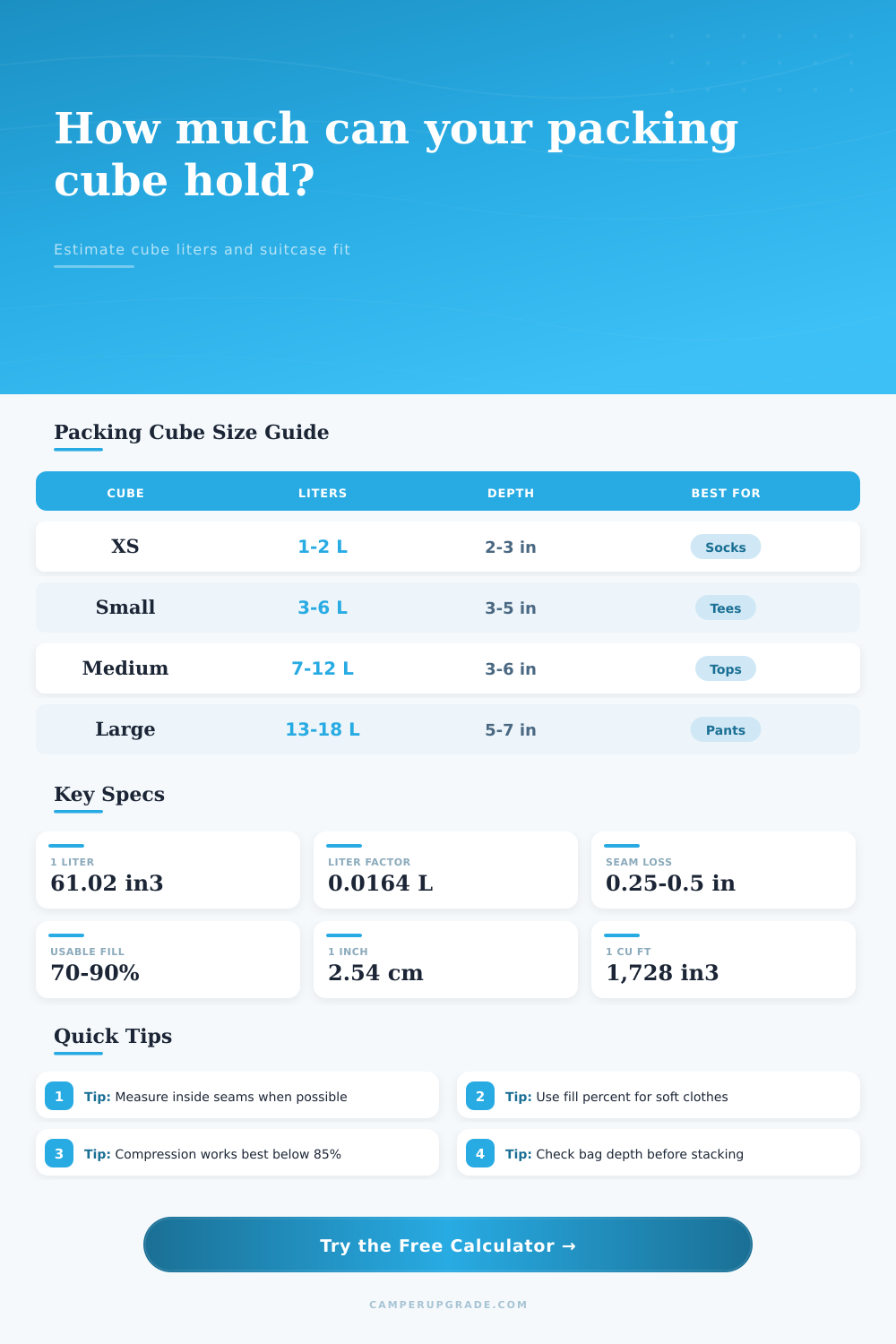
Estimate packing cube liters, compressed volume, clothing load, cube count, and suitcase fit from real dimensions instead of guessing by size labels.
| Named preset | Outside dimensions | Listed or geometric size | Calculator use |
|---|---|---|---|
| Eagle Creek Pack-It Reveal XS | 7.5 x 4.5 x 2.5 in | About 1 L | Socks, briefs, cords, sleep mask, and compact accessories. |
| Eagle Creek Pack-It Reveal S | 10 x 7 x 3 in | About 3 L | One-person underwear cube or a small warm-weather shirt stack. |
| Eagle Creek Pack-It Reveal M | 14 x 10 x 3 in | About 7 L | Flat folded tops, shorts, sleepwear, or a light weekend cube. |
| Peak Design Packing Cube Small | 12.6 x 6.7 x 3.1-6.7 in | Compression cube | Separated clean and worn layers in one narrow cube footprint. |
| Peak Design Packing Cube Medium | 12.6 x 12.6 x 3.1-6.7 in | About 18 L expanded | Main clothing cube for a larger travel backpack or roller bag. |
| Osprey Ultralight Large | 13 x 9 x 3 in | Flat large cube | Lightweight organization where low cube weight matters. |
| REI Co-op Expandable Small | 10.25 x 4 x 3.25-6.25 in | 244-305 cu in | Narrow packing lane for socks, underwear, and base layers. |
| REI Co-op Expandable Large | 14 x 4 x 3.25-6.25 in | 274.6-396.6 cu in | Long slim organizer for rolled layers along a suitcase side. |
| Patagonia Black Hole Cube 6L | 11 x 4.3 x 7 in | 6 L | Burly divided cube for dense layers or mixed travel gear. |
| Sea to Summit Garment Mesh Bag Large | 16 x 12 x 4 in | About 12.6 L geometric | Bulky fleece, pants, or a large folded garment stack. |
| Step | Formula | Why it matters | Typical range |
|---|---|---|---|
| Outside volume | length x width x depth | Fast geometric cube size before seams and soft corners. | 80-1,100 cu in |
| Inside dimensions | dimension - 2 x seam allowance | Approximates fabric binding, zipper tape, and corner fold loss. | 0.2-0.5 in loss |
| Usable volume | inside volume x shape x material x fill | Turns a hard box number into clothing space you can actually use. | 60-90% outside |
| Compressed volume | usable volume x (1 - compression %) | Estimates the luggage space after the compression zipper is closed. | 10-45% reduction |
| Liters | cubic inches x 0.016387064 | Converts cube volume into the luggage capacity unit most bags use. | 1 L = 61.02 cu in |
| Item type | Folded volume | Rolled volume | Compression note |
|---|---|---|---|
| Underwear or socks pair | 0.15-0.30 L | 0.12-0.25 L | Small items fill corner gaps better than shirts. |
| Light T-shirt | 0.45-0.70 L | 0.35-0.60 L | Rolling improves cube density when pieces are similar size. |
| Long sleeve or base layer | 0.70-1.10 L | 0.55-0.90 L | Compression works well if fabric is not already tightly folded. |
| Shorts or thin pants | 1.00-1.70 L | 0.85-1.40 L | Use larger cubes to avoid hard ridges across the stack. |
| Fleece or sweater | 2.00-4.00 L | 1.70-3.30 L | Bulky loft compresses, but rebounds against zipper seams. |
| Packable jacket | 1.50-3.50 L | 1.20-3.00 L | Use a lower fill percentage if the jacket has a slick shell. |
| Travel bag size | Practical cube volume | Common cube mix | Fit warning |
|---|---|---|---|
| 20-25 L daypack | 6-12 L total | 1 small + 1 slim cube | Keep at least half the pack free for layers and water. |
| 28-35 L travel backpack | 14-24 L total | 1 medium + 1 small cube | Check frame curve; boxy cubes can bridge across the back panel. |
| 38-45 L carry-on | 22-34 L total | 2 medium cubes + pouch | Leave space for toiletry kit, shoes, jacket, and dirty laundry. |
| 60-70 L duffel | 35-50 L total | 2 large + 2 small cubes | Soft bags swallow volume but need balanced weight distribution. |
| Checked roller | 45-70 L total | 3 large + 2 medium cubes | Stacking too high can push against lid pockets and rails. |
| Conversion or setting | Exact value | Calculator role | Use when |
|---|---|---|---|
| Cubic inches to liters | 1 cu in = 0.016387064 L | Primary capacity conversion | Dimensions are measured in inches. |
| Cubic centimeters to liters | 1,000 cu cm = 1 L | Metric cross-check | Dimensions are measured in centimeters. |
| Light compression | 10-20% depth reduction | Normal clothing squeeze | Mostly shirts, underwear, or base layers. |
| Firm compression | 25-35% depth reduction | Travel cube squeeze | Compression zipper closes smoothly without strain. |
| Aggressive compression | 40-50% depth reduction | Best-case soft goods | Lofty fleece or shells, not dense cotton stacks. |
But packing cubes aren’t magic boxes: they don’t make your clothes vanish; you zip ’em up, and they look neat in the suitcase. That is nice; there’s something about seeing things in order that makes you feel good.
But seeing something neatly arranged doesn’t answer the question of whether or not bag closes. Volume is what’s really constrained here, not appearance. Your packing cube may fit into the suitcase, and look compact sitting on the shelf, but its usable capacity depend on factors like fabric stiffness, seams, clothing-rolling technique, and presence or absence of compression zippers. Ignore these physical constraints, and come to airport trying to force lid closed, praying it doesn’t blow apart on the conveyor belt.
How to Pack Your Suitcase Properly
And if you’re plugging your own measurements into the calculator (above), math is done for you, no more “Well, I think maybe there’s room for three medium cubes” guessing. You won’t have to hope a bag labeled “large” holds everything when all bags is just vaguely sized as small, medium, or large. You know exactly what you have in liters and inches.
That mindset change alters packing. It moves away from hope and toward geometry. It begins to view space as a limited thing consumed by each round corner, seam allowance, and zipper track.
That’s where you enter the measurements based off of product page (or your own cubes) and then it gives you the outside dimensions. The outer dimensions will be the largest possible size (those are the numbers you measured). But that number is just about always optimistic, as there’s thickness to the fabric that requires some seam allowance, typically a quarter to a half an inch per edge. And there’s also things called profile factors to consider. If I have a rigid clamshell cube, that’s going to hold its shape compared to a soft ripstop bag which bulges when overstuffed. Even though both might have the same capacity as listed, that structural difference mean a lot more when you’re putting it into suitcase. A bulging cube take up more space in your suitcase!
Next, look at fill level and compression settings. Most packing plans goes off the rails here. On paper, a cube might hold five liters, but if you’re only filling it to, say, 70% capacity with something fluffy like knits, effective clothing volume will be much less than the listed value. Our calculator allows you to specify an appropriate fill percentage and a compression reduction factor.
Why? Because a compression zipper doesn’t make stuff magically larger; it makes stuff take up less vertical space by giving up either width or stiffness. A cube that’s squeezed down by 30%, for example, may free up more vertical space in your pack, but at the cost of being more difficult to rearrange later. If you know that tradeoff, then you’ll have to think twice about whether everything should be compressed or whether something could just fold loosely in its own flexible pouch.
The page also includes a handy-dandy reference table with real-world examples of popular cubes. This shows you exactly what size your particular brand name matches, like this: An extra small cube could fit things like your chargers and maybe even some socks without taking up unnecessary space. A large compression cube will fit a bulkier fleece which tends to spring back pretty strongly as well. Match the correct cube to the type of item, such as a shirt versus jeans. This way, you won’t pack one shirt in a huge box or try to jam jeans into a small sleeve pocket. Not only does it keep items organized but it keeps your pack efficient.
If you think about it, each item in your suitcase is like one puzzle piece; with both volume and weight. Add up the total volume of all those pieces and compare that number to your bag’s capacity to see what percentage of your luggage are taken up. That will tell you how much wiggle room you’ve got left for toiletries, shoes, and dirtier clothing.
Anything over ninety percent? You’re gonna have a bad time. Reserve at least twenty to thirty percent of your bag for last-minute things you know you’ll forget until you’re past security.
It’s more than just how you fold. It’s a matter of how you pack. It’s spatial planning: once you know what really goes inside your cubes, you won’t guess anymore; you’ll plan a load to fit. Packing light is not buying less but filling the space you’ve got with purpose. The zipper closes without needing any force. It sounds simple, but it is impossible when you are short on time. Do all the math ahead of time and the process will remain calm; and you’ll go home with everything. You should of checked those measurements first.