Camping Pillow Fill Volume Calculator
Estimate shell volume, fill weight, finished loft, and packed liters for DIY or adjustable camp pillows.
⛺Trail-tested presets
📏Pillow shell and fill inputs
Rounded rectangles use a 0.78 volume factor for curved edges and domed panels.
Fill estimate
🧵Material and specification comparison
📊Reference tables
| Shape profile | Formula used | Shape factor | Best camp use |
|---|---|---|---|
| Rounded rectangle | Length × width × loft × 0.78 | 0.78 | Backpacking pillow shells with domed panels |
| Boxed rectangle | Length × width × loft × 0.88 | 0.88 | RV, cot, or car-camping pillow forms |
| Mummy taper | Length × average width × loft × 0.76 | 0.76 | Sleeping bag hood and ultralight taper shapes |
| Cylinder roll | π × radius² × length | 1.00 | Neck rolls, hammock pillows, lumbar bolsters |
| Known shell volume | Measured volume entered directly | 1.00 | Water-displacement bag test or pattern volume |
| Sleep position | Typical camping loft | Firmness target | Calculator adjustment |
|---|---|---|---|
| Stomach sleeper | 1.5–2.5 in | Soft, 72% | Use low loft and back-sleeper pressure factor |
| Back sleeper | 2.5–3.5 in | Soft to medium, 72–82% | Keep buffer small so neck height stays low |
| Mixed sleeper | 3–4.5 in | Medium, 82% | Use the standard 1.00 pressure factor |
| Side sleeper | 4.5–6 in | Firm, 92% | Add the shoulder-gap pressure factor |
| Hammock sleeper | 2–3.5 in | Soft to medium, 72–82% | Use narrower width or a neck-roll cylinder |
| Fill material | Volume yield | Pack ratio used | Support feel |
|---|---|---|---|
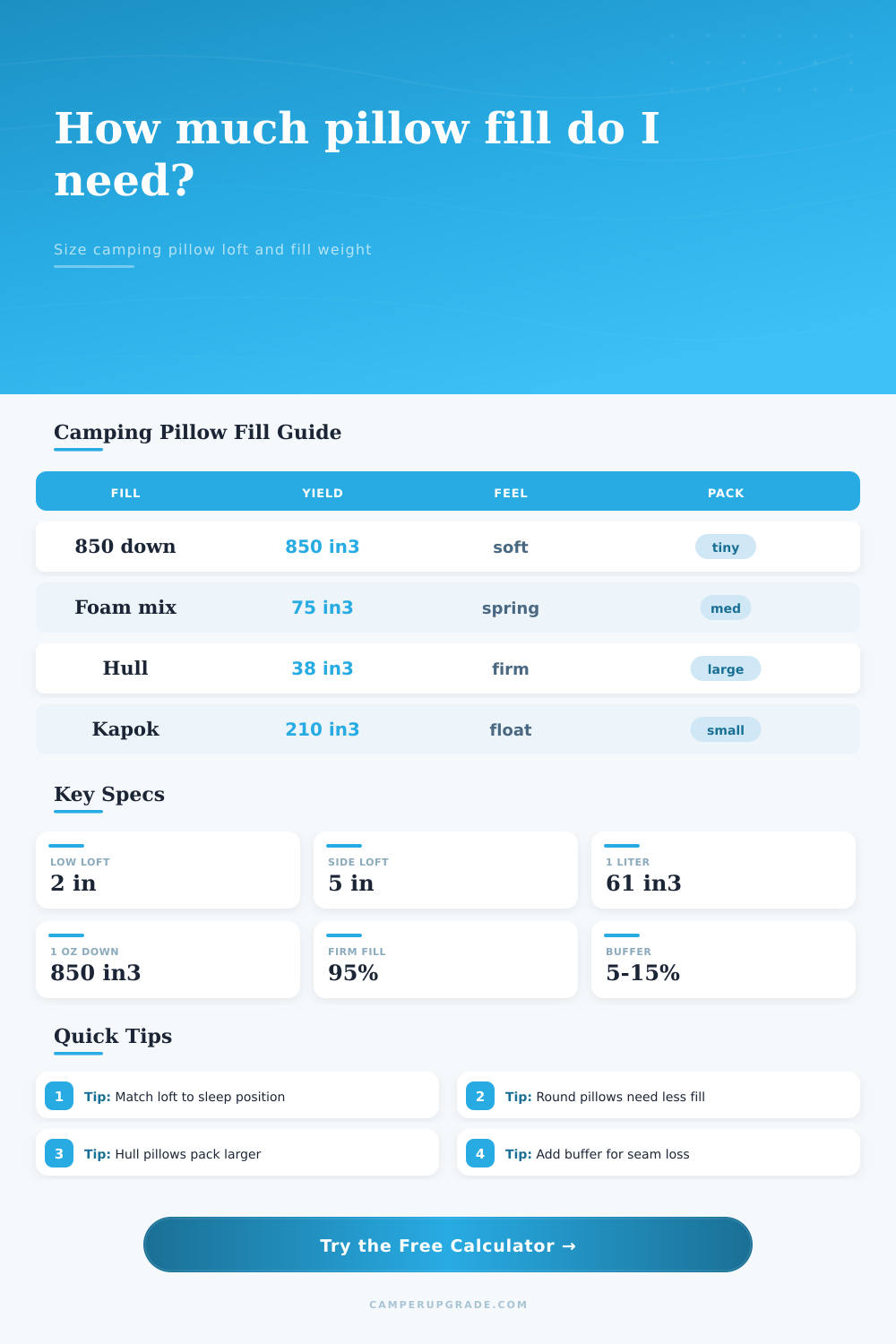
| 850 fp goose down | 850 cu in per oz | 2.8:1 | Very soft and ultralight |
| 650 fp duck down | 650 cu in per oz | 2.5:1 | Soft with a little more weight |
| Synthetic cluster fiber | 180 cu in per oz | 2.0:1 | Lofty and damp tolerant |
| Shredded memory foam | 75 cu in per oz | 1.55:1 | Springy side-sleeper support |
| Kapok fiber | 210 cu in per oz | 2.1:1 | Light, floaty, and plant based |
| Wool batting pieces | 95 cu in per oz | 1.45:1 | Dense, breathable, and stable |
| Buckwheat hulls | 38 cu in per oz | 1.12:1 | Firm, moldable, and heavy |
| Air-core topper fill | 320 cu in per oz | 2.4:1 | Thin comfort layer over air |
| Common camp pillow | Finished size | Shell volume | 850 fp down needed |
|---|---|---|---|
| Ultralight stuff-sack pillow | 15 × 10 × 3 in | 351 cu in | 0.4–0.5 oz |
| Compact mummy hood pillow | 16 × 11/7 × 3 in | 328 cu in | 0.4–0.5 oz |
| Car-camping travel pillow | 20 × 14 × 5 in | 1092 cu in | 1.2–1.5 oz |
| RV bunk pillow | 24 × 16 × 5 in | 1689 cu in | 1.9–2.4 oz |
| Hammock neck roll | 12 in long, 5 in dia | 236 cu in | 0.3–0.4 oz |
💡Calculation tips
Backpackers obsess about paring their packs to the gram, yet few considers their pillow. The low-cost solution is an inflatable one; great when used in still air but too loud if caught in any breeze. Thin nylon provide little support for the arch of your neck, leading to soreness in the morning. Maybe you prefer a higher pillow: something fluffy with foam or even down?
Finding the right combination of volume and loft (density) require some insight, this calculator does all the math for you, converting units between density and geometry. That said, fabric shells can be misleading about how much they will hold. When you lay down a pillow twenty inches by twelve inches on your table, it doesn’t have that same volume once its been stitched together. There is seams to account for, and then there are baffles which has dead zones in them that get filled up with fill. Also, rounded corners mean less inside.
How to Choose the Right Pillow
The tool takes those losses into consideration with a seam allowance setting and shape factor. So if you’re making a simple square box, it won’t lose very much. But if you’re creating a more complicated baffle system with rounded rectangles, you’ll realy see the difference in how much stuff goes inside. Knowing this is key to producing a pillow that feels as firm as you’d like.
Because it has loft, down expand significantly by the ounce (high fill power). If you need the pillow to compress into a tiny stuff sack, down or a light synthetic cluster are your only real option. Some side sleepers likes the springy resistance offered with shredded foam which is dense and heavy. For those who want a more resilient filling, kapok is buoyant but loses its resilience quicker than synthetic fibers. See material comparison section for the explanation of these yield differences.
In short, you’re swapping out support styles for packed size. To make the pillow compress into a small stuff sack, go with down or light synthetic clusters. If you don’t care about pack volume, go with heavier foam or buckwheat hulls, as these materials offers stability that soft fibers can’t match.
How high? How much loft you want depends on the sleeper type. Stomach sleepers needs nearly zero loft so their necks do not strain back. Side sleepers need enough loft to bridge distance from shoulder to ear, which is often four inches or more of uncompressed material.
Use the calculator to select your target loft and it will adjust the fill weight to your chosen percentage of firmness. Less fill in the same shell make for a softer setting (the material compresses under your head). More fill then the space can hold makes for a firmer setting (a taut surface that doesn’t bottom-out). It’s a balance of structural support and plush comfort.
There are other factors that more people don’t want to acknowledge: Sleep style matter to performance. The Pressure Factor Inputs recognize this because we all shift in our sleep. Medium firm will provide contouring when we are on our backs and also prevent us from rolling into a hole if we toss around at night. Extra gap space for side sleepers with wider shoulders is something we need to consider as well.
To do so, the tool bumps up the fill volume requirement just enough to avoid having your head dip down too much and strain your neck muscles over time. A smart move would of adding a buffer. When down is repeatedly packed into place, it compacts its fibers and loses its loft. Having more fill in the beginning will allow you to take out what’s needed so that your pillow isn’t too hard (instead of scrambling around trying to find fill in far-off places). A better scenario would be having some sort of reservoir of fill that you can remove if it feels too firm.
After plugging in your preference and measurements, you’ll recieve a tangible amount for volume and weight. Use these numbers as a starting point. Test the feel during your dry runs and go from there. Everyone has their own comfort level, but the physics apply universally. Knowing the base numbers will prevent you from having to buy unnecessary fill or ending up with a flat sack of dissapears.