Synthetic Fill Weight Calculator
Estimate synthetic insulation weight, cut area, GSM equivalent, and compressed volume for camper quilts, sleeping bags, cushions, pillows, and soft gear.
⛺Camp Gear Presets
📏Fill Project Inputs
Formula path: finished area × coverage multiplier × layer count × seam allowance, then material oz/yd² and overage. Metric entries are converted to inches internally.
Full Calculation Breakdown
🧶Material / Spec Comparison Grid
📊Reference Tables
| Insulation spec | oz/yd² | GSM | Typical camper use |
|---|---|---|---|
| PrimaLoft Gold 60 GSM | 1.77 | 60 | Liners, light seat backs, layer boosters |
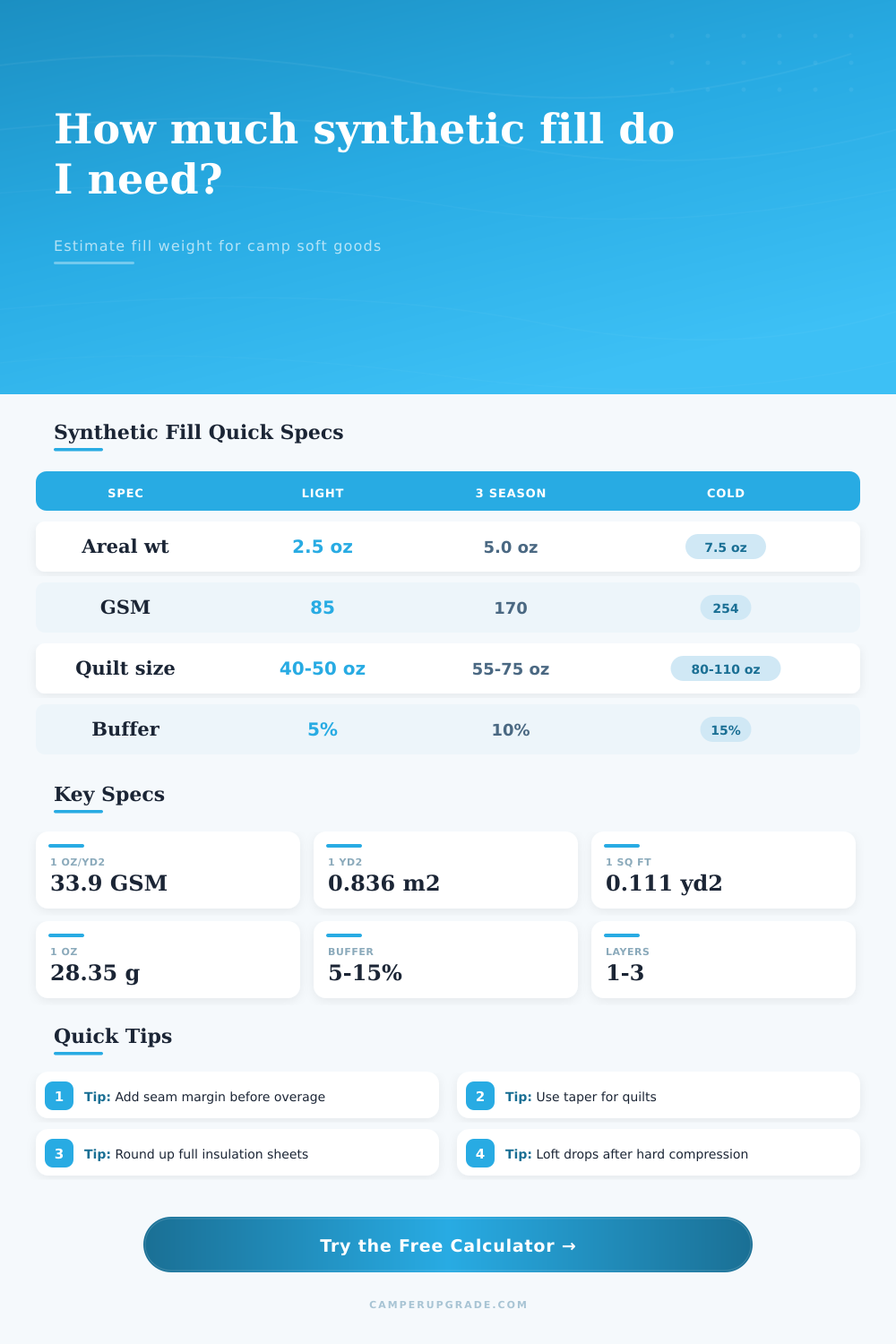
| Climashield APEX 2.5 | 2.50 | 85 | Summer quilts, pillow wraps, mild van bedding |
| Climashield APEX 3.6 | 3.60 | 122 | Cooler throws, dog beds, shoulder-season liners |
| Climashield APEX 5.0 | 5.00 | 170 | Three-season quilts and sleeping-bag panels |
| Climashield APEX 7.5 | 7.50 | 254 | Cold-weather synthetic camper quilts |
| Shape | Area formula | Best use | What to measure |
|---|---|---|---|
| Rectangle panel | Length × width | Comforters, toppers, bench inserts | Finished length and finished width |
| Tapered quilt | Length × (top + foot) / 2 | Backpacking quilts, footbox blankets | Length, shoulder width, foot width |
| Mummy shell | Length × average shoulder, hip, foot width | Sleeping bag refill planning | Length, shoulder, hip, and foot widths |
| Round cushion | 3.1416 × radius² | Dinette cushions and round bolsters | Finished diameter of one face |
| Custom area | Direct area entry | Patterned panels or CAD layouts | Total finished square footage or square meters |
| Cut planning item | Imperial conversion | Metric conversion | Calculator use |
|---|---|---|---|
| Area | 1 sq yd = 9 sq ft | 1 sq yd = 0.836 m² | Converts finished area into insulation yardage |
| Areal weight | 1 oz/yd² | 33.906 GSM | Compares APEX and metric batting specs |
| Mass | 1 oz = 28.3495 g | 1000 g = 1 kg | Shows fill weight in ounces, grams, and kilograms |
| Seam allowance | Applied to cut area | Applied before weight | Accounts for binding, curves, and trimming |
| Overage buffer | Applied to final fill | Applied after seam area | Rounds up for mistakes and panel matching |
| Common camp project | Finished size | Area | Approx fill at 5 oz/yd² |
|---|---|---|---|
| Solo tapered quilt | 78 in x 54/42 in | 26.0 sq ft | 15.9 oz with 10% buffer |
| RV bunk comforter insert | 80 in x 58 in | 32.2 sq ft | 20.2 oz with 10% buffer |
| Truck bed blanket insert | 72 in x 60 in | 30.0 sq ft | 18.3 oz with 10% buffer |
| Teardrop mattress topper | 75 in x 46 in | 24.0 sq ft | 14.7 oz with 10% buffer |
| Pair of camp pillows | 20 in x 12 in x 2 | 3.3 sq ft | 2.0 oz with 10% buffer |
💡Calculation Tips
So this wasn’t an issue of materials quality or sewing. Rather, it was failing to factor in cut vs. It failed to factor in the finished area plus trim waste on curved edges. That is easy to fix and you can prevent making that same mistake if you learn about insulation weight as it applies to real-world warmth.
Insulation comes in different areal weights (the amount of something per unit of area), typically listed as ounce per square yard or gram per square meter. For example, a light summer bag may be 2.5 ounces per square yard while a cold weather setup might need 7.5 ounces or more. You enter the dimensions and the calculator do the math. It then uses your physical space to determine the required weight and material specification.
How to Calculate Insulation Weight
Sheet insulation comes in various specs, all different areal weights, and you can’t buy by volume, only by area. So if you don’t take seam allowances into account, you will come up short. Seam allowance is where many first timers gets tripped up. You must add more margin for sewing (and binding) when you cut out pieces of fabric. The tool applies that % to your raw area and calculates the total weight from there.
Your panels won’t quite fit, making the outer parts thin (which then leaks heat). This is what happens when you measure only the inside of your shell, buy exactly that amount, and then wonder why it doesn’t feel right. Also wise: leave a little extra for error and trim. Curvy shapes are harder to cut and result in more waste different than a simple rectangle. You can adjust this overage from zero to twenty percent based on how sure you are of your cutting abilities.
Projects aren’t always flat rectangles. Sleeping bags feature complex shell shapes that wrap over several surfaces. Quilts taper down on the foot end to save weight. To take this into account, the coverage multiplier take geometry into account. A simple topper use one layer. But when we’re talking about a full sleeping bag with insulation split between its top and bottom shells, it may need nearly double the area.
Then there’s the question of how many layers of insulation to stack up. Each adds to the warmth but also significantly increases packed volume. Packed Volume: Synthetic fill does compress well, but only at first. Stacking three bags will use that compressibility less. It calculates how much it expects your bag to compress and then computes what your packed volume will be. From there, you can determine if that added insulation was realy necessary.
The cost and weight of your synthetic bag depend on the material used. Popular materials like Climashield APEX or PrimaLoft has varying thermal efficiency but are around the same weight. Higher GSM rating = warmer and fluffier (more loft), but also bulkier when they’re stuffed into a pack. The weight reference tables in the calculator demonstrate typical use cases for each spec. This allows you to match material with seasons, such as a 60 GSM liner being nice for milder nights or 254 GSM for some serious cold.
In short, it’s about being precise. If you measure your pattern well and let the calculator do its thing, you’ll end up purchasing just enough fill. No wasted money buying more than necessary but also no disappointment if it isn’t quite warm enough. It will eliminate the guessing and replace it with a plan. You should of lay that insulation out next time and don’t hope it works. Know precisely what you need, down to the ounce.