Patio Umbrella Canopy Size Calculator
Estimate the canopy span, useful shade area, and overhang reserve for dining tables, lounge zones, balconies, pool decks, and offset patio layouts.
Recommended Canopy Results
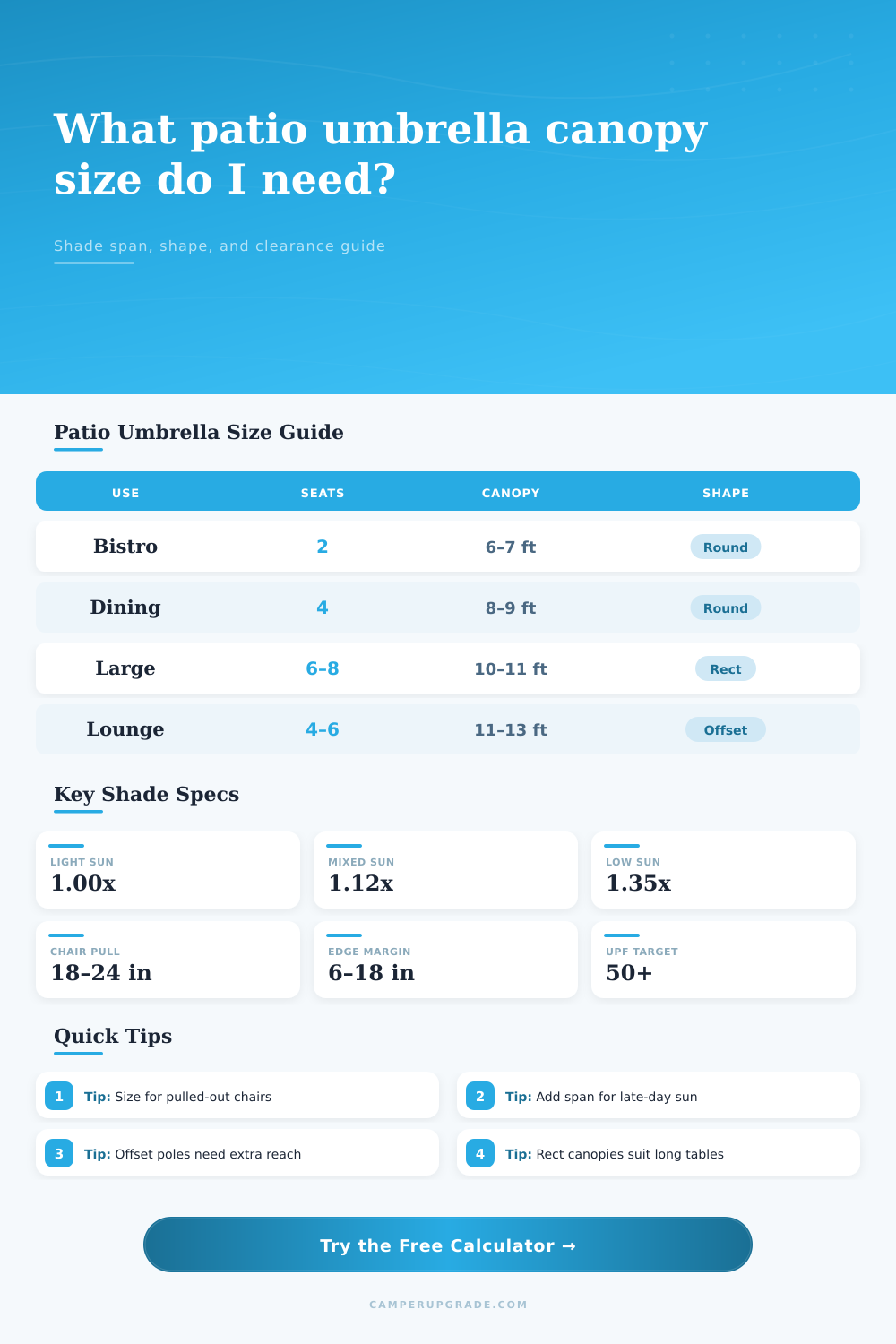
| Patio layout | Typical footprint | Minimum canopy | Best canopy shape |
|---|---|---|---|
| Small bistro table | 24 to 30 in round table with 2 chairs | 6 to 7 ft diameter | Round or square |
| Four seat dining | 42 to 48 in round or square table | 8 to 9 ft diameter or side | Round or square |
| Six seat dining | 72 x 40 in rectangular table | 10 x 7 ft to 11 x 8 ft | Rectangular |
| Lounge sectional | 8 x 8 ft corner seating zone | 11 to 13 ft span | Square or cantilever round |
| Pool chaise pair | 7 x 7 ft recliner zone | 10 to 11 ft diameter | Round, square, or offset |
| Canopy shape | Area formula | When it fits best | Sizing note |
|---|---|---|---|
| Round | 3.1416 x radius squared | Round tables, square seating zones | Use target diagonal for rectangles. |
| Square | side x side | Square patios and sectional corners | Use the larger protected side. |
| Rectangular | long span x short span | Long dining tables and counters | Match the long axis to the table. |
| Cantilever round | same as round canopy | Offset seating without center pole | Add center offset to required span. |
| Sun profile | Multiplier used | Typical patio condition | Calculator effect |
|---|---|---|---|
| Mostly overhead sun | 1.00x | Midday shade or already protected side yard | No extra span beyond clearance. |
| Mixed midday and afternoon | 1.12x | Open patio with several bright hours | Adds modest long-side reserve. |
| Frequent angled afternoon sun | 1.22x | South or west exposure in warm months | Increases span and reserve area. |
| Low sun or west-facing patio | 1.35x | Late-day seating or open campsite | Requires the largest canopy allowance. |
| Canopy span | Round canopy area | Square canopy area | Typical protected use |
|---|---|---|---|
| 6 ft | 28.3 sq ft | 36 sq ft | Small bistro or reading chair |
| 8 ft | 50.3 sq ft | 64 sq ft | Two to four seat table |
| 9 ft | 63.6 sq ft | 81 sq ft | Four seat dining zone |
| 10 ft | 78.5 sq ft | 100 sq ft | Large dining or lounge pair |
| 11 ft | 95.0 sq ft | 121 sq ft | Six seat table or sectional area |
| 13 ft | 132.7 sq ft | 169 sq ft | Offset lounge or hot tub deck |
Why Did You Buy an Umbrella? If you bought an umbrella for your patio, chances are, you did so because it looked good online. The pole seemed solid and the fabric looked good. So you carried it out, set it up over your dining table… and realized something was wrong. All the chairs was sitting in the sun, and the shade itself was overhead at the table center. What happened?
Most people make this mistake: they use diameter as their only measuring stick. They spot a number, like “eight feet”, and they think that means the umbrella will cast shade over an eight foot by eight foot area. Wrong. A patio umbrella isn’t a piece of furnitures; it’s a geometry issue. The calculator do the math for you. It also shows you what inputs are important and why.
How to Measure Your Patio Space Correctly
Begin with footprint. How do you calculate it? Most everyone measures just the table, that’s not how it works. You must measure whole zone. People move when they pull their chairs back and they also move when they get up to go inside. Unless that space is covered, the umbrella doesn’t serve its purpose. To include human component, the tool separates out edge margin from chair clearance. For comfort add eighteen inches to the table diameter. Add more space to create a visual gap where shade meets the deck.
Sun profile is another key variable. If your patio’s exposure is west-facing, what shades well at midday will be no good by four o’clock. The calculator account for such changes through a sun profile multiplier. In winter on northern latitudes, and even in late summer afternoons in many places, the sun hits from low angles. That means it requires a wider umbrella span different than high overhead, say, at midday. A multiplier of 1.35 for low sun expresses the geometry truthfully. Light coming from below throw longer shadows; you have to account for that with added fabric width. Otherwise you get an umbrella that works for two hours a day.
Umbrella size depend on perceived coverage, which is affected by fabric selection. Thicker marine acrylics block more UV rays then typical woven polyester fabrics. The calculator accounts for this by adjusting the necessary umbrella span based off fabric opacity. If you want the same level of UV protection from an umbrella, then a bigger one will be needed if you select a lighter (and less costly) fabric. It’s a cost/size trade-off. Go big with the standard stuff or small with the pricey stuff. Either way, you’ll get about the same amount of comfort. It just looks different and costs differenty.
But it’s also important to think about how your furniture fit beneath an umbrella. For instance, a round umbrella works best over a round table. A long canopy that runs along the length of a rectangular set of dining chair works better than a round one. An offset arm umbrella or square canopy might make more sense if you’re using a sectional sofa in a corner rather than trying to force a round one there. The reference table on the page will pair the right shape with the furniture layout to avoid awkward placements such as having people sitting on exposed concrete when the shade falls across the pool.
Another element is pole position. Umbrella tables with a hole in the middle (center-hole) are easy, though limiting; it takes up space (cluttering your view), and removes a seating option. Offsets/cantilevers leave the center free but bring their own dynamics, where does the pole go? How long an arm do you need? How much overhang does the canopy provide?
In windier environments, larger canopies behaves as sails. Thirteen feet calls for a hefty base, or really strong wall mounting. Don’t sacrifice stability for increased coverage. You should of considered the weight.
The way I see it, the purchase of an umbrella is about more than color, it’s also a matter of geometry and light. It’s about understanding how people move around in the area where the table sits. Not simply the dimensions of the table itself. It’s about how sunlight travels throughout the day. And it’s about selecting a shape that works with your furnitures arrangement. Get those three things right, and you’ll have a shade that’s essential to the structure, not merely an accessory.