Bunting Length Calculator
Plan campsite bunting, pennant garlands, awning flags, and canopy lines with allowance for sag, end ties, corners, seams, spacing, and fabric yield.
Full Breakdown
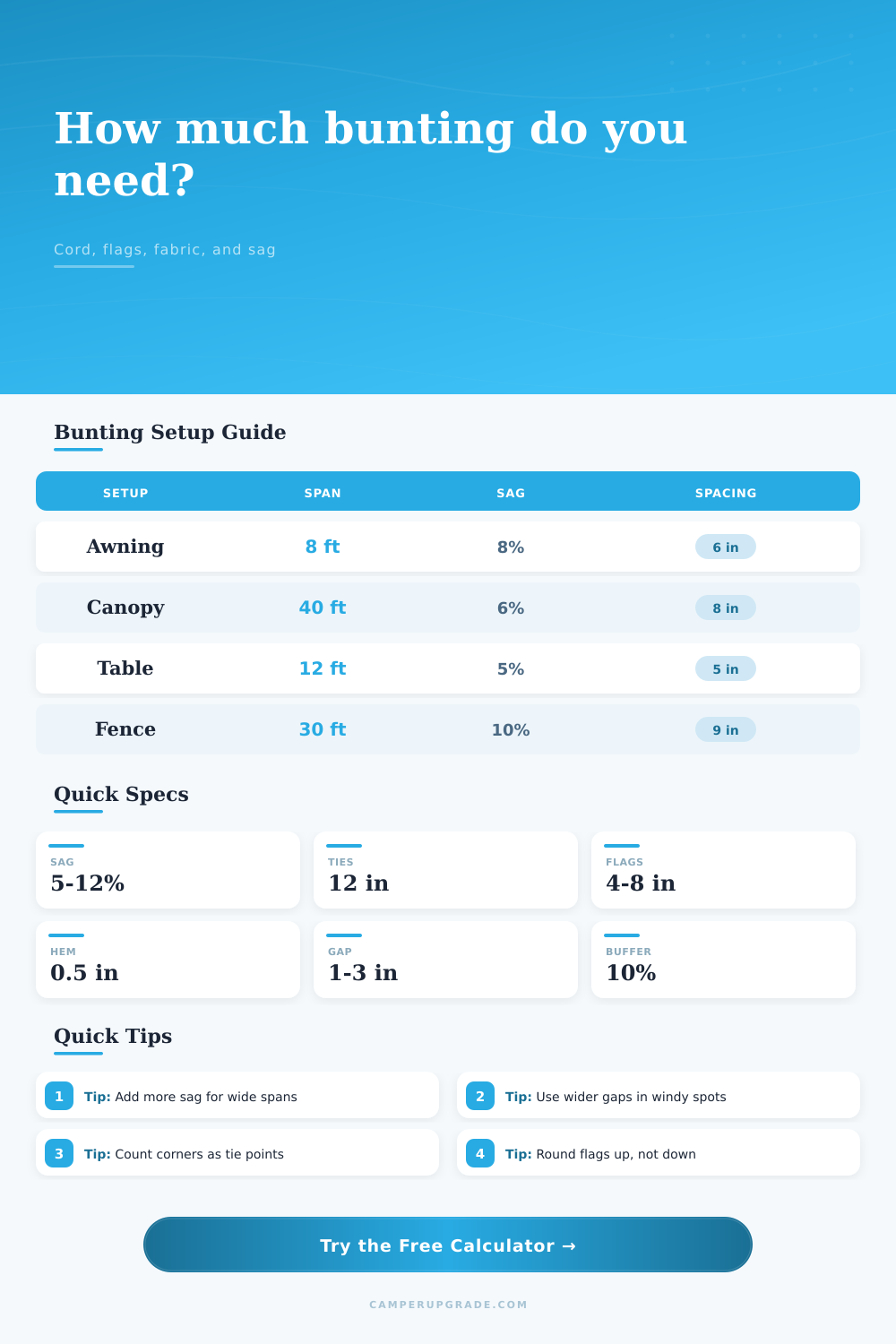
| Camping setup | Typical span | Suggested sag | Good flag pitch |
|---|---|---|---|
| RV awning front | 8–21 ft | 6–10% | 6 in flag + 2 in gap |
| 10x10 canopy perimeter | 40 ft total | 4–8% | 6 in flag + 2 in gap |
| Picnic table rail | 6–12 ft | 3–6% | 4 in flag + 1 in gap |
| Camp kitchen rope | 10–18 ft | 6–12% | 5 in flag + 2 in gap |
| Group shelter entrance | 18–30 ft | 8–14% | 8 in flag + 3 in gap |
| Pennant style | Fabric area formula | Best use | Cutting note |
|---|---|---|---|
| Triangle pennant | width × height / 2 | Classic campsite bunting | Nests efficiently in alternating rows |
| Swallowtail flag | width × height × 0.85 | Sporty RV or rally line | Extra notch cuts increase waste |
| Rectangle flag | width × height | Readable labels or numbers | Simple grain alignment |
| Half-circle scallop | π × radius² / 2 | Soft table or camper trim | Needs careful curve cutting |
| Flag width | 2 in gap | Flags per 10 ft | Look on campsite |
|---|---|---|---|
| 4 in | 6 in pitch | 20 flags | Dense, playful trim |
| 5 in | 7 in pitch | 18 flags | Compact awning line |
| 6 in | 8 in pitch | 15 flags | Balanced standard bunting |
| 8 in | 10 in pitch | 12 flags | Bold canopy edge |
| 10 in | 12 in pitch | 10 flags | Large shelter marker |
| Project size | Visible span | Cut cord at 8% sag | 6 in flags, 2 in gap |
|---|---|---|---|
| Small trailer window | 5 ft | 7.4 ft with ties | 8 flags |
| Picnic table front | 8 ft | 10.6 ft with ties | 12 flags |
| RV awning front | 16 ft | 19.3 ft with ties | 24 flags |
| Canopy one side | 10 ft | 12.8 ft with ties | 15 flags |
| Canopy full wrap | 40 ft | 51.2 ft with four runs | 60 flags |
Allowing for drape in the line transforms nylon shelters into intentional campsites. But how do you make it look right? Frustration arises if flags is bunching and sagging. Most campers simply measure from pole to pole, which makes a tight line appear stiff. To give good bunting some room to breathe, take drape into consideration before laying any fabric down.
After selecting your style and span, the calculator do the math for you. Depending on the level of relaxation you want (a suggested sag allowance of five to twelve percent), it will add the right amount for that sag allowance. This matters because too little sag makes your line taut (clothesline effect), while too much make it unstable.
How to Plan Your Bunting
Your selected pennant width and gap spacing is included in calculations. Choose your drop height and shape of flags, the system calculates number of pieces to cut. The main hang-up for everyone is selecting appropriate gaps. For very close views (such as at a picnic table) a two-inch gap is fine. In tighter spots, make the gaps smaller, but keep the pattern thick enough so there are no obvious empty areas between them. But when used on a forty-foot canopy, that same spacing seem cluttered from a distance. The table below is a guideline for matching flag widths to gap width for balance.
Close gaps will blur all the flags together into a solid band of color. In reality, however, nothing can change like the wind. What seems ideal on paper could of been a bust when you rig-up beside the lake. To account for this, the calculator features an adjustable wind exposure which increase the flag spacing. This simple tweak eliminates fluttering sound while maintaining visibility during a breeze.
Other considerations include knots and end ties. Giving yourself 12 inches or so of cord at each end will give you a little leeway in case you find yourself fumbling around in the dark with some difficult nylon. The other thing that bites newbies is the variable of fabric yield. A bolt of material has triangle corners that is wasted space. Depending on how wide your fabric is and what your seam allowance is, the tool calculates how much extra there will be in triangles. Also, it depends on whether the fabric pattern is directional. If you can turn the fabric to make the best use of the print, you may need more or less.
After you get your number, try cutting out one practice flag. Does the fabric have the right weight and drape? Does it hang well enough with your setup? With bunting, its pretty forgiving, so getting it laid out properly from the start saves time.
When camping, not only does good decor help style your space, but it also sets the mood. This line looks like part of the scenery, not clutter, yet it’s colorful. And because I took the time to carefully measure, plan, and make sure it fell naturaly with the fabric…it says something: You put some thought into this place, even if it’s a pile of dirt beneath a tree. Each time you pull in to your campsite it’s pulled together and looks great. That up-front work always pays off.