Tunnel Tent Pitch Length Calculator
Estimate the full peg-to-peg pitch length, side clearance, ground area, and diagonal site span for tunnel tents with vestibules and guyline runs.
Pitch space result
| Pitch mode | Length multiplier | Width multiplier | Best use |
|---|---|---|---|
| Tight pitch | 0.85x guy reach | 0.85x side reach | Small marked pad with mild weather |
| Calm site | 0.95x guy reach | 0.95x side reach | Sheltered campsite or tree cover |
| Standard pitch | 1.00x guy reach | 1.00x side reach | Normal touring and weekend camping |
| Storm pitch | 1.25x guy reach | 1.20x side reach | Exposed sites and stronger pegging angle |
| Tent class | Typical fly length | Typical fly width | Pitch length with guys |
|---|---|---|---|
| 2-person backpacking tunnel | 7.2-8.5 ft | 4.3-5.0 ft | 15-18 ft |
| 3-person GT vestibule tunnel | 12.5-15.0 ft | 5.2-6.0 ft | 20-24 ft |
| 4-person family tunnel | 14.0-17.0 ft | 8.0-10.5 ft | 23-28 ft |
| 5-6 person air tunnel | 20.0-24.5 ft | 11.0-13.5 ft | 30-36 ft |
| 7-8 person large tunnel | 25.0-30.0 ft | 13.0-16.0 ft | 36-44 ft |
| Guyline angle | Approx. reach | Pitch effect | Notes |
|---|---|---|---|
| 25° | Long and low | Needs most ground | Good holding power on exposed ground |
| 35° | Balanced | Standard calculator default | Common compromise for tunnel tents |
| 45° | Shorter reach | Useful on tighter pads | Can load pegs more vertically |
| 55° | Very compact | Minimum site footprint | Use only when conditions are calm |
| Preset | Sleeping plus vestibules | Guyline setting | Estimated full pitch |
|---|---|---|---|
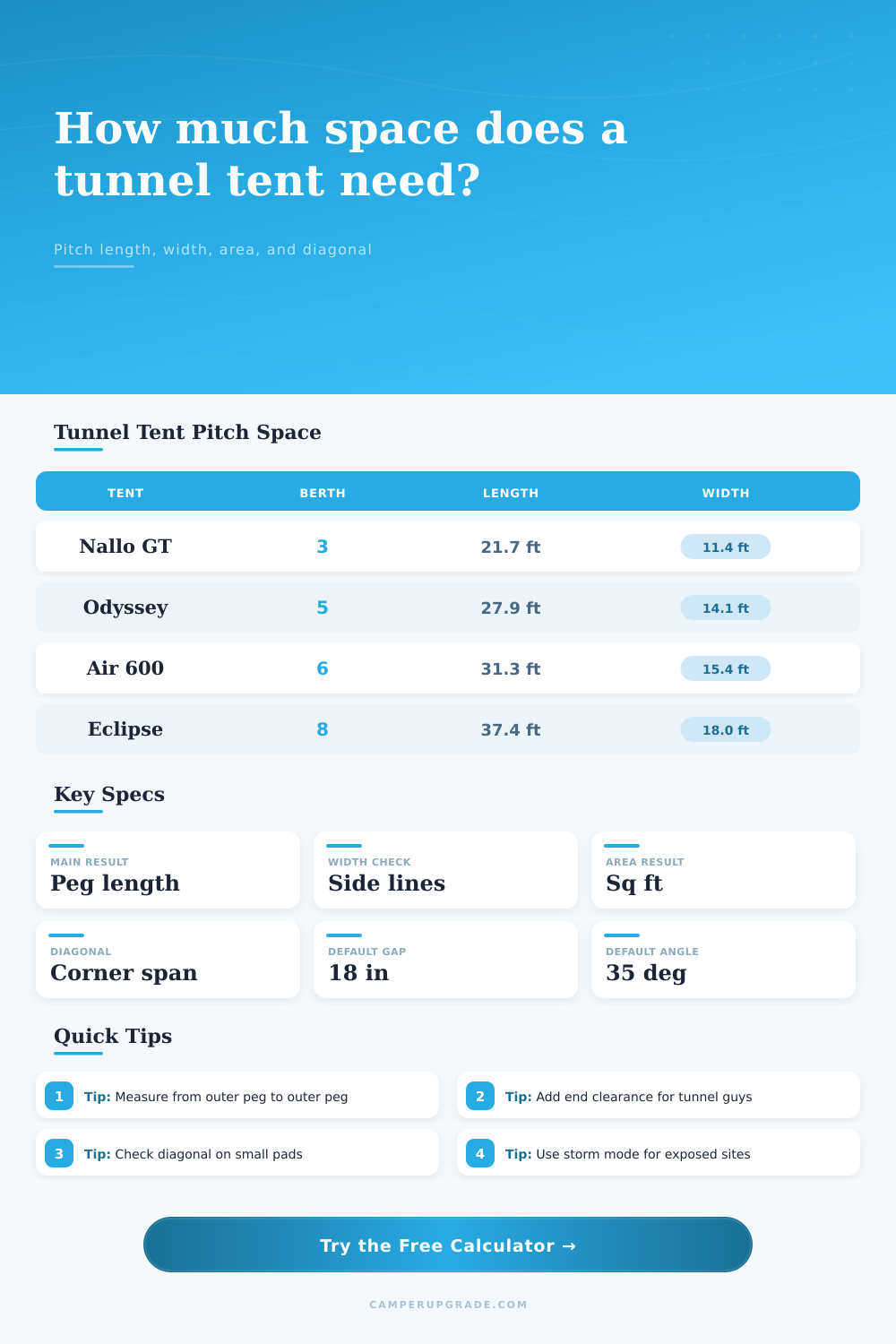
| Hilleberg Nallo 3 GT | About 15.0 ft shell length | Standard mountain tunnel | About 22 ft by 11 ft |
| Hilleberg Keron 4 GT | About 17.3 ft shell length | Long expedition vestibule | About 25 ft by 12 ft |
| Vango Odyssey 500 | About 21.0 ft shell length | Family campsite spacing | About 28 ft by 14 ft |
| Vango Air 600XL | About 24.0 ft shell length | Large airbeam tunnel | About 31 ft by 15 ft |
| Kampa Brean 8 Air | About 29.0 ft shell length | Large group tunnel pitch | About 37 ft by 18 ft |
When it comes to tunnel tents, size do matter. But not just the floor size. Because they’re designed to rise above the ground in a graceful way, they takes up far more space than their floor numbers indicate. The number of guys and their distances from the shell, plus footprint of the shell itself, all play into how much space is needed.
When you think about the space for your sleeping pad, you seldom factor in extra room for the tent to function well. Measure by foot print and you’ll probably be wrestling with your back lines while trying to avoid tangling them on your buddy’s bumper out back; or worse yet, having your front pegs dangle unsteadily over the edge.
Why Tent Size Matters More Than You Think
Once you enter your desired guy line lengths and shell dimensions into the calculator, it take care of the rest of the math, no need to do trigonometry in your head while swatting mosquitos at dusk. The other thing: A tunnel tent isn’t a box, it’s a series of hoops kept in line with exterior lines. To maintain those hoops’ roundness, you must stretch your pegs far past fabric boundary.
And don’t forget: The end guys adds a lot of length to the overall pitch. Often, three or four feet of space at each end is needed to achieve proper tension with a typical setup. Vestibules further increase the overall size. While adding usable area. When fully out, what was once a tight, two-person tent becomes a twenty-foot one before you know it. That’s where a lot of folks overlook the detail… And then attempt to stuff a ten-foot footprint through an eight-foot opening.
The pitch mode changes your footprint based off requirements. For example, if you’re pitching it in a protected valley with gentle breeze, you can tighten those lines and minimize the area. Using the tool, you’ll choose the tight option to reduce the amount of guyline needed. But if you’re out on some exposed ridge with continuous wind, then you’ll want to set it up as a storm pitch.
In high winds, steeper guyline angles creates better stability; so this mode will increase both the width and length factors. A good compromise is about a 35 degree angle. That’s what creates evenly distributed tension in both directions. The closer to vertical, the less reach, but that’s a risky efficiency if weather rolls in.
Side guys: They’re deceiving too. The sides stretches out under pressure and the tent fabric puffs out. Without factoring in side line widths, you could end up invading a fire pit or walkway. Notice that the vestibule size increase the overall footprint. That’s why a tunnel tent looks spacious from one end, but it can span almost sixteen feet across if fully staked out.
Be sure to measure diagonally as well (most campsites aren’t perfect rectangles). Your tent may fit lengthwise, but corner trees or utility pads may prevent a full-length pitch. Diagonal measurements helps determine whether there’s space to square-up the pitch.
How fast can you set up and how much does the material weigh? These questions go a long way toward deciding what tent you get. But whether or not it works out at camp depends entirely on space. And figuring out how a tent fits into a pack can be tricky. Outer peg to outer peg, that’s the only true measurement for how it’ll fit.
This happens until you’re standing there in the pouring rain trying to figure out why the back two pegs keep slipping into a ditch and you don’t have enough room to back up. You should of checked this earlier. If you run your exact model through an estimator prior to heading out, you stop guessing and eliminate hoping it will work. Instead you know it will.
Those extra few feet you measured ahead of time are normaly what decide if you have a stressful time moving gear around or a nice, relaxing night camping. You’ll recieve better results with the tool.