Sledge Pull Force on Snow Calculator
Estimate rope tension, breakaway force, grade load, and hauling power for pulks, rescue sledges, ice-fishing sleds, and winter camping loads.
🛷Real sledge presets
📏Sledge and snow inputs
Sledge pull results
🧱Runner material/spec grid
❄Snow friction reference table
| Snow condition | Planning coefficient | What it means | Force on 100 lb flat load |
|---|---|---|---|
| Glazed ice or hard lake ice | 0.04 to 0.07 | Hard support, little plowing, fastest glide | 4 to 7 lb before runner factor |
| Packed cold trail | 0.06 to 0.10 | Firm snowmobile, ski, or boot-packed track | 6 to 10 lb before runner factor |
| Wind crust | 0.09 to 0.14 | Crust supports the sled but edges can saw through | 9 to 14 lb before runner factor |
| Dry powder track | 0.12 to 0.20 | Loose snow adds bow wave and side drag | 12 to 20 lb before runner factor |
| Fresh loose snow | 0.18 to 0.28 | Sled is breaking trail and compacting snow | 18 to 28 lb before runner factor |
| Wet spring snow | 0.22 to 0.35 | Suction, water film, and heavy deformation | 22 to 35 lb before runner factor |
| Slush or deep plowing | 0.35 to 0.55 | Bottom drags while front pushes snow aside | 35 to 55 lb before runner factor |
📊Slope and pull-angle table
| Trail geometry | Approx angle | Added uphill force | Pulling note |
|---|---|---|---|
| 0% grade, flat lake | 0° | 0 lb per 100 lb load | Friction dominates; glide upgrades matter most |
| 5% grade, gentle climb | 2.9° | 5 lb per 100 lb load | Noticeable over long approaches |
| 10% grade, steady hill | 5.7° | 10 lb per 100 lb load | Often doubles packed-trail pull force |
| 15% grade, steep forest road | 8.5° | 15 lb per 100 lb load | Use shorter stages or team hauling |
| 25% grade, hard pitch | 14.0° | 24 lb per 100 lb load | Traction and switchbacks become limiting |
| 20° rope angle | 20° | Reduces normal force | Helpful, but too high lifts instead of pulls |
🔧Runner material adjustment table
| Runner or bottom | Coefficient factor | Best snow fit | Practical limitation |
|---|---|---|---|
| UHMW-PE runner strip | 0.80x | Cold packed trail, crust, expedition pulk tracks | Needs clean alignment and enough runner width |
| Waxed HDPE sled bottom | 0.90x | Mixed trail use and recreational hauling | Wax can wear off in abrasive crust |
| Standard plastic sled | 1.00x | General winter camping and ice-fishing loads | Wide tubs plow more in deep loose snow |
| Waxed wood runners | 1.08x | Classic toboggan tracks and cold dry snow | Finish and temperature matter a lot |
| Bare wood toboggan | 1.18x | Short hauls when simplicity matters | Absorbs water and slows in wet snow |
| Aluminum runner | 1.25x | Durable utility hauling on firm snow | Can bind and scrape in gritty crust |
| Steel runner | 1.35x | Heavy utility sleds on hard packed surfaces | Heavy, cold, and draggy in soft snow |
| Soft inflatable base | 1.55x | Rescue or passenger comfort where speed is secondary | Large contact patch creates high drag |
📘Common sledge load table
| Sledge use | Typical total load | Common surface | Flat steady pull estimate |
|---|---|---|---|
| Day pulk with spare layers | 35 to 55 lb | Packed trail or firm crust | 3 to 8 lb with good runners |
| Weekend winter camping pulk | 70 to 100 lb | Mixed packed trail and powder | 8 to 22 lb depending on track |
| Expedition pulk | 110 to 180 lb | Dry snow, sastrugi, wind crust | 15 to 40 lb before steep grades |
| Ice fishing gear sled | 60 to 140 lb | Lake ice, crust, or wet access snow | 5 to 35 lb by surface condition |
| Child passenger sled | 45 to 90 lb | Packed park trail or groomed path | 4 to 14 lb with normal starts |
| Rescue toboggan | 180 to 260 lb | Packed rescue track or wet snow | 20 to 80 lb plus handlers on slopes |
💡Sledge pull tips
Pulling a sled sounds easy right? It’s not till you’re halfway up the trail with sore shoulders that you realize it might be harder then you thought. The runners was good and the gear was packed light. When you left the car, the snow was great. Now you feel like you are dragging wall of concrete.
Enter the magic number called friction coefficient. This number vary greatly based off slushy snow, ice crust or even dry powdery snow. Knowing how much you can expect to pull is important because guessing the wrong answer makes a nice hike a hard day of work. The pull calculator (above) do all the math for you after you input your snow condition and load weight. That way you don’t have to guess while out on the trail.
How to Make Pulling a Sled Easier
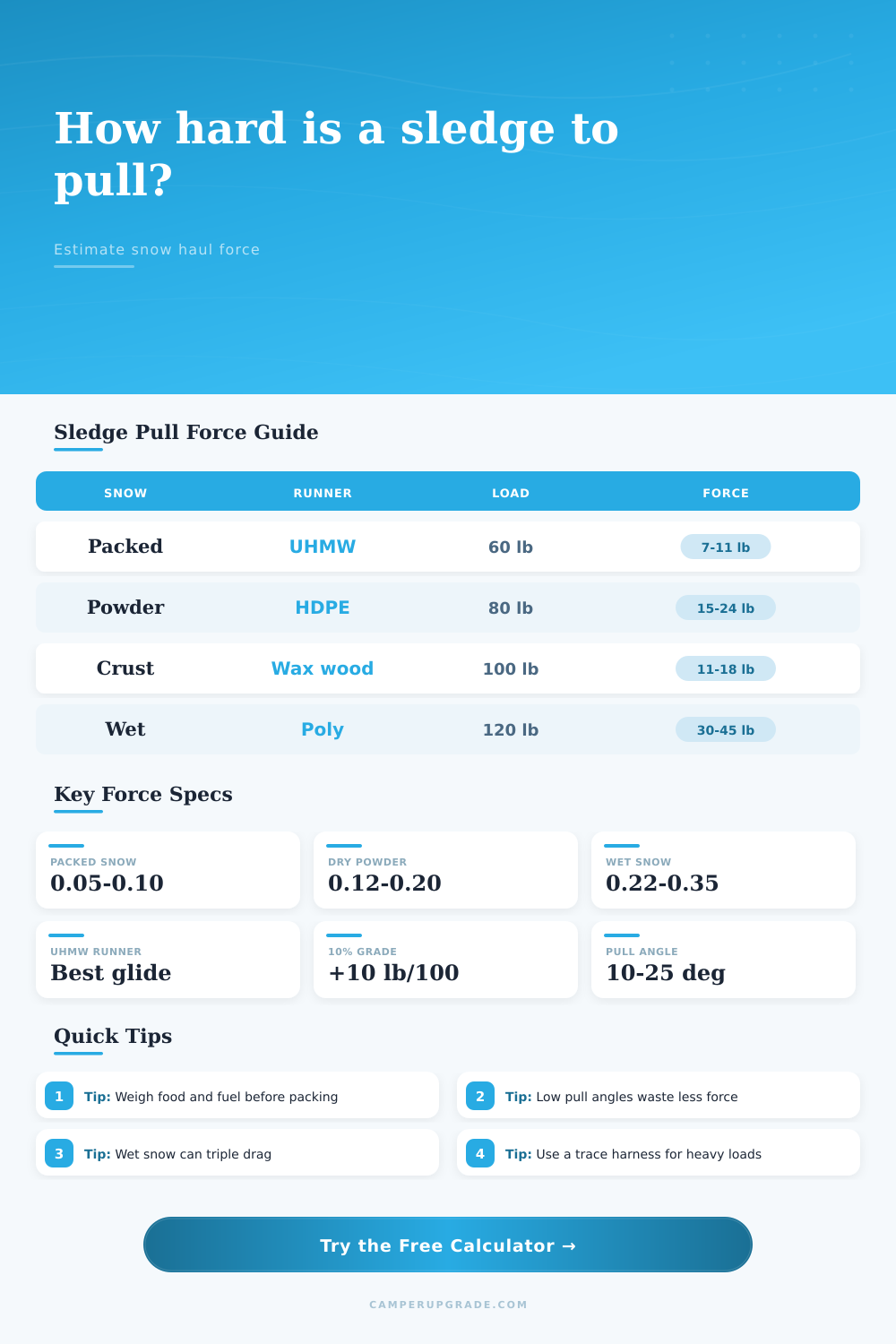
Everyone obsesses about weight. Yes, that’s important, but there are two factors: weight and resistance (friction). Weight matter, but it’s only half of the equation; the other half is resistance which depends on what surface you’re traveling over. For example, a hard-packed trail might have a resistance factor of 0.08, meaning your sled slide well. Go on new snow and it goes up to 0.15 or more. That’s right, you’ll be plowing instead of sliding through soft snow. Spring wet snow is even worse. Sometimes suction and water weight can triple the drag. What felt like sixty pounds in a pulk in deep snow will feel heavier than an eighty pound pulk on ice. If you’re interested in comparing different surfaces side-by-side, the reference table on the page explain this briefly.
A big part of that has to do with runner materials as well. Standard plastic tubs will work but have more friction than UHMW polyethylene strips which reduce friction significently compared to bare wood. Even using UHMW polyethylene strips make a huge difference versus bare wood. It’s not just that they’re slick, how much does it deform the snow? A wider, flatter bottom will sink and create drag. Narrow runners will cut under the crust and stay connected to the harder layer below. Carry a kid up this hill or haul some firewood and you’ll find the extra dollars you spend on better runners pays off in caloric savings.
Don’t think you’ve got to go buy expensive stuff to get started either. But stepping up from a toy sled into something made for good traction is a whole different ball game in terms of physics.
Another factor that surprises folks is that slope angle matter. After all, it doesn’t matter how in shape you are; gravity doesn’t discriminate. For every 100 lbs of pack weight, it’ll exert about 10 lbs of force on a 10% grade. That’s on a 10% grade. It doesn’t matter if your runners is slick as butter either. The steeper the incline, the more it limit the amount of weight you can carry and it follows a straight line. Lowering the angle of your pulls (and using better harnesses) reduces some of these effects but gravity stays the same. If you know a hill will stop you dead in your tracks before you even get over the top, you could of adjusted accordingly: either lighten up beforehand or pace yourself so you don’t hit the wall.
Contrary to what your gut tells you, pull angle is critical. The less your runners push into the snow, the lower the normal force pushing back up into them. Less normal force mean less friction. But don’t pull so vertically that you waste all your energy lifting the sled instead of pulling it along. Ten to twenty degrees is typically the sweet spot where you minimize drag while still making forward headway. A good trace harness will spread this load over your legs and hips (not just your arms) which minimizes strain. For brief trips, hand-pulling may suffice, but for prolonged hauling, you’ll need mechanical advantage.
So, there it is, winter hauling is all about a combination of gravity, friction, and weight. The snows moisture content and the mountain’s incline are two things you have no control over. But everything else can be optimized: the type of wax on your runners, how heavy your load are, the angle at which you pull them. Control these factors and you control the things we tend to overlook. Winter hauling isn’t just about getting your gear from point A to point B. It’s about doing so in a way that doesn’t completely exhaust you by the time you get to camp. Once you learn what causes the resistance, each step becomes a little easier.