Raft Lashing Float Capacity Calculator
Estimate how much load a lashed raft float set can carry after submergence limits, reserve freeboard, frame weight, safety factor, and lashing efficiency.
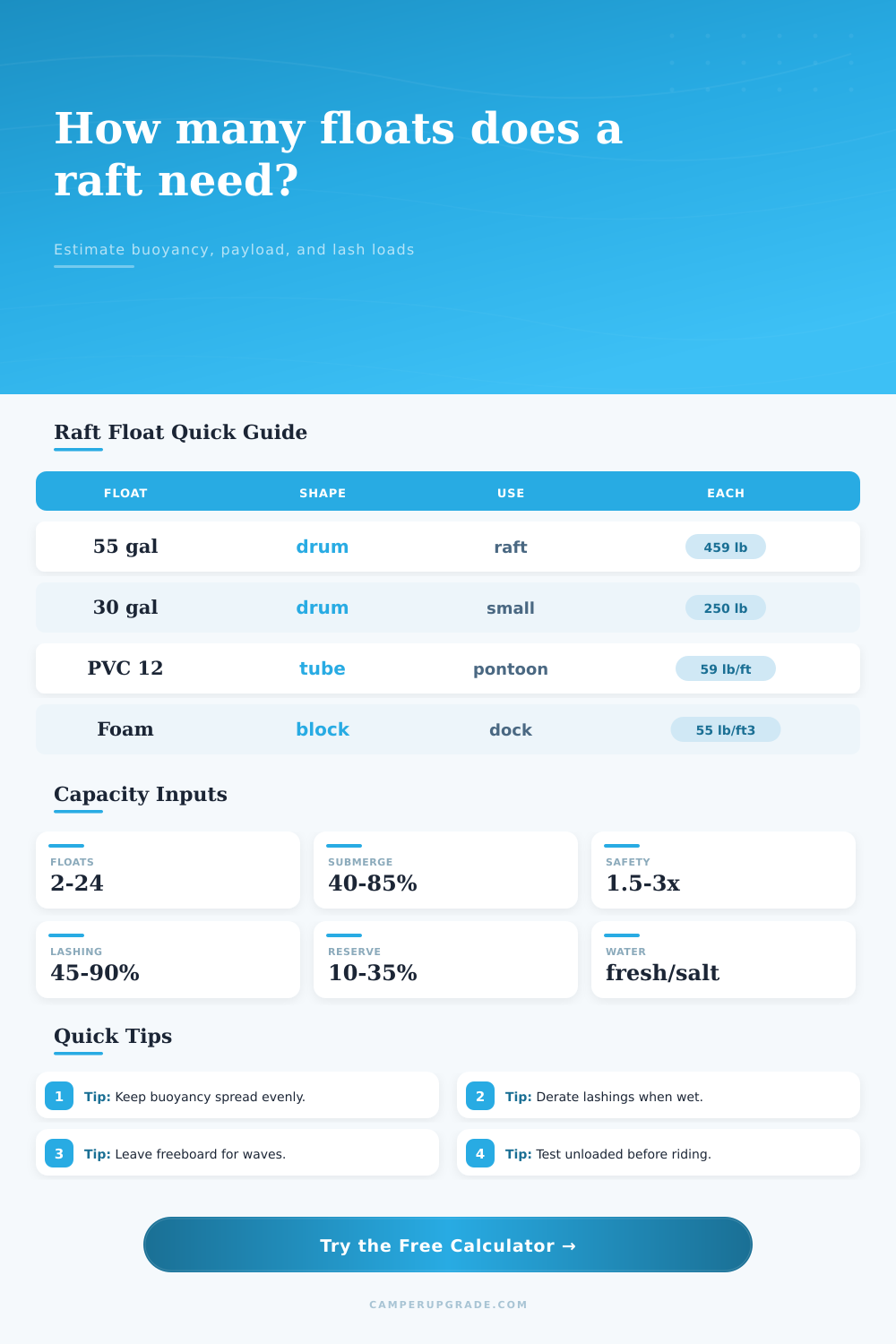
| Float type | Typical dimension or volume | Full fresh-water displacement | 65% submergence before reserve |
|---|---|---|---|
| 55 gallon drum | 55 gal sealed volume | 459 lb each | 298 lb each |
| 30 gallon barrel | 30 gal sealed volume | 250 lb each | 163 lb each |
| 5 gallon jug | 5 gal sealed volume | 41.7 lb each | 27.1 lb each |
| 2 liter bottle | 0.528 gal sealed volume | 4.4 lb each | 2.9 lb each |
| 8 in round tube | 0.349 ft3 per ft | 21.8 lb per ft | 14.2 lb per ft |
| 12 in round tube | 0.785 ft3 per ft | 49.0 lb per ft | 31.9 lb per ft |
| Target submergence | Remaining freeboard | Use case | Planning note |
|---|---|---|---|
| 40% | 60% | Light gear platform | Very conservative but needs more floats. |
| 55% | 45% | Calm-water swim raft | Good reserve when load moves around. |
| 65% | 35% | General camp raft | Balanced starting point for improvised floats. |
| 75% | 25% | Low cargo raft | Use only in calm water with even load spread. |
| 85% | 15% | Emergency test limit | Little wave margin; not recommended for people. |
| Lashing condition | Suggested efficiency | What changes it | Field check |
|---|---|---|---|
| New rated rope, smooth contact | 85% to 90% | Large bend radius, protected edges, dry rope | Wraps stay tight after bouncing the frame. |
| Good utility cord, careful knots | 70% to 80% | Normal knot strength loss and minor abrasion | No slipping when raft is rocked side to side. |
| Wet natural fiber or paracord | 55% to 70% | Stretch, water absorption, small diameter cord | Re-tension after the first water test. |
| Unknown rope or sharp contact | 45% to 55% | Wear, UV damage, crushed fibers, small bend radius | Replace or protect before carrying people. |
| Raft setup | Float count | Usable buoyancy at 65% | Practical planning note |
|---|---|---|---|
| Small barrel raft | 4 x 55 gal drums | about 1,194 lb before reserve | Subtract frame, reserve, and safety factor before people. |
| Family swim platform | 6 x 55 gal drums | about 1,791 lb before reserve | Better stability when drums are spread to the corners. |
| Jug teaching raft | 24 x 5 gal jugs | about 650 lb before reserve | Contain jugs so one loose cap does not cascade into failure. |
| Foam dock float | 4 x 2x4x1 ft blocks | about 1,298 lb before reserve | Protect foam from abrasion and fuel exposure. |
| Pipe pontoon pair | 2 x 12 in x 10 ft tubes | about 637 lb before reserve | Long pontoons trim well but need cross-bracing. |
Typically the aroma of a camp raft coming ashore is equal parts pine needles and wet rope. When physics weren’t right from the start, panic sets in quickly. There you stand in knee deep water staring at your carefully lashed raft as it violently lists to port due to oversight that a sealed 55- gallon drum doesn’t raise forty-sixty pounds of payload all by itself. No, sir. That’s what happens after it’s fully submerged…something you definitely don’t want your raft riding that low in the drink.
What separates your comfort level while floating on a raft from your boat taking on water is frequentally found under one roof: understanding how displacement actualy works in the real world vs. It is how it looks on a spreadsheet. It’s got good buoyancy. But it’s picky, too. For example: Push a 55-gallon plastic drum all the way under water and it’ll displace around four hundred fifty-nine pounds of fresh water. Sounds great until you realize it’s not just empty space inside. There’s the drum, and there’s also the frame that holds the drum together. On top of that, you’re going to want some freeboard.
How to Build a Safe Raft
If you fill your raft so full that all of floats are level with the water, any little bit of motion from waves or shifting passenger will cause water to go over edge. Subtract off the frame weight, then factor in how much you’d like to keep in reserve (for safety), and finally take into account the humans inside. Then think about getting in. Knowing about submergence percentages is useful for more than just learning something new.
Maybe they’ll say it can holds an eighty-five percent load submerged. But then that leaves fifteen percent out of the water. There is not a lot of room when it’s a calm day on lake, much less in windy chop or current on a river. Shooting for between sixty and seventy percent makes more sense; enough buffer to keep some air in the system and headroom on top of deck if somebody decides to splash you unexpectedly.
The site calculates all of this for you instantly. It uses your float size or number and counts them up to show what is left after accounting for safety reserves and the weight of the frame. This avoids the typical error of using gross displacement as net payload capacity. Another abstract variable is lashing efficiency.
When your raft begins flexing, you’ll see difference. Catalog rope strength ratings are calculated for straight pulls, in ideal conditions, without knots. In reality, your rope soaks up water and wraps around hard angles. It also ties into complex knot that cut its breaking strength to a small fraction of what it was. Don’t think it’s pessimistic to derate your lashing strength by thirty or even fifty percent. It’s realistic. Old paracord loses even more strength, and so do wet natural fibers.
Your chosen efficiency factor allows the tool to guesstimate how much load is being applied at each lashing point. That lets you know whether you can get away with a regular utility cord or have to upgrade to rated synthetic rope to ensure those drum stay attached while you’re moving along. The whole nature of build depends on what kind of float material you choose.
50 gallon plastic drums will displace a lot of water, but they are bulkier and hard to tie down well enough to keep them from sliding sideways. PVC pipe is sleeker and ties up easy into a rigid and tight platform, but takes much more length to get the same amount of lift. Foam blocks are great for staying put. They are indestructible and won’t even leak if they get punctured. However, they can be pricey and heavy to lug around at first. It’s all about trade offs: performance, cost, and convenience.
The reference tables below compare average displacements for commonly used materials such as 30 gallon barrels, 50 gallon drums, and several different diameters of PVC tubing. These are quick benchmarks to help you make sure that the materials you’re considering can actually hold weight you want them to before you invest hours in knot-tying. But there’s another reason for all those safety factors: they’re your insurance policy in the world of improvised engineering.
If you build the raft with a safety factor of 2, then you’ve designed the thing to carry double its intended load. That takes into account uneven loading (people, gear, cargo aren’t always evenly distributed), water absorbed into wood frames, or jolt of hitting the shore unexpectedly. It provides for the variability built into real world situations that no spreadsheet can anticipate.
Plug your numbers into the input boxes. As you adjust the safety factor upward, you’ll see safe payload decrease. It’s a sobering exercise that goes far to explain why so many DIY rafts seem cramped or unsafe at full capacity. We’re not looking for buoyancy alone here, we’re looking for reserves so that the raft floats reliably and predictably.
First test it without passengers in shallow water. How does it sit? Are any of the floats pulling out of alignment from tension? Once you have things dialed-in, eyeball the load. If something doesn’t feel right, heed your eyes, not the numbers on paper. Tweaking the balance or adding more floats is far simpler in shallower water than deep out in middle.
The bottom line is that the safest raft is one whose limits you know and never exceed, so you always have plenty of space on the deck between yourself and the water’s edge.