Antenna Gain Range Calculator
Estimate camper antenna range from frequency, transmit power, antenna gain, cable loss, receiver sensitivity, antenna height, terrain, foliage, and link margin.
Antenna Range Results
| Antenna type | Typical gain | Pattern behavior | Camper use |
|---|---|---|---|
| Rubber duck handheld | -2 to 1 dBi | Low gain, convenient, lossy near vehicle metal | GMRS, ham HT, scanner checks |
| Quarter-wave roof whip | 0 to 2.1 dBi | Broad omni pattern with good overhead coverage | CB, VHF, UHF, general mobile use |
| Mobile collinear whip | 3 to 6 dBi | Flatter omni pattern, more range toward horizon | GMRS, cellular, ham base camp |
| Panel antenna | 7 to 12 dBi | Directional front lobe, rejects rear clutter | Wi-Fi, cellular modem, campsite bridge |
| Yagi or log-periodic | 8 to 15 dBi | Narrow aim with stronger front-to-back ratio | TV, cellular, point-to-point radio |
| Dish or grid | 18 to 30 dBi | Very narrow beam, high wind load and aiming demand | Long Wi-Fi links, fixed camp relays |
| Feed line condition | VHF loss | UHF loss | Wi-Fi / cell note |
|---|---|---|---|
| Short premium coax, 10 ft | 0.2-0.5 dB | 0.4-0.9 dB | Usually preserves most antenna gain |
| Typical mobile coax, 15-20 ft | 0.6-1.2 dB | 1.2-2.5 dB | Good for roof racks and camper shells |
| Thin adapter-heavy run | 1.5-3 dB | 3-6 dB | Can erase a high-gain antenna advantage |
| Long mast drop, 40-60 ft | 1.5-4 dB | 4-10 dB | Use low-loss coax or move radio closer |
| Weathered or damaged coax | Unstable | Unstable | Moisture raises loss and noise floor |
| Band | Common frequency | Range character | Camper planning note |
|---|---|---|---|
| CB radio | 26-27 MHz | Ground-wave plus skip at times | Low antenna height and vehicle ground plane matter |
| VHF high band | 144-162 MHz | Good outdoor line-of-sight range | Works well from masts, ridges, and open water |
| UHF / GMRS | 420-470 MHz | Line-of-sight with building and tree loss | Height is critical for campground loops |
| Cellular low band | 600-850 MHz | Better foliage reach than higher bands | Useful for boosters in rural fringe areas |
| 2.4 GHz Wi-Fi | 2400 MHz | Moderate range, clutter sensitive | Directional panels help across campgrounds |
| 5 GHz Wi-Fi | 5150-5850 MHz | High loss but clean directional links | Best for clear point-to-point paths |
| Scenario | Gain setup | Likely range | Primary limiter |
|---|---|---|---|
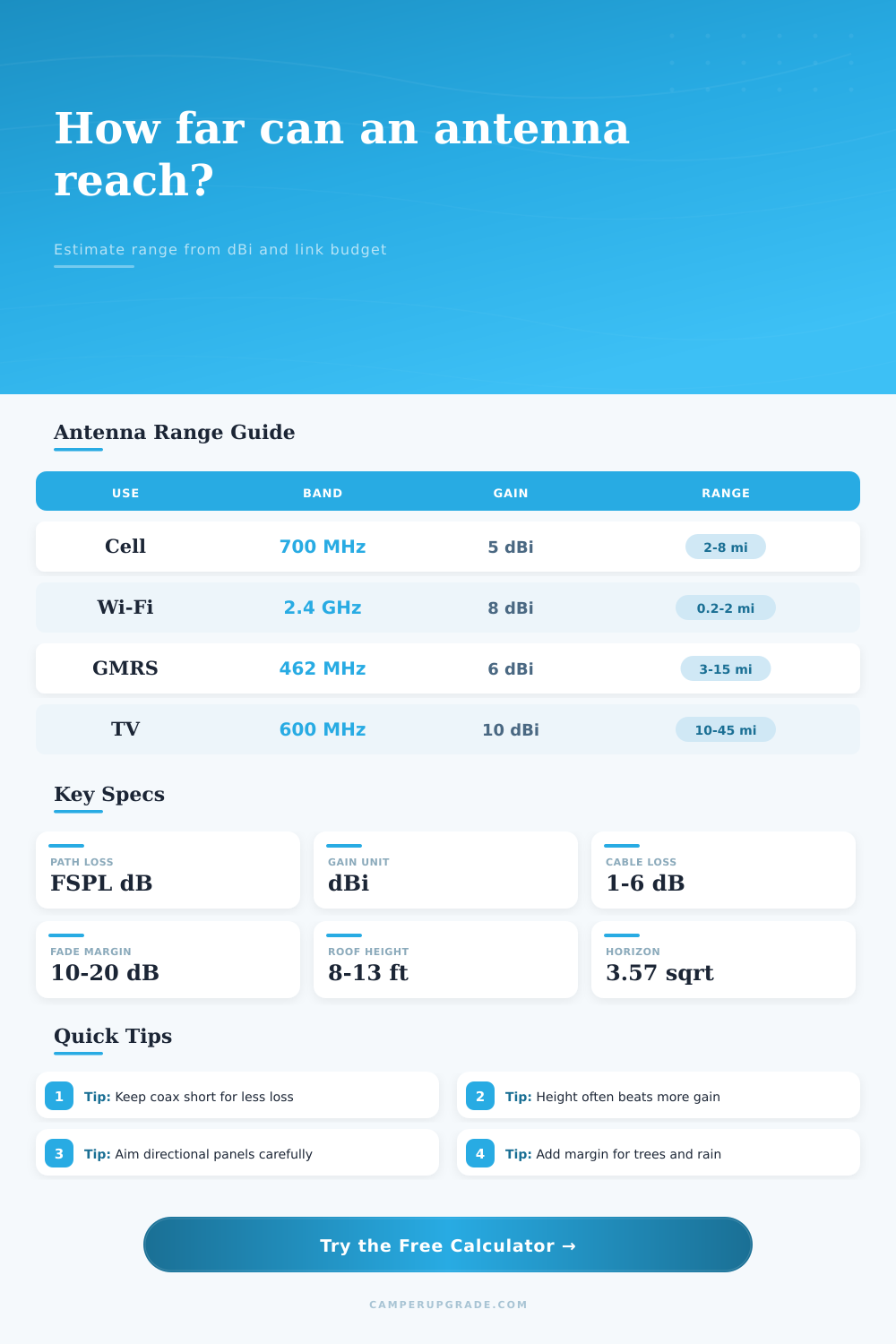
| GMRS vehicle to handheld | 6 dBi roof whip to rubber duck | 3-15 miles | Radio horizon and trees |
| Campground Wi-Fi bridge | 8 dBi panel to router antenna | 0.2-2 miles | Buildings, trees, aiming |
| Cell booster donor antenna | 5 dBi omni or 10 dBi directional | 2-12 miles | Tower band and terrain |
| RV TV yagi | 10-14 dBi directional | 10-45 miles | Terrain and transmitter height |
| LoRa campsite sensor | 2-5 dBi omni pair | 1-10 miles | Data rate and foliage |
Camping in the boonies? You have high hopes of watching dinner, but the signal dissapears when you drive around that last ridge line. Campers encounter this too often. Simply purchasing the biggest possible antenna isn’t enough to get range needed. Before calculating range to your roof, you need to know about invisible losses, terrain, and height; factors reducing the signal long before it hits your roof. That’s what the calculator above models: clear-air range and actual field performance. Avoid costly errors out on the trail by knowing what these figures mean.
Antennas is rated for their dBi (decibels relative to an isotropic radiator). The larger the number, the greater the gain; so on paper, a eight dBi antenna looks like it’s better than a two dBi whip. However, this added gain are usually coupled with a narrow beam width. To maximize performance, you have to point it directly at a faraway tower. If you’re parked in a wooded valley, directional antennas will has trouble locking in to those signals bouncing off several surface.
How to Get Better Cell Signal While Camping
Omni-directional whips pick up signal from every direction horizontally. So if you don’t really know where the cell tower is located, they’ll be forgiving about that. It’s up to you whether you’d rather have more coverage or raw power depending on how you typically park.
Cable loss is a silent killer of camper communications. For example, if you put a ten dBi yagi antenna on top of your fiberglass roof rack, you could run it down through some cheap coaxial cable into your modem inside. You might have 3 or 4 db loss along that forty-foot run of coax. Coax loses more signal at higher frequencies like cellular and Wi-Fi bands; lower frequencies like VHF or UHF go better. Often putting high-gain antennas onto lossy cables doesn’t work well, a modest antenna with shorter runs of low-loss wiring do better. The tool lets you separately specify how much signal gets lost on transmit vs recieve cables, which shows where most of your signal budget goes, down the cable or out into the airwaves.
When dealing with limited power, height is generally more effective than gain. On average a camper roof is around twelve feet high. That means most distant towers are below horizon for your antenna. To clear line of sight issues, clear any nearby obstructions like other RVs, heavy bushes, and vehicles. You can do this by mounting your unit in a high spot or using a mast. The calculator accounts for the radio horizon and assumes an estimate based off the antenna’s height to the remote station’s elevation. Often moving up a few feet makes more sense then increasing gain with +2dBi. You’re literally rising above the local clutter which eats high frequency energy.
Each link budget includes terrain profile complexity. Ideal conditions occur in an open desert, where the signal follows a direct line-of-sight over the longest distance possible. Urban RV parks or dense forest features high levels of attenuation by metal siding, water content in rain-soaked foliage, and leaves. To account for such conditions, the calculator provides derating factors that shows expected performance as opposed to ideal scenarios. You also have an option to specify a fade margin, which is how much extra you want. With a 15 dB fade margin, the link will still function even in the face of light rain or moderate interference.
And don’t forget about receiver sensitivity: Today’s LTE/5G modems are incredibly sensitive and can pull in tiny signal bits that an older radio would of dismissed as noise. When boosting a cellular link, how well your phone hears the tower is frequently more important than how loudly your donor antenna shouts back. The tool lets you specify this sensitivity limit precisely. This lets you avoid guessing a wide range based off general ideas so the settings match your actual equipment.
Anticipate the worst day, not the best: What is working in bright summery sunshine might be down in a drenching fall storm where wet leaves block the signal. Build a fade margin into your design to ensure that service actualy works when needed the most. Make conservative assumptions about foliage and terrain; then adjust upward as appropriate for your unique location’s odd openness. Mother Nature will always take a toll on the signal path, the math will show you what is possible without wasting money on equipment that can’t beat physics. Shorten those cables, lift those antennas high, and recognize that nature will always take its pound of flesh from the signal path.