Human Waste Volume Calculator
Estimate toilet waste volume, tank fill time, cassette trips, and reserve capacity for RV, camper van, tent camping, overlanding, and off-grid toilet setups.
Formula Breakdown
| Waste component | Planning range | Calculator default | Capacity note |
|---|---|---|---|
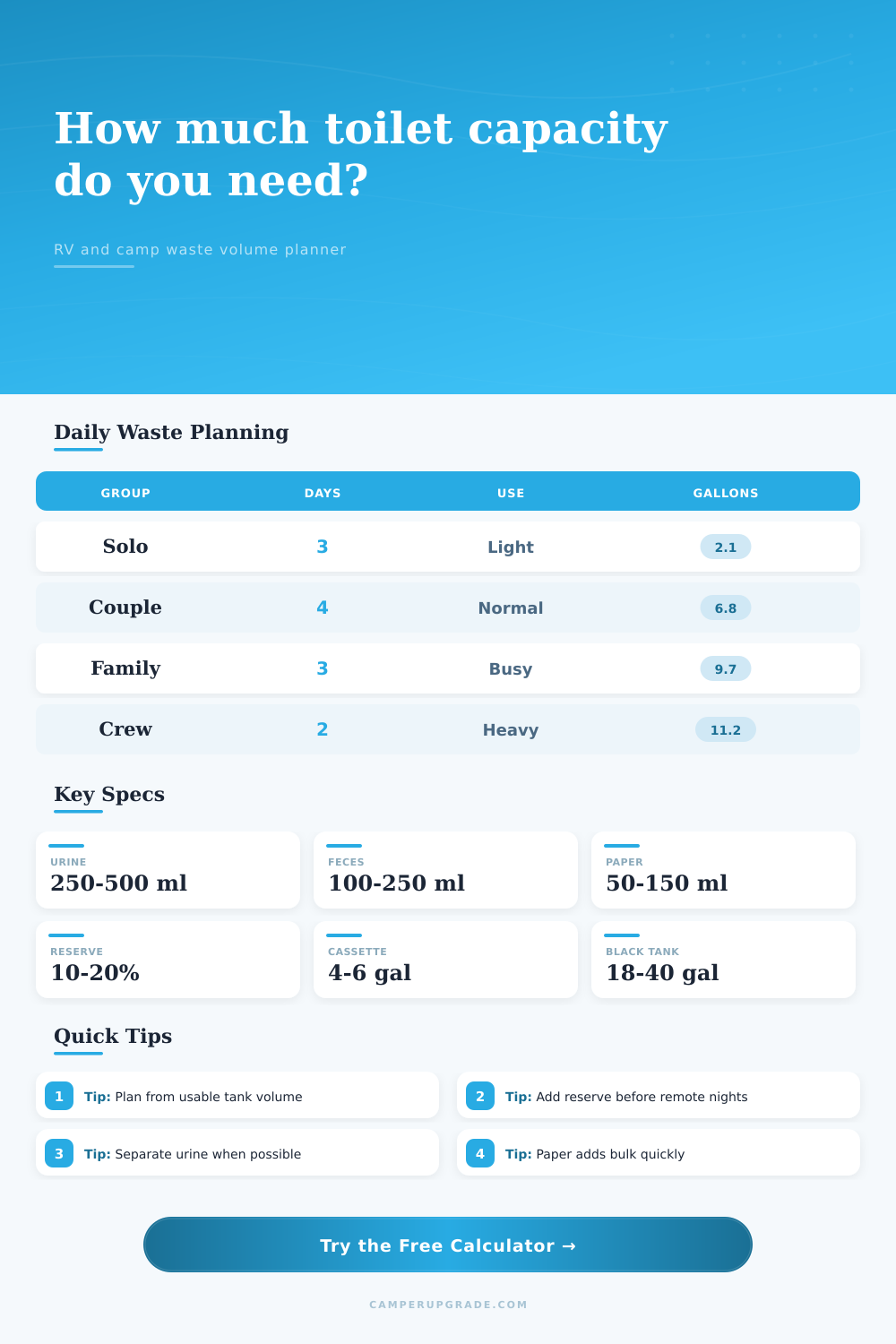
| Urine per toilet visit | 250-500 ml per use | 350 ml | Hydration and temperature can move this sharply. |
| Bowel movement solids | 100-250 ml per event | 180 ml | Use higher values for conservative pack-out planning. |
| Toilet paper bulk | 50-150 ml per event | 90 ml | Packing paper separately reduces tank volume. |
| Flush water or cover media | 0-750 ml per event | 300 ml | Manual-flush toilets vary by pump stroke count. |
| Toilet system | Common usable capacity | Urine in main container | Best calculator setting |
|---|---|---|---|
| RV black tank | 18-40 gal | 100% | Use actual usable gallons and 10-20% reserve. |
| Cassette toilet | 4-6 gal | 100% | Service before long drives or rough tracks. |
| Portable flush toilet | 2.5-5.5 gal | 100% | Small tanks usually need daily checks for groups. |
| Composting separator | Solids bin varies | 0-20% | Calculate urine jug separately when diverted. |
| Dry bag or wag bag | Per-bag pack-out | 0-100% | Use lower flush volume and include gel or powder bulk. |
| Group and use pattern | Approx. gallons per day | 5 gal cassette safe days | 20 gal black tank safe days |
|---|---|---|---|
| 1 person, light use | 0.6-0.9 gal/day | 4.5-7 days | 18-28 days |
| 2 people, normal use | 1.5-2.1 gal/day | 2-3 days | 8-11 days |
| 4 people, busy camp use | 3.2-4.4 gal/day | 1 day | 3.5-5 days |
| 6 people, heavy shared use | 5.2-7.0 gal/day | Less than 1 day | 2.3-3.1 days |
| Reserve choice | Usable from 5 gal tank | Usable from 20 gal tank | When it fits |
|---|---|---|---|
| 0% | 5.0 gal | 20.0 gal | Stationary campsite with easy dump access. |
| 10% | 4.5 gal | 18.0 gal | Normal RV park or campground movement. |
| 15% | 4.25 gal | 17.0 gal | Mixed roads, cassette handling, and sensor uncertainty. |
| 20% | 4.0 gal | 16.0 gal | Remote camping, heat, slosh, or delayed dump access. |
This happens when you are in some dark parking lot three hundred miles from nowhere and the level sensor starts flashing red because of waste volume. Then you know what that means. It’s the moment of your trip. It determines if you locate a dump station or begin covertly scouting roadside ditches along the way. The calculator above will calculate this for you but knowing why those numbers play into equation avoids that panicked moment.
Most people overestimate how much they can carry based off full tank usage figures. No. Those aren’t usable volumes. Filling a five gallon cassette all the way make it a back injury waiting to happen, not to mention 3 gallons is still pretty hefty.
How to Plan Your RV Toilet Use
Urine is main culprit when it comes to volume. Not solids. Knowing this will alter your planning. The average adult pee between 3-7 times a day. Each pee is anywhere from 250-500 ml. When you include flush water and toilet paper, the amount realy adds up. To account for this, the tool allows you to change urine capture percentage.
With a diverting composting system, you’ll have a dry and compact solids container while your urine jug is filled to the brim. Time to tend to two different stream! With a traditional black tank, it’s all mixed together, which means you’re carrying around both waste AND water. The latter being the big space eater (which is where folks gets tripped up). They look at their tiny bit of solid waste and think they’ve got days of range… But it’s actualy the liquid that does all the displacing.
Remember toilet paper absorbs liquids. In your pack, it’s different. When wet, a sheet that’s an inch thick on roll can double or even triple in size and take up half a liter of space. That can add up if you’re planning to boondock for a week with another person. The table on the page explains this well. With average usage of both water and TP, two folks will use a little tank in two days; going solo may get you three or four days.
The single factor is usually hydration, one body versus another and what they drink. More water intake equals more output. It’s basic biology stuff, but wrecks many plans.
Reserve capacity is your insurance policy against reality. RV black tanks use conductive probes as sensors and these sensors are notoriously bad. They become coated by waste which make them inaccurate. So your black tank could be full but the sensor think it’s only half full. You have ten to twenty percent reserved in case of this and other errors. These include sloshing caused by driving over rough terrain (that’s why I leave some space) or if your sensor isn’t calibrated exactly right. Leaving space for slop and sensor error keep the waste from leaking out into your living area. And that smell… Do you really want to deal with that while driving for hours?
Also take into account how many people will be using it. Adding one person increase usage linearly, but two people typically use more than twice as much because they have the convenience of being two users. Kids are all different in ways like age and whether they are potty trained. Families will vary greatly. You can specify what percent each user uses, which is useful if you’re looking at options.
If you cut back on paper you might be able to squeeze a larger cassette into your van. Or perhaps you want to go with daily dumps, since you have six people? That’s different. There is no one-size-fits-all here because it depends on your set-up, route, and what you’re willing to carry around.
The other trade off is with dry bag systems. By using absorbers or running separate streams, there’s no liquid volume at all, but everything has to come home with you. Carrying eight-plus pounds of packed-out waste doesn’t make for a fun time. Depending on your math, this might be acceptable, particularly if distance is an issue. Usually, it won’t be, the weight penalty isn’t offset by convenience for longer trips. Liquid storage wins for distance, and solid storage wins for discretion. So just know what you value before you pull out of driveway.
The way it works takes the guess out of planning. Just enter your tank size, group size, and trip duration to find out how many safe days you can go per fill. So you know exactly when to dump before you’re desperate, allowing you to enjoy the view rather than worrying about the toilet. You can now venture deeper off-grid with peace of mind because you know your limits.
The variables are yours. And the waste will take care of itself. That’s what being good at overlanding looks like; calm, ready for anything, and not scared of that blinking red light.