Wood Ash Volume Calculator
Estimate cooled fire pit, stove, fireplace, or campsite wood ash by volume, weight, container count, and practical handling allowance.
Wood Ash Estimate
| Average ash depth | Volume from 10 sq ft | Volume from 100 sq ft | Metric equivalent |
|---|---|---|---|
| 0.5 in light film | 0.42 cu ft | 4.17 cu ft | 0.012 m³ per 10 sq ft |
| 1 in shallow layer | 0.83 cu ft | 8.33 cu ft | 0.024 m³ per 10 sq ft |
| 2 in normal burn layer | 1.67 cu ft | 16.67 cu ft | 0.047 m³ per 10 sq ft |
| 3 in heavy weekend layer | 2.50 cu ft | 25.00 cu ft | 0.071 m³ per 10 sq ft |
| 4 in deep pit layer | 3.33 cu ft | 33.33 cu ft | 0.094 m³ per 10 sq ft |
| 6 in overdue cleanout | 5.00 cu ft | 50.00 cu ft | 0.142 m³ per 10 sq ft |
| Container | Nominal volume | 75% safe fill | Loose dry ash weight |
|---|---|---|---|
| Small metal can | 2 gal / 0.27 cu ft | 1.5 gal / 0.20 cu ft | About 7 lb |
| Standard ash bucket | 5 gal / 0.67 cu ft | 3.75 gal / 0.50 cu ft | About 18 lb |
| Metal utility bin | 10 gal / 1.34 cu ft | 7.5 gal / 1.00 cu ft | About 35 lb |
| Covered metal can | 20 gal / 2.67 cu ft | 15 gal / 2.01 cu ft | About 70 lb |
| Large ash can | 31 gal / 4.14 cu ft | 23.25 gal / 3.11 cu ft | About 109 lb |
| Scenario | Measured space | Typical ash depth | Estimated volume |
|---|---|---|---|
| Portable smokeless fire pit | 19 in round base | 1.5 in | 0.25 cu ft / 1.9 gal |
| RV raised fire pan | 24 in x 24 in tray | 2 in | 0.67 cu ft / 5.0 gal |
| Weekend campfire ring | 36 in round ring | 2 in | 1.18 cu ft / 8.8 gal |
| Group campsite fire ring | 48 in round ring | 3 in | 3.14 cu ft / 23.5 gal |
| Small cabin stove pan | 18 in x 12 in pan | 3 in | 0.38 cu ft / 2.8 gal |
| Home fireplace cleanout | 36 in x 20 in box | 2.5 in | 1.04 cu ft / 7.8 gal |
| Reference factor | Conservative value | Best for | Important limit |
|---|---|---|---|
| Light garden application | 10 lb per 1,000 sq ft | Dry sifted hardwood ash | Do not use near acid-loving plants |
| Container headspace | 25% empty space | Carrying and cooling ash | Use lower fill for warm ash |
| Cooling hold time | At least 72 hours | Fireplace, stove, and campsite ash | Coals can remain hot when buried |
| Cubic conversion | 1 cu ft = 7.4805 gal | Bucket and bin planning | Rounded bucket sizes vary by brand |
| Metric conversion | 1 cu ft = 0.0283168 m³ | Metric volume reporting | Density still depends on moisture |
Wood leaves behind a mineral called ash. When burned, ash looks like light gray snow; except it never melts. And most folks simply shovel it away, never thinking about what they’re dealing with. Ash doesn’t behave like gravel or dirt; for one thing, it’s much lighter and fluffier. But when compacted tightly, it weigh quite a bit. Knowing how to estimate volume matter here. That’s where this thing comes into play.
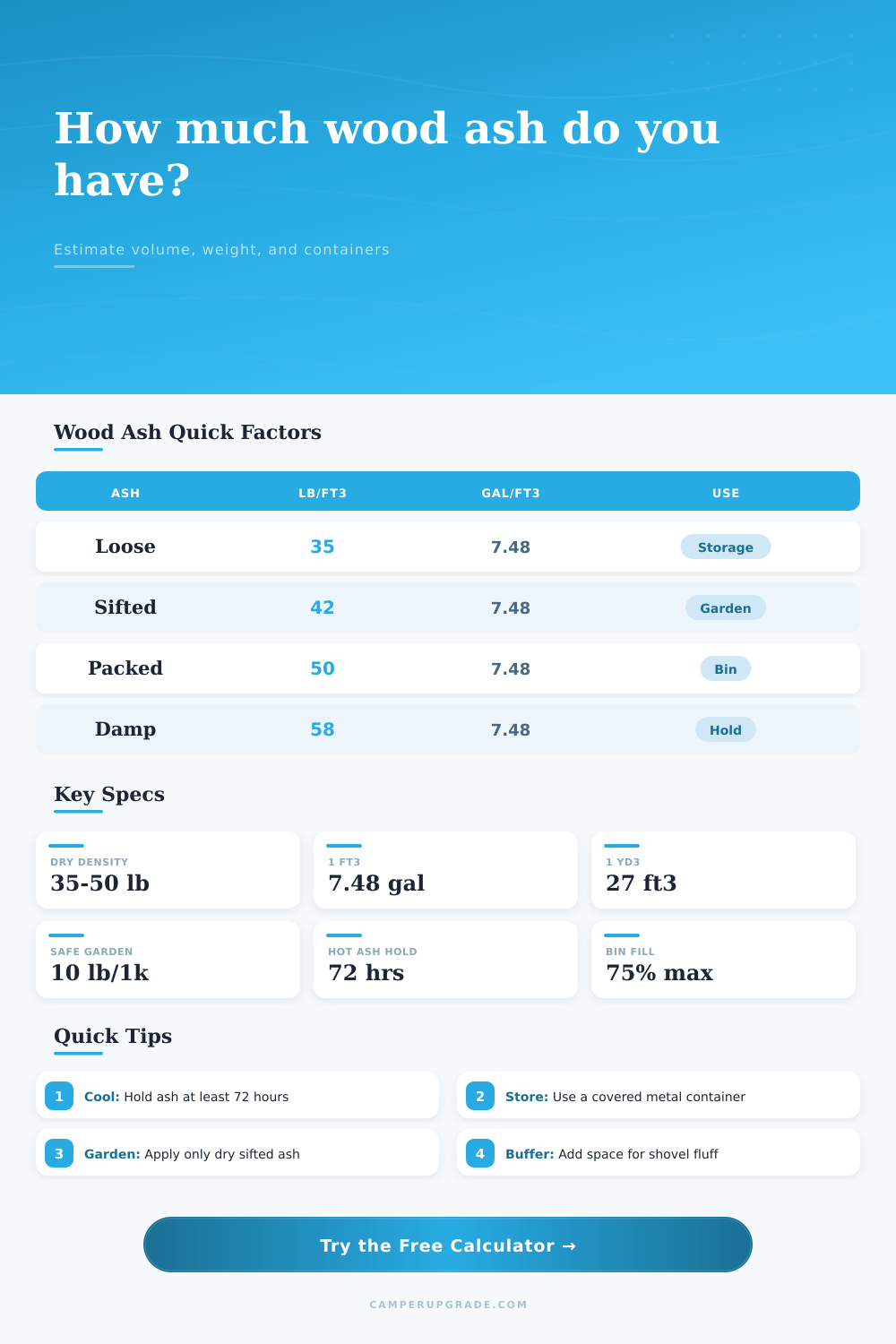
It calculates how much you’ve got based off how dense the ash is, as well as its depth and shape. No math required; just some knowledge of what you’re putting in. First off: How loose and dry is the ash? Campfire ash tend to be around thirty-five pounds per cubic foot of volume. That’s light; light enough that if you were to scoop it up with a shovel, it’d puff out a bit. To allow for that, there’s a buffer on calculator for expansion.
Why Ash Weight Matters for Safe Handling
Put all that same ash in metal bin. Let time or something heavy compress it. Now we’re talking fifty-ish pounds per cubic foot, which take up a whole lot less room for the same amount of ash. Container size is an important selection criterion, but few know how big “big” is. For example, a typical five-gallon bucket seems generous…but then you attempt to load it with wet hardwood ash that’s been soaking beneath a tarp. Moistened ash packs a punch: When damp, it weighs as much as fifty-eight pounds per cubic foot. Even at that low density, a single bucket of soaked wood ash weigh nearly 40 pounds. Those numbers multiply quickly when carried over rough terrain or up a flight of stairs.
To make up for it, the calculator allows for humidity adjustments and even takes into consideration maximum amount of ash allowed in any container (i.e., to avoid overflowing or retaining excessive heat). Ash remaining too long can become dangerously hot for days. So leaving room is more than convenient…it’s prudent.
And then there’s this: What will you do with the ash once it arrives? Are you considering applying some in your garden? Do you want to understand the effects? It can be positive by adding potassium and raising pH. However, it can also be negative because it contain no food and might shock acid-loving species like blueberries or azaleas. Because ash contains no food, and sifted dry ash isn’t organic material, it is a great addition to certain soils, which also benefit from raised pH. But you’ll use it sparingly, maybe up to about a pound a square foot, or ten pounds per thousand square feet, applied lightly. You should of known that. So first think: How many bucketfuls will I be moving around, and how many square feet does each one cover?
The calculator offers an estimate of that “garden equivalent,” helping you see how it would work before any humping of the buckets begins. It turns concrete volume into real-world landscaping goodness.
Stove owners will notice that wood ash come in two types: softer and harder. A hard wood makes a denser ash; it’s heavy and settles well in the pan. A soft wood, like pine or fir, generates fluffy light grey ash that take up more space even though it provides the same amount of energy. That affects the base density for the tool and sets expectations different than what kind of fuel was used. This allows you to avoid assuming that some tiny pile isn’t too heavy. The density tables that come with the calculator spell this out nicely, explaining how introduction of charcoal fragments into the mix can change your projections by several pounds per cubic foot.
In short, handling wood ash is more of a brain exercise then a muscle test. Knowing your volume helps you pick the right container. This avoids nasty surprises with heavy loads and allows for safe storage intervals. It is the difference between lifting something without any clue what you are dealing with and making a messy job a measurable one.
The gray stuff might look the same, but under the surface there are differences in volume, moisture content, and density that a proper estimate alone will uncover. You’ll need to be carefuly aware of this when you start livig with all this ash. It is actualy more complacated than it looks.