Hiking Heart Rate Zone Calculator
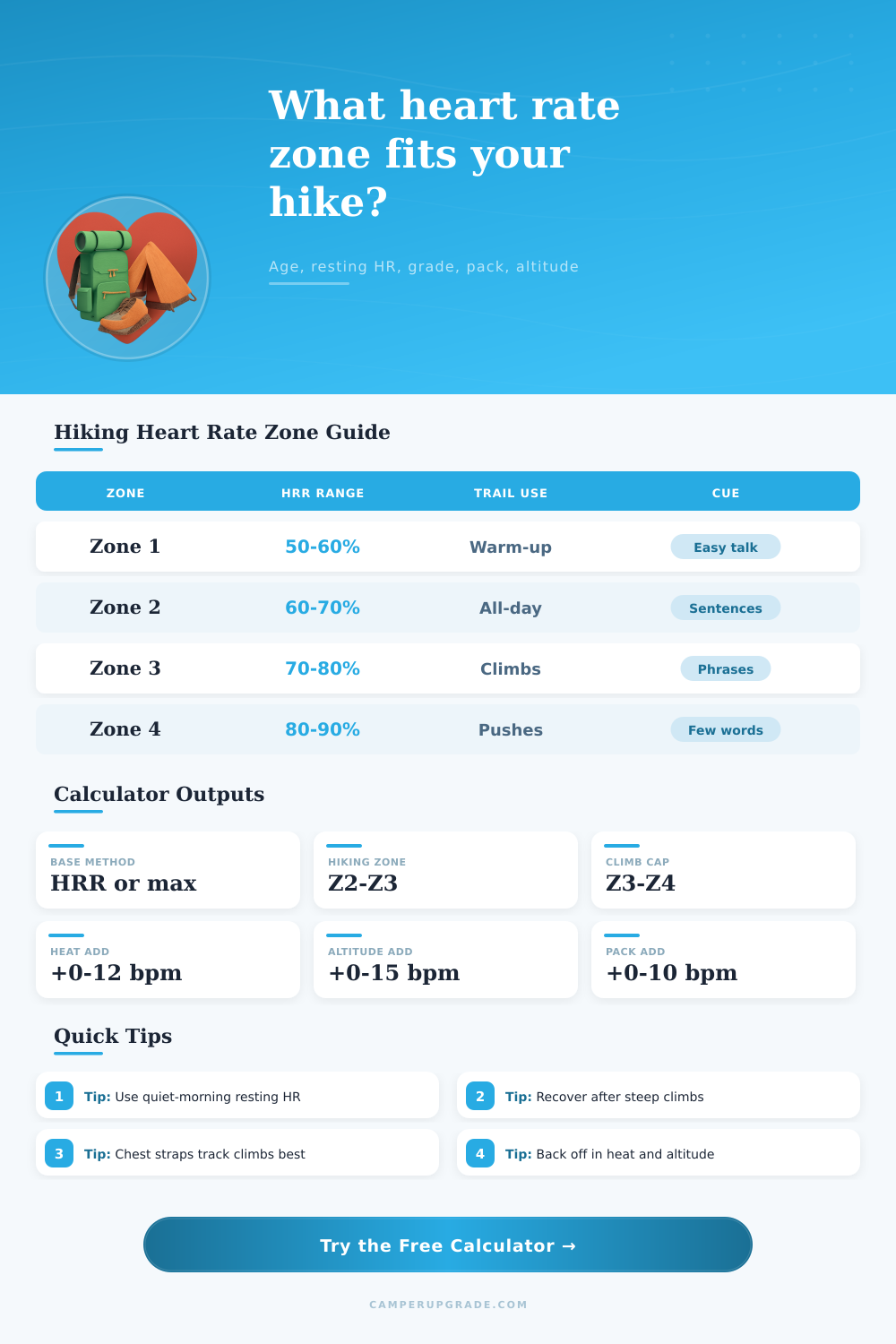
Estimate usable trail zones from heart rate reserve or max heart rate, then adjust for grade, terrain, pack weight, altitude, heat, and hike duration.
| Zone | HRR range | Hiking use | Talk test cue |
|---|---|---|---|
| Zone 1 | 50-60% | Warm-up, easy descent, active recovery | Comfortable conversation |
| Zone 2 | 60-70% | Most all-day hiking and backpacking | Full sentences |
| Zone 3 | 70-80% | Long climbs, brisk traverses, cold starts | Short phrases |
| Zone 4 | 80-90% | Short steep steps, passing, summit pushes | Few words |
| Zone 5 | 90-100% | Not a steady hiking target | Very hard effort |
| Terrain or grade | Typical HR lift | Planning note | Best response |
|---|---|---|---|
| Flat smooth path | 0-2 bpm | Cadence and pace dominate. | Keep easy zone steady. |
| Rolling trail | 3-7 bpm | Small rises create repeated surges. | Use descents to bring HR down. |
| Steady climb | 8-14 bpm | Zone 3 may be normal for trained hikers. | Shorten stride before slowing completely. |
| Loose or technical surface | 4-10 bpm | Balance and braking increase cost. | Use poles and lower step height. |
| Snow, mud, or sand | 8-16 bpm | Foot slip raises effort at the same speed. | Plan more breaks and more fluids. |
| Environment | Common effect | Calculator modifier | Trail caution |
|---|---|---|---|
| Under 3,000 ft | Baseline for most hikers | +0 bpm | Use normal zones. |
| 6,000-9,000 ft | Higher breathing rate | +5 bpm | Expect slower pace at same HR. |
| 9,000-12,000 ft | Reduced oxygen availability | +9 bpm | Keep climbs below cap. |
| Hot exposed trail | Cardiac drift from cooling load | +8 bpm | Use shade breaks and electrolytes. |
| Very hot or humid | Rapid drift possible | +12 bpm | Lower target and watch symptoms. |
| Pack load | Typical use | HR effect | Adjustment cue |
|---|---|---|---|
| 0-10 lb | Short fitness hike or trail walk | 0-2 bpm | Normal cadence works. |
| 10-25 lb | Day hike with water, layers, food | 2-5 bpm | Keep Zone 2 on approaches. |
| 25-40 lb | Overnight backpack | 5-8 bpm | Use more frequent micro-rests. |
| 40-55 lb | Winter or multi-day load | 8-10 bpm | Reduce pace before HR spikes. |
| 55 lb+ | Expedition or carry-heavy trip | 10+ bpm | Recheck pack plan and climb cap. |
| Monitor type | Trail accuracy | Strength | Limitation | Best hiking use |
|---|---|---|---|---|
| Chest strap ECG | Highest during climbs | Fast response to surges | Needs moisture and snug fit | Training hikes and steep pacing |
| Arm optical band | High when fitted well | Comfortable under pack straps | Can lag hard intervals | Long day hikes and backpacking |
| Wrist optical watch | Moderate to high | Convenient navigation plus HR | Loose fit, cold skin, poles can reduce accuracy | General zone awareness |
| Phone camera app | Spot check only | No extra sensor needed | Not continuous on trail | Resting HR checks before hiking |
| Manual pulse count | Spot check only | Works without batteries | Hard to measure while moving | Backup check at breaks |
When most of us set out to hike a trail, we do it with best of intentions. By the end, though, many of us is sucking wind because we forgot about the engine in our chests. You grab some water and consult your map, but you still end up exhausted because you’re ignoring the engine in your chest. That error will affect you from now until noon, turning what was supposed to be a nice Sunday stroll into an endurance contest.
The difference? The calculator above converts vague fitness goals into concrete beats per minute targets that work on real terrain. Based off your age and resting pulse, it sets a baseline, then adds on reality checks like steep grades and pack weight so you can actualy hike smarter, not just harder.
How to Use Your Heart Rate When Hiking
But the mathematics are based not only on your maximum heart rate percentage but also your heart rate reserve. This is important because you and I might both have the same max heart rate, but one of us could be far more fit. He will has a lower resting pulse and thus far more reserve capacity to use for effort. That reserve is what allows you to have a zone where you feel like you can sustain yourself for hours, not minutes.
This accounts for the fact that you aren’t standing still while hiking and that terrain requires energy with each step. It works like this: your heart reacts different than based on the terrain. On a flat smooth surface, your heart remains relatively calm and your legs does the work. When you introduce some technical rock roots or loose gravel, your body is spending additional energy just trying to stay balanced. Even though you might slow down, you’ll have a high pulse that represents that “balance” cost. As the tables on the page explain in detail, each type of surface adds beats per minute to your base number. While you cannot out-train friction or gravity, you can anticipate their impact before they steal your lunch break.
The weight of your pack becomes a silent anchor around your waist. A 20-pound pack seems fine when you’re facing a gradual incline for the first few hours. But then you encounter a long steep incline that goes on for miles. Every step requires more effort from your cardiovascular system to haul your heavier body uphill. Without realizing it, you can push yourself into a dangerous red zone by carrying all that extra gear. Water bottles, cameras, and emergency layers adds up faster than you think.
The other two big wack-a-mo’ variables is heat and elevation. The first happens because of cardiac drift, where the body sends blood to the skin for cooling instead of to the muscles for work. The second is due to less oxygen per breath at high altitudes, meaning the heart has to work harder simply to keep you alive. Overlook either one of them and you’ll find yourself dangerously overheated and exhausted long before you should of been.
Respect your level of fitness for the day as well. How effectively your heart can deliver oxygen to working muscles depend largely upon whether you’re hydrated and had a good night’s sleep. But if your legs is fatigued from prior effort, or you didn’t get a good night’s rest, those effective zones will shift down. That “easy” pace that felt like a push before could easily feel like a hard push now that you’re tired. More times than not, it’s better to listen to what your body tells you versus reading the numbers on a watch screen.
With this calculator, don’t expect to hit the exact number each time you go hiking! It’s about knowing what you’re capable of and sticking to it. This cap on your climbs becomes your ceiling, not your goal. You’ll still need some wiggle room (when descending and taking brief breaks) in order to recover. Going over that number too many times will use up those reserves faster than you can restock on snacks and water. Pacing conserves energy for both reaching the summit and making your way back home.
All-in-all, hiking isn’t about suffering on the trail; it’s about loving it. When your legs grow tired or your maps run out, having knowledge of heart rate zones provides an inner compass you can trust. It turns the art of guessing into the science of strategizing. It allows for planning ahead and ending up happy rather than sad. This change in perspective completely alters your experience of being outside.