Stride to Mile Conversion Calculator
Convert strides to miles using your measured stride length, then adjust for trail surface, grade, pack weight, and cadence for a better hiking or walking estimate.
🥾Trail and walking presets
⚙Stride inputs
Stride conversion results
📏Stride spec comparison grid
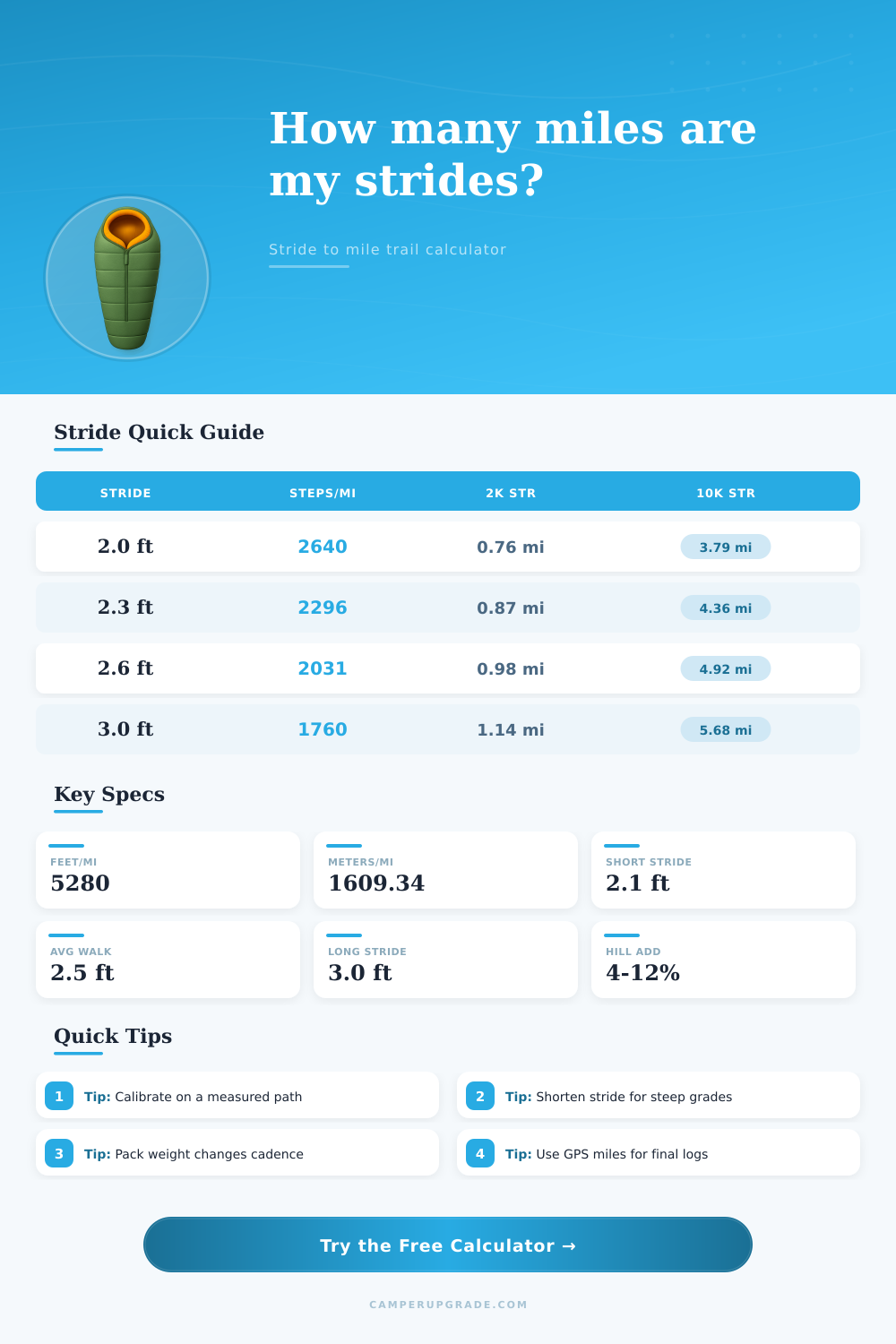
📊Stride length reference table
| Stride length | Metric length | Strides per mile | Steps per mile |
|---|---|---|---|
| 2.0 ft | 0.61 m | 2,640 | 5,280 |
| 2.3 ft | 0.70 m | 2,296 | 4,591 |
| 2.5 ft | 0.76 m | 2,112 | 4,224 |
| 2.8 ft | 0.85 m | 1,886 | 3,771 |
| 3.0 ft | 0.91 m | 1,760 | 3,520 |
🧭Common stride-to-mile conversions
| Stride count | At 2.3 ft | At 2.5 ft | At 3.0 ft |
|---|---|---|---|
| 1,000 strides | 0.44 mi | 0.47 mi | 0.57 mi |
| 2,500 strides | 1.09 mi | 1.18 mi | 1.42 mi |
| 5,000 strides | 2.18 mi | 2.37 mi | 2.84 mi |
| 8,000 strides | 3.48 mi | 3.79 mi | 4.55 mi |
| 10,000 strides | 4.36 mi | 4.73 mi | 5.68 mi |
⛰Surface and load adjustment table
| Route profile | Adjustment used | Stride effect | Use when |
|---|---|---|---|
| Paved path | 0% | Normal stride | Roads, sidewalks, firm bike paths |
| Packed dirt | 3% | Slightly shorter stride | Campground trails and dry forest path |
| Rooty or rocky | 8% | Foot placement slows | Uneven singletrack or boulder steps |
| Loose sand | 14% | Stride slips shorter | Beach walks and dry washes |
| Snow or mud | 18% | High effort per mile | Soft ground, snowshoes, saturated trail |
🏕Outdoor route examples at 2.5 ft stride
| Outdoor route | Approx distance | Stride count | Planning note |
|---|---|---|---|
| Small campground loop | 0.5 mi | 1,056 strides | Good calibration warmup |
| Lake access trail | 1.2 mi | 2,534 strides | Add footing factor if rocky |
| Visitor center out-and-back | 2.0 mi | 4,224 strides | Easy distance check |
| Ridgeline day hike | 5.0 mi | 10,560 strides | Grade and pack matter |
| Long camp approach | 8.0 mi | 16,896 strides | Use buffer for fatigue |
💡Field notes
A mile is just a line drawn on a piece of paper that’s been measured out to five thousand two hundred and eighty feet. That’s true for most hikers. But when your backpack weighs forty pounds and roots protrude from every side of the trail, then it’s a whole other story. Your legs don’t bargain with the mileage on a map. They reacts to what’s happening now: Is this uphill or downhill? Is there loose gravel? Are my muscle tired?
So while it may be true that your GPS is telling you that you’re only two miles in, your body knows if those two miles were realy worth four. It’s the distinction between ending your day hike full of energy versus barely making it back to a trailhead.
Why Your Legs Know More Than The Map
It begins with your own stride length. Most online converters guess it based off your height. This is always a lazy guess. The truth is, your stride depend on many things. It depends on how you’re feeling, what shoes you have on, and how you move. On a good day I might take 26,000 steps to go a mile, but my stride might be very short, just 20 feet long. That’d be more than twenty-six hundred strides to make a mile. Stretch me out to three feet, though, and suddeny I’m under 1,760.
To find your stride, measure it. Walk somewhere you know the distance (a marked-out track or a loop around camp works well). Count your full strides. A stride is left-right. Count all those together, and that’s your number. If you use a pedometer that counts your step, divide by 2 since each of those is half a stride. That’s where folks mess up. They think their steps equals their stride, so they come up with a distance twice as far than they’ve actually walked.
The next thing you do is adjust based on the environment. Sidewalks? No problem: concrete’s concrete. But trails made of dirt? Not so much. Energy-absorbing soft soil. Sinking in the mud (or sand) and not getting clean footing with each step. Stride gets shorter as the body fights for purchase instead of going forward. To make up for that drag, this tool includes grade and surface condition percentage buffers to the base length. Packed dirt trails will include only a slight three percent buffer; loose snow or super muddy conditions may require almost a 20 percent increase. Now that’s not just a number in the computer, it translates into needing more calories, more water, more time to travel the same distance on a map. People who underestimate this factor find themselves way behind schedule after dark because what they thought was a five-mile walk along a level sidewalk turned out to be a couple mile slog uphill that felt like ten.
Similarly, pack weight throws your stride off kilter. With a lightweight daypack, you can really stretch your legs. You can extend your step and get a long stride. When you’re loaded down with extra gear, however, you’ll find yourself lower and tighter to the ground. Your steps will be shorter, more frequent. And you’ll adjust your pace (the rhythm at which you move). Slow it down if you’re crossing some gnarly rocky section: though your stride count might not decrease, your overall moving time will.
The page’s table of reference figures makes all this clear. They shows what your stride count equates to in terms of miles when you alter any one of these factors. However, when to make these tweaks is an art. It comes down to practice, your own personal experience, and observation. You realize your stride shorten when you get tired or as the trail gets a bit more technical. No magic formula exists to solve all hikes. They’re chaotic. Your energy change from hour to hour.
The tool will give you a starting point, a baseline estimate based on something much more precise than the length of the trail marked on a ruler. This will help you better predict how long you’ll need breaks and how much water you’ll need. But it won’t take the place of the feedback loop that comes from paying attention to what your body is telling you. How do your legs feel after three miles? Does your stride seem compressed? Are you breathing hard? If so, that mile required a greater effort then the average calculation would of shown. Adjust your speed accordingly. Use the data as a guide, but never as the absolute truth.
Ultimately hiking is learning to find your pace: the pace that will get you where you need to go while keeping you there. It might be to push for a summit or stroll through a park. Listen to your body and adjust your pace when you’re feeling fatigued. Find the way your body best moves across various terrain and let it work with the trail. Let yourself move instead of fighting it. Find the way your body best moves across various terrain and let it work in tandem with the trail. Let yourself move instead of fight against it.
Realize that every mile isn’t simply a measurement. It’s a promise made between your legs and the ground beneath them. It is a promise to honor the true distance rather than the one written on a piece of paper.