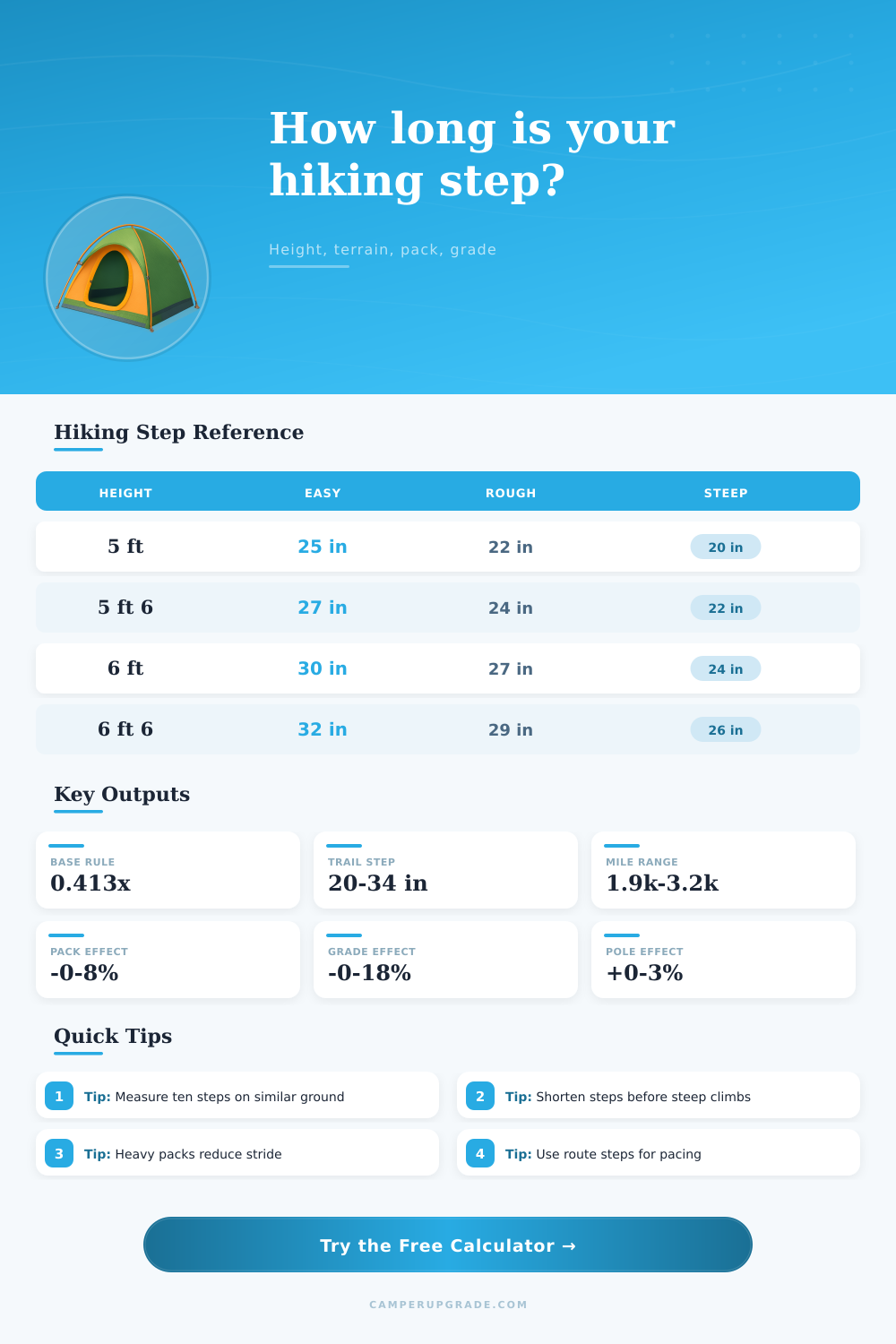
Step Length by Height Hiking Calculator
Estimate trail step length, steps per mile, route step count, cadence, and terrain-adjusted stride from height and hiking conditions.
| Hiker height | Base step | Smooth trail | Rocky or rooty | Steep climb |
|---|---|---|---|---|
| 5 ft 0 in / 152 cm | 24.8 in / 63 cm | 2,555 steps/mi | 2,747 steps/mi | 3,043 steps/mi |
| 5 ft 6 in / 168 cm | 27.3 in / 69 cm | 2,318 steps/mi | 2,493 steps/mi | 2,761 steps/mi |
| 5 ft 10 in / 178 cm | 28.9 in / 73 cm | 2,193 steps/mi | 2,358 steps/mi | 2,612 steps/mi |
| 6 ft 2 in / 188 cm | 30.6 in / 78 cm | 2,075 steps/mi | 2,231 steps/mi | 2,472 steps/mi |
| 6 ft 6 in / 198 cm | 32.2 in / 82 cm | 1,969 steps/mi | 2,117 steps/mi | 2,345 steps/mi |
| Trail condition | Step adjustment | Why it changes | Cadence expectation |
|---|---|---|---|
| Smooth dirt or packed gravel | 0% | Predictable foot placement | Normal trail rhythm |
| Mixed roots and small rocks | -4% | More deliberate placement | Slightly slower |
| Rocky uneven tread | -7% | Shorter stable contacts | Slow to steady |
| Sand, scree, or loose ash | -10% | Slip and energy loss | Short and steady |
| Mud, wet roots, or slick slabs | -12% | Traction limits stride | Cautious cadence |
| Boulder field or talus | -18% | Step length follows holds | Highly variable |
| Grade band | Adjustment | Typical use | Planning note |
|---|---|---|---|
| 0-3% | 0% | Lake loops, valley trails | Use base result |
| 4-7% | -3% | Gentle climbing trail | Steps rise modestly |
| 8-12% | -7% | Sustained uphill | Shorter stride saves energy |
| 13-18% | -12% | Steep summit path | Cadence may drop |
| 19%+ | -18% | Very steep trail or stairs | Count changes quickly |
| Scenario | Distance | Adjusted step | Estimated steps |
|---|---|---|---|
| Campground nature loop | 1.0 mi / 1.6 km | 28 in / 71 cm | 2,263 |
| Half-day forest hike | 4.5 mi / 7.2 km | 27 in / 69 cm | 10,560 |
| Rocky overlook trail | 3.2 mi / 5.1 km | 25 in / 64 cm | 8,110 |
| Loaded backpacking section | 8.0 mi / 12.9 km | 24 in / 61 cm | 21,120 |
| Steep summit approach | 5.0 mi / 8.0 km | 23 in / 58 cm | 13,774 |
We’ve all been there on the trail: your legs say you’ve walked 10 miles, but your watch says you only walked five. That’s typically due to not understanding your own mechanics vs. You are just guessing at your pace. The vast majority of hikers consider distance as just distance, yet changing your step length alters the math.
For example, stepping with a smoother stride will cover more ground each minute then a shorter stride with the same heart rate. This calculator estimates your hiking step length based off your height. It also factors in pack weight, fatigue, pace, poles, grade, and surface for practical step planning. It helps fill the gap between where you’re at, and where you’d rather be, converting abstract miles into concrete steps.
How to Calculate Your Hiking Steps
Surprisingly, it’s a pretty straightforward calculation. The length of your legs determines how wide your stride should be: long legs sweep out to a larger arc, while short legs cover shorter distances. To get started, the general formula is: 0.413 x (your height in inches). That figure is derived from studies into an average person’s biomechanics when they walk around. This provides a starting point for flat ground where the going is relatively easy.
And then there’s real life on a trail. Where do all those rocks and roots go? That starting point dissapears. Now we’re putting our feet down deliberately instead of relying on momentum alone. Plug in your height and select the conditions, and the calculator will crunch numbers for you. You no longer need to guess with coefficients and conversions.
The second factor is terrain. Terrain will shrink your stride. If it’s a smooth dirt trail, keep that same base length. Throw in deep sand or loose gravel, and suddenly each step has become a wrestling match against gravity. Your foot must dig in to get a grip, slip, sink, and then shift your weight. That will make your stride much shorter. To adjust for this, the tool accounts for surface type and applies reduction percentages accordingly.
Seven percent off your step isn’t uncommon on rocky trails. Cut that down to almost twenty if you’re hiking through boulder fields. It doesn’t sound like much. But add it all up across a ten mile hike, and those are thousands of additional steps you may not have accounted for. More steps mean increased impact to your calves and knees.
The same applies to grade. You’ll automatically shorten your stride when traveling uphill as you’re carrying mass and must lift it against gravity. On a steep hill, you will be forced to shorten your step to keep your power and stay stable. Braking with each footfall down-hill can be worse. That’s why the model accounts for those changes in grade. Shorter, more deliberate steps is required on steeper sections. Not only does that protect your joints from too much eccentric loading, but it also prevents you from overstriding. One of the most common causes of falls on slick surfaces.
Weight also enters more quietly: in packs. By the third hour, you’re not aware of it. But a heavy pack makes your core work harder and shift your center of gravity. Fatigue on your core means shorter strides, something you do without thinking. The model deducts a few percent for every ten pounds you carry. On long runs, this makes a difference to pacing, even though it’s barely noticeable. That cumulative effect helps explain why those final three miles will feel longer then the first three (if you’re carrying thirty pounds).
Little things like trekking poles add some balance. You can keep your stride long because they let you plant into uneven surfaces and stay stable without changing your step length. If used consistently, they give you a modest credit. No magic there. Just helping to save rhythm. Allowances for fatigue take care of the leg burn at the end of the day. When fresh legs go, they go different than tired legs. Plan accordingly so you don’t plan a day that is too optimistic and have everything fall apart by noon.
Knowing those inputs changes the way you approach planning a hike. Rather than measuring time with an estimated pace, now you can measure the effort with a step count. Thinking, “Oh, I’ll need 30k steps on that hike because it’s going to be tough and my backpack is really heavy,” allows you to make adjustments both before and during the trek. Maybe you begin earlier, or carry extra food.
The reference table on the page shows what the range will be for different conditions and heights. It’s also largely about figuring out what it is realy measuring. Step length isn’t about reaching as far as possible. It’s about safety and efficiency. If you’re shortening your step on slippery or steep terrain, that’s not weakness; it’s smart adaptation.
You can calibrate the model even more by measuring your real-world step on some familiar ground. Take 10 steps on comparable terrain and measure how far they are; then divide that by ten. If you have that number, type it in. It will personalize the estimate. It works out better when you plan with changed numbers. You knew it was going to be hard so you don’t get burned out on it. And when you got there, you had some gas left in the tank.
Next time you’re standing at the trail head, take a look at the surface and the grade before you start hiking. Adjust your expectations. Your legs will appreciate it.