Tent Weight Per Person Calculator
Compare packed shelter weight, shared carry weight, comfort space, and trip target bands for backpacking, paddling, car camping, and winter tents.
1.Choose a real tent setup
2.Enter shelter details
Your shelter load summary
3.Material and construction comparison
| Spec | Tarp / pyramid | Double-wall backpacking | Family dome | Winter tent |
|---|---|---|---|---|
| Typical total per person | 0.8-1.8 lb | 1.5-3.0 lb | 2.5-6.0 lb | 3.0-5.5 lb |
| Weight driver | Fabric area and stakes | Poles, fly, inner, floor | Standing height and poles | Stronger poles and fabric |
| Space efficiency | High if pitched well | Balanced | Comfort-focused | Lower, due storm shape |
| Best use | Experienced light trips | Backpacking and mixed camps | Campgrounds and families | Snow, wind, exposed routes |
4.Reference tables
| Trip profile | Light target | Reasonable band | Heavy above |
|---|---|---|---|
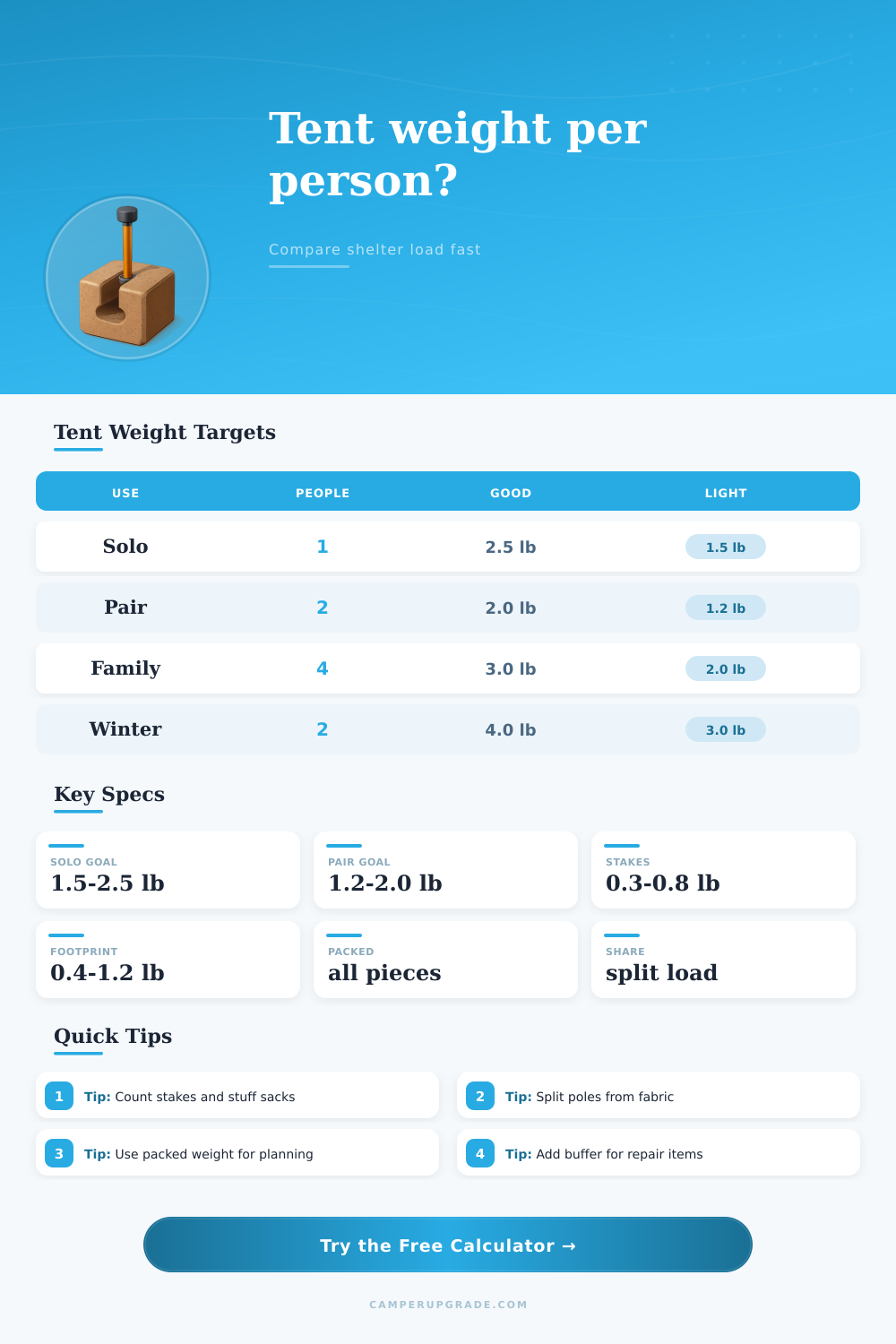
| Ultralight backpacking | 1.0 lb/person | 1.0-1.8 lb/person | 2.4 lb/person |
| Light backpacking | 1.5 lb/person | 1.5-2.5 lb/person | 3.2 lb/person |
| Standard backpacking | 2.0 lb/person | 2.0-3.2 lb/person | 4.0 lb/person |
| Paddling or bikepacking | 2.0 lb/person | 2.0-3.5 lb/person | 4.5 lb/person |
| Car camping comfort | 3.0 lb/person | 3.0-6.5 lb/person | 8.0 lb/person |
| Winter / alpine margin | 3.0 lb/person | 3.0-5.5 lb/person | 6.5 lb/person |
| Capacity | Backpacking floor area | Comfort floor area | Typical packed weight |
|---|---|---|---|
| 1 person | 16-22 sq ft | 22-28 sq ft | 1.2-3.5 lb |
| 2 person | 27-34 sq ft | 34-42 sq ft | 2.2-6.0 lb |
| 3 person | 38-48 sq ft | 48-60 sq ft | 4.0-8.5 lb |
| 4 person | 55-65 sq ft | 65-80 sq ft | 8.0-14.0 lb |
| 6 person | 80-95 sq ft | 95-120 sq ft | 14.0-24.0 lb |
| Item to include | Common range | Metric range | Planning note |
|---|---|---|---|
| Factory stakes | 3-10 oz | 85-283 g | Often counted in packed weight, but verify. |
| Extra stakes and cord | 2-12 oz | 57-340 g | Add for exposed camps and tarp pitches. |
| Groundsheet | 4-20 oz | 113-567 g | Tyvek, polycryo, nylon, or factory footprint. |
| Repair sleeve and patches | 1-4 oz | 28-113 g | Small but worth counting for long trips. |
| Snow anchors | 8-32 oz | 227-907 g | Usually separate from standard tent weight. |
| Preset style | People | Total shelter | Per person | Space note |
|---|---|---|---|---|
| Solo ultralight | 1 | 1.7 lb | 1.7 lb | Tight but efficient. |
| 2P backpacking | 2 | 4.9 lb | 2.4 lb | Comfortable shared load. |
| 3P canoe trip | 3 | 7.4 lb | 2.5 lb | Good space with boat carry. |
| Family dome | 4 | 13.6 lb | 3.4 lb | Fine for short carries. |
| Winter mountaineering | 2 | 8.9 lb | 4.5 lb | Protection beats low weight. |
5.Practical checks
Maybe you’re feeling pain in your shoulders by the third day of a backpacking trip, and cursing the tent bag swinging off your hip. That tent is heavy, and weight listed on the package doesn’t include all the other items you’ll have on trail: the footprint, the stuff sack, the stakes and guylines. That’s why the calculator up top puts those extras back into the calculation, allowing you to understand the real-world cost of carrying the shelter instead of just the cost of shipping.
But they want to know: How much do I have to carry? Not just how much does it all weigh, but how much does each person need to carry? A 4 pound tent divided between two people seem like two pounds apiece, right? But what if one person carries the heavier poles and the other person carry the lighter fly? What if someone packs their tent with additional sand stakes, which aren’t included in the tent’s weight? Little pieces of gear can realy add up over time when traveling. They want you to be able to account for the weight of everything you plan to pack, including cords and repair kits.
Understanding Real Tent Weight and Comfort
This way, you can see exactly how much stuff will go into your pack and divide it among the people who will sleep inside. That way, you get a more realistic idea of how much you’re carrying vs. What you wanted/need to carry. And that’s where this comes into play when reading trip profiles. While a family car camping trip can get away with six pounds for every member, an ultralight backpacker might be forced to stick to a one-pound shelter weight each. It’s not just a matter of fitness, but rather how much margin for error you want when the wind picks up or rain starts falling on an exposed ridge.
Despite costing calories initially, a larger tent usually also equates to a more stable, more comfortable night’s rest, saving energy over time compared to shivering in a flimsy shelter through a storm. Ultimately, you’ll have to decide whether the short-term physical price is worth avoiding the misery of getting wet.
These figures also take into account material selection. For example, a traditional nylon tent will be lighter and cheaper than a dyneema composite, but bulkier and heavier on pack-out (and even more so once wet). You can adjust for this with a buffer weight percentage if you’re going into wet conditions or expect significant snow load. After all, what good does it do knowing the dry weight of a tent is only two pounds at the store, if it’s going to gain another pound after a few days of rain? This isn’t dry weight, this is trail weight in actualy conditions.
Finally, there’s space. We tend to neglect this. You want a lightweight tent, but what if you’re claustrophobic? What if you have to leave some of your gear outside your sleeping bag? There are fields in the tool for both vestibule space and floor area so you can weigh the comfort versus the weight.
Maybe you have a dog, a couple backpacks, and some wet boots you want to keep out of your sleeping bag. In that case, a slightly heavier shelter might make sense. It is better than watching your morale crumble while you struggle to sleep on cold ground with muddy feet. Morale is worth something. It costs a bit more, but it pays off in the end.
And that’s what planning your gear is all about: knowing your body, knowing your trip style, and making those tradeoffs so you have the best tool (tent) for the job you’re doing. When you break down the overall pack weight by person and include accessories, you take the guessing out of packing day. No more hope that the tent won’t be to heavy; now you know exactly how much it will add to your pack. And that makes a difference as you stand at the trailhead, ready to go, not wondering anymore.