Gravity Filter Flow Time Calculator
Estimate how long a hanging gravity filter will take from bag volume, water head, filter media, clarity, temperature, and restriction losses.
Gravity Filter Estimate
| Filter media | Baseline at 3 ft head | Best use | Slowdown sensitivity |
|---|---|---|---|
| Fast hollow fiber cartridge | 2.8 L/min | Group bottles and dinner water | Medium with fine sediment |
| Standard hollow fiber cartridge | 1.8 L/min | Backpacking gravity bags | Medium to high |
| Fine hollow fiber cartridge | 1.2 L/min | Clearer water with compact kits | High in cloudy water |
| Ceramic gravity element | 0.7 L/min | Durable basecamp filtration | Moderate, cleanable surface |
| Carbon block gravity cartridge | 0.55 L/min | Taste and chemical reduction stage | High if sediment reaches block |
| Inline squeeze filter in gravity mode | 1.0 L/min | Small clean bottle refills | Medium, outlet dependent |
| Bag mesh prefilter only | 5.0 L/min | Straining debris before treatment | Low, not a purifier |
| Two stage hollow fiber plus carbon | 0.9 L/min | Camp taste polishing | High when carbon loads |
| Condition | Multiplier | Typical source | Field response |
|---|---|---|---|
| Clear spring or tap refill | 1.00 | Spring box, clear creek, campground tap | Normal gravity run |
| Tea colored but low sediment | 0.92 | Tannic lakes or forest streams | Prefilter optional |
| Lightly cloudy creek | 0.82 | Small stream after foot traffic | Cloth prefilter helps |
| Cloudy lake or glacial edge | 0.68 | Windy shore pickup | Settle before filtering |
| Silty river water | 0.55 | Desert wash, glacial river, runoff | Settle and decant |
| Very silty runoff | 0.42 | Storm runoff or churned shallows | Use a settling bag first |
| Average head | Head factor | Standard filter flow | 6 L clear batch |
|---|---|---|---|
| 1 ft / 0.30 m | 0.58 | 1.04 L/min | 5.8 min |
| 2 ft / 0.61 m | 0.82 | 1.47 L/min | 4.1 min |
| 3 ft / 0.91 m | 1.00 | 1.80 L/min | 3.3 min |
| 4 ft / 1.22 m | 1.15 | 2.08 L/min | 2.9 min |
| 5 ft / 1.52 m | 1.29 | 2.32 L/min | 2.6 min |
| 6 ft / 1.83 m | 1.41 | 2.55 L/min | 2.4 min |
| Camp need | Volume | Recommended reserve | Target max wait |
|---|---|---|---|
| Solo evening bottle refill | 1.5 to 2 L | 10% | Under 10 min |
| Duo dinner and bottles | 4 to 6 L | 20% | Under 20 min |
| Family breakfast water | 8 to 12 L | 20% | Under 35 min |
| Basecamp dish and drink run | 15 to 20 L | 30% | Under 60 min |
Water filters hung on a tree branch look easy: gravity does the job; time to go make some fire/cook up grub. With no pump, it looks like a solid set-up. In practice, often it isn’t…you strap it on and wait (slowly) for drips, or your filter gets gummed up with silt and quits flowing in short order. It is usually not a gear failure, but physics that frustrate.
It is less important because water sucks. It is more important because you overestimated the amount of head pressure you could get away with and underestimated the amount of sediment the filter would have to deal with. When you input your parameters, the calculator does all calculations so you don’t have to worry about converting and coefficients. What most folks forget is how many variables exist that can be figured into equation…until you’re standing there holding an empty bottle while the sun sets.
How to Filter Water Better
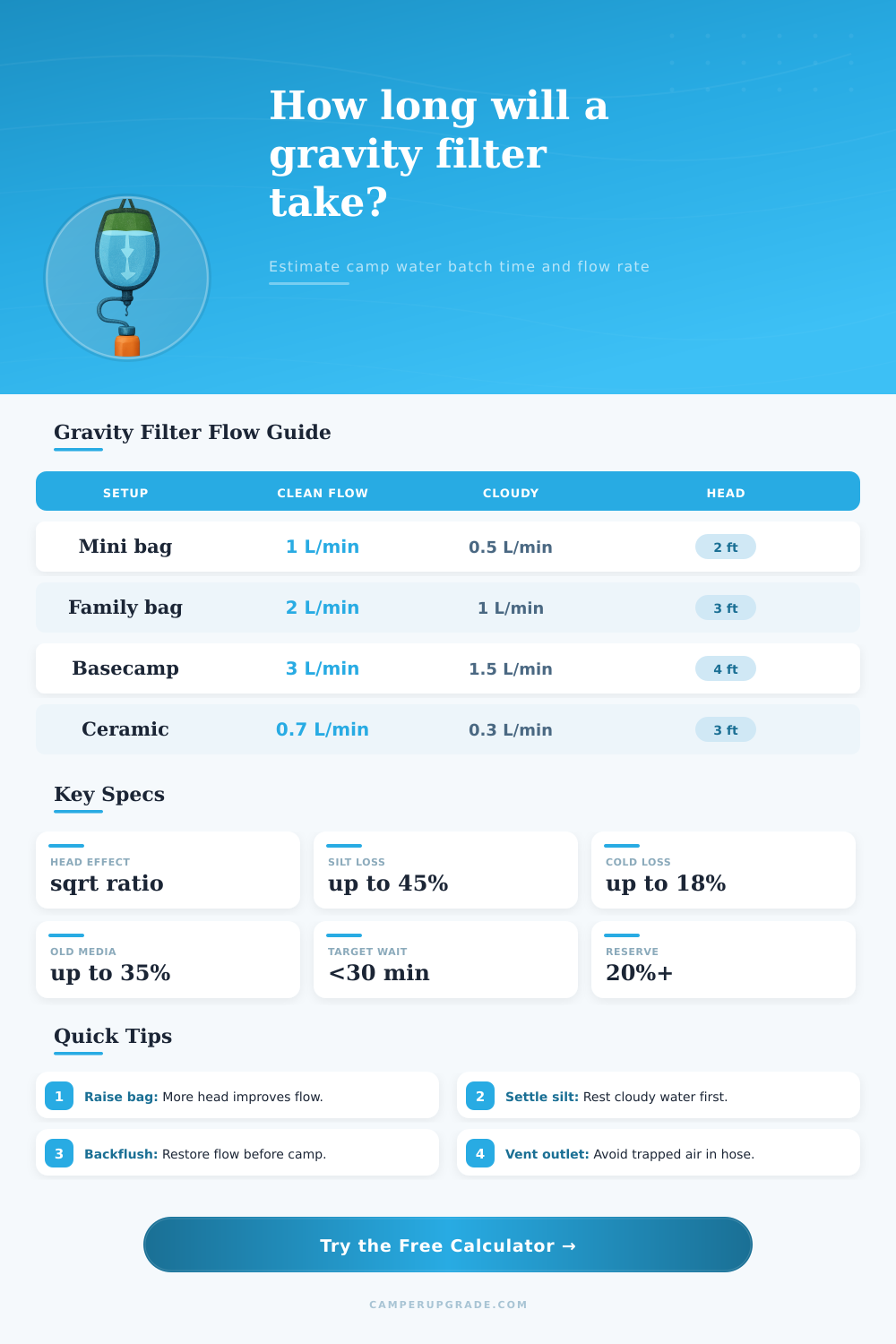
The first variable is head height. Head height is vertical distance between top of hanging bag where dirty water touches surface of water and bottom of spout leading back out. According to physics, flow rate is proportional to square root of head height. So doubling your head height doesn’t double your flow. Your flow will increase by around forty-one percent. It is not exponential, it is noticeable enough to make a difference when making plans.
For instance, if you have to hang up three liters of water at dusk after being stuck in a tree all day with no place lower than a few feet above your head, don’t expect it to happen fast. But understanding physics of head height help you manage your expectations or look elsewhere for an anchor before sundown.
Water quality is equally or even more important. Muddy water is particularly hard on hollow fiber membrane because fine silt acts as sandpaper on the membrane. It clogs the membrane’s pores very quickly and drastically decreases their flow. In clear water like that of an alpine stream, I get maximum throughput. Silty river water can cut that by almost half or more.
Conditions vary from clear spring water all the way to storm runoff, the calculator has multipliers for each. It also depends on whether or not you allow the water to settle before filtering. Oftentimes allowing sediment to fall out of the water for 20 minutes will filter faster then powering through a clog in the middle of your run. That’s what most folks fail to consider. They believe filtration speed is fixed, but it is really dynamic and degrades over time as the membrane loads up.
There is another wrinkle: temperature. Warmer water is thinner, colder water is thicker. Gravity fight against getting fluid through narrow channels in cold water. So much so that in freezing high-altitude weather, even gravity can’t overcome the thickness. That’s why the calculator accounts for temperature differences as well.
It’ll also account for age of your filter media. A new cartridge will have greater flow than a 500-liter-old cartridge filled with creek water. Old media will still get clogged, but not quite as fast. Regularly backflushing your cartridge won’t help; it will degrade over time and constrict flow sooner than normal. It is predictable, but inevitable. When you know what shape your filter is in, you can decide if you should of replaced it ahead of a long trip or just endure waiting a little longer.
Afterwards, it will tell you average flow rate, how long the batch should take, and the most interesting part: the service margin. That’s what lets you troubleshoot if something isn’t quite right. A low service margin means that you’re at the limit of gravity’s ability to handle things based off those settings. Time to clean your filter elements or maybe use a wider outlet hose? It is not only about getting water in there. It’s about keeping system running so it will work as designed when you’re miles away from civilization.
The reference tables on the page break all that down, comparing various media types. Fast hollow fibers need pristine input water to perform well; ceramic elements will last longer but flow more slowly. These trade-offs get weighed when planning a camp run. Is it faster with clear water and a high-head set-up or is it longer with low hanging points and muddy water sources? How does the tool help you see that decision? That’s the nice part. It takes away the angst of not knowing how long it’s going to take.
You won’t have to guess anymore; you can just make good use of your time. Knowing the time from hot coals to clean dinner water doesn’t hurt. Gravity waits patiently for you, but you better be ready too.
Once you understand the limits of water clarity and head height, you stop fighting the physics and start working with it. And that means having clean water without the stress, exactly when you need it.