Camp Soap Dilution Calculator
Mix concentrated camp soap into practical field bottles, estimate trip supply, and adjust for cleanup task, water hardness, soil load, and reserve.
Camp Soap Mix Results
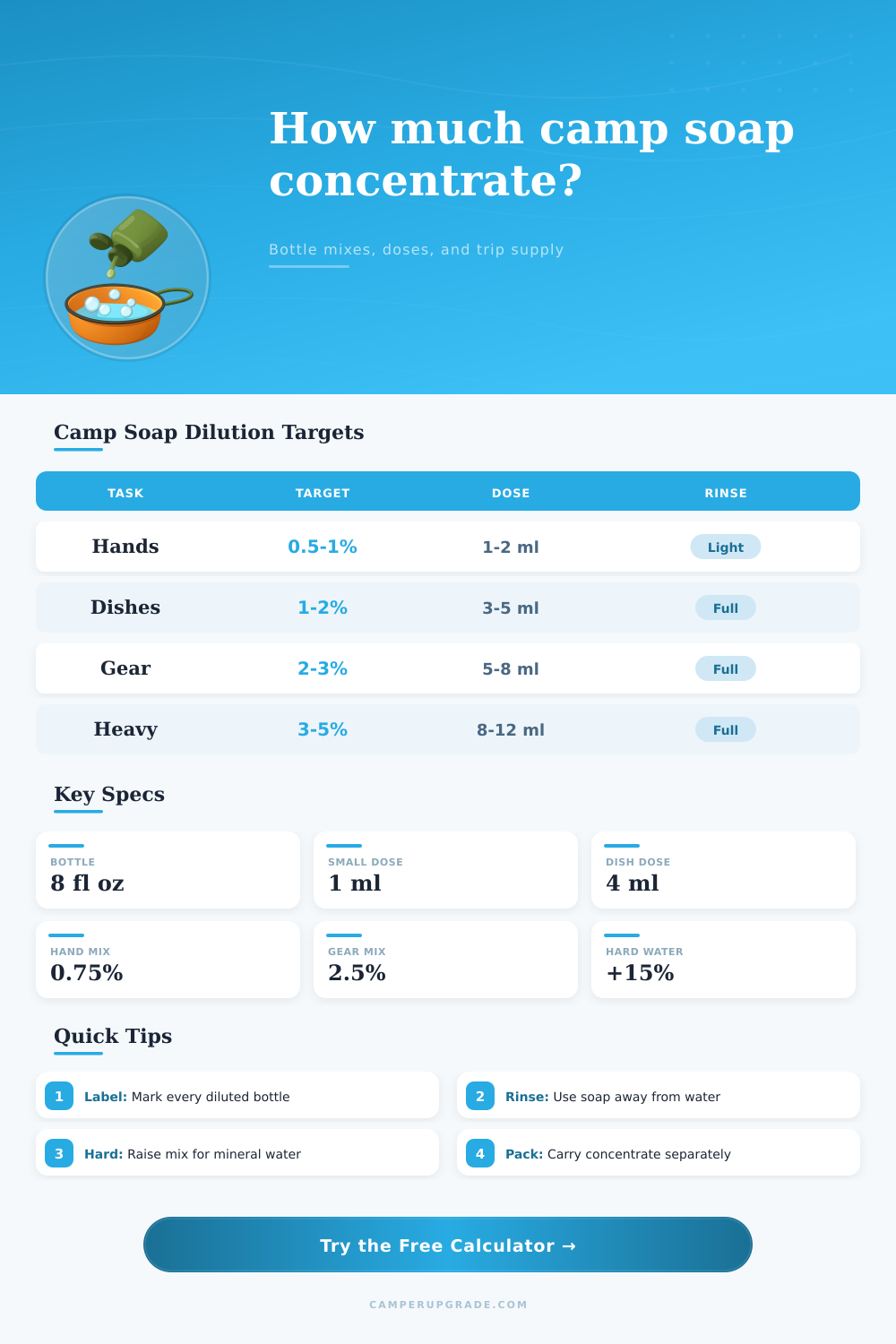
| Camp task | Target soap strength | Typical diluted dose | Best container |
|---|---|---|---|
| Foam hand wash | 0.5% to 1.0% | 1 to 2 ml per wash | Foam pump or small squeeze bottle |
| General dish washing | 1.0% to 2.0% | 3 to 5 ml per dish session | 8 fl oz squeeze bottle |
| Counter and RV sink wipe-down | 0.75% to 1.5% | 2 to 4 ml sprayed onto cloth | Trigger or mist bottle |
| Boots, bikes, and hard gear | 2.0% to 3.0% | 5 to 8 ml per scrub | Wide-mouth wash bottle |
| Small clothing wash | 1.0% to 2.0% | 5 to 10 ml per liter basin | Basin or dry bag wash |
| Greasy pans and heavy residue | 3.0% to 5.0% | 8 to 12 ml per pan | Small high-strength bottle |
| Bottle volume | 0.75% from 40% | 1.5% from 40% | 2.5% from 40% |
|---|---|---|---|
| 100 ml pocket bottle | 1.9 ml concentrate | 3.8 ml concentrate | 6.3 ml concentrate |
| 250 ml camp bottle | 4.7 ml concentrate | 9.4 ml concentrate | 15.6 ml concentrate |
| 500 ml shared bottle | 9.4 ml concentrate | 18.8 ml concentrate | 31.3 ml concentrate |
| 1 liter basin mix | 18.8 ml concentrate | 37.5 ml concentrate | 62.5 ml concentrate |
| Container | Practical capacity | At 2 ml dose | At 5 ml dose |
|---|---|---|---|
| 1 fl oz mini bottle | 30 ml | 15 light washes | 6 dish doses |
| 2 fl oz squeeze bottle | 59 ml | 29 light washes | 12 dish doses |
| 4 fl oz bottle | 118 ml | 59 light washes | 24 dish doses |
| 8 fl oz bottle | 237 ml | 118 light washes | 47 dish doses |
| 16 fl oz bottle | 473 ml | 237 light washes | 95 dish doses |
| Condition | Multiplier | When to use it | Field sign |
|---|---|---|---|
| Soft water, light soil | 0.90 | Rainwater, filtered RV tank, quick hand wash | Lathers quickly |
| Normal camp water | 1.00 | Most dish kits and campsite taps | Rinses cleanly |
| Hard water or dusty gear | 1.15 | Mineral-heavy taps, desert dust, muddy soles | Weak lather |
| Very hard water or oily residue | 1.30 | Grease, chain grime, soot, fish cleanup | Film remains |
Few backcountry trips end due to loss of trail or foul weather, but rather an underestimation of soapy needs. “A drop will do” you think, loading up a pint-size bottle of concentrate that has magical powers and can never run out. Day two comes around, and despite washing your hands after touching raw meat, they’re still feeling slimy and oh my gosh, there’s barely enough for one more use left in this bottle.
Dilution ratios for camp soap seem easy enough in theory, but get dicey in application. Water hardness, type of task, number of pancake eaters, and even concentration strengths is all variables that need to be considered. Go wrong here and either carry dead weight or, as is often the case, run out of active cleaner mid-meal, leaving greasy plate that nonetheless feel like silk.
How to Use Camp Soap Correctly
Above is the tool I use for that math; now all you have to do is pack light and stay clean. First it asks what you’re washing. Scrubbing grease off your dirty cast iron skillet is going to take a stronger solution than washing your hands. A 0.5 percent mix works fine for personal hygiene and lathers well in soft water, but using the same dilute solution to wash dishes are akin to using spit to clean a kitchen. For that, you’ll want something with more active surfactant to bust through the oil and starches. This task-based difference affects how much concentrate the calculator uses. It ensures you don’t waste precious grams on super-strength solutions where light will do just fine, yet it saves up enough punch to tackle heavy lifting at the end of the trip.
In the real world, this all depends on water quality. Both rainwater and a soft spring will allow your soap to lather efficiently at lower concentrations. Dusty conditions coat your gear with grit. It is different than that mineral-heavy tap water at a state park. Your soap may work great down to very low concentrations, then suddenly be barely functional when faced with the same volume. The inputs consider the soil load and hardness adjustment. Those ions in hard water binds to the soap molecule, rendering it less effective at getting things clean unless you use more. Fifteen percent more concentrate for oily residue or hard water? Seems like a tiny tweak. But it prevents that frustrating moment when your dishwater stays cloudy and greasy no matter how much you scrub.
Next, consider bottle size. While an eight-ounce squeeze bottle is a good all-arounder, filling it up with straight-up concentrate is a bad idea for two reasons. One, you won’t actualy use the full strength (wasting product). Two, pure concentrate will ruin plastics/seals over time. So mix in larger quantities beforehand; either at home or at the trailhead, to save space and minimize spills. The tables on this page tells you exactly how much concentrate to add to different-sized bottles to reach desired strength. That way, you know how much you have on hand to last the whole trip for everyone in your group.
When determining how much supply to pack, it’s not about distance, but group dynamic that matters most. If you’re a family camping for the weekend with three meals per day, you need much less then if you’re a solo hiker who plans to wash her hands twice daily. Based off days and people count, the calculator predicts the total diluted volume you’ll need, including a suggested reserve buffer (because life happens). You drop a plate in the dirt, spill coffee on your shirt, or decide to wash your wool socks at the end of your trip. A 20% reserve covers unexpected spills like this without making you carry double what you need from the get go.
The golden rule is packing strong and using weak. You don’t want the concentrated soap to leak onto your clothes and ruin them. Keep it in a secure first container away from where you live. In smaller second containers (bottles), mix just enough for tomorrow or the day after. That way if one of these smaller bottles gets spilled or breaks in your pack, it won’t contaminate your main supply. Plus this lets you adjust the strength on the fly. If the water turns out to be softer than expected, you can mix less concentrate next time. If things get too greasy, you can mix a stronger batch for this time.
Lastly, don’t forget that biodegradable does not equal safe. Use soap sparingly, even biodegradable, mild soaps! And always use it at least two hundred feet away from any spring, lake, or stream. Responsible camping includes managing graywater. By using the right amount of dilution, you’ll get the most sanitation while minimizing environmental impact. That’s why we provide exact measurements instead of guesswork estimates, helping you get just enough cleanliness while staying environmentally conscious.
In the end, this is just another example of the wilderness making preparation meet reality. You don’t worry about suds when you know how to mix your soap and how much to bring with you. Dishes and clean hands are little things that mean a lot out there miles from home. Enjoy the meal.