Salt Ice Slurry Temperature Calculator
Estimate how cold an ice, water, and salt slurry will run for cooler chilling, fish handling, drink baths, and RV food prep using salt concentration, ice reserve, purity, starting temperature, and heat leak.
🧭Real Slurry Presets
⚙Slurry Inputs
🧂Salt And Ice Specification Grid
📊Reference Tables
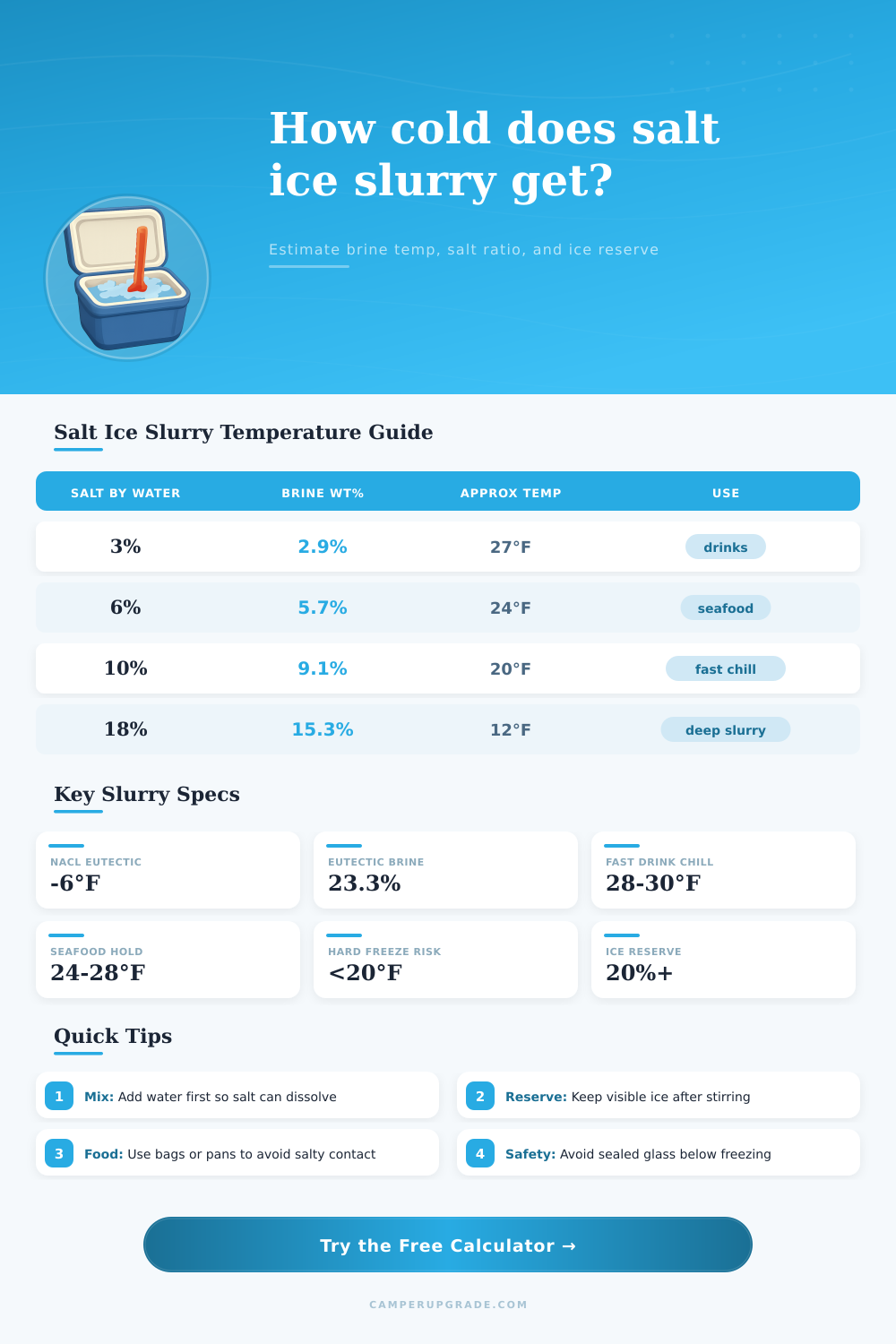
| NaCl Brine Strength | Approx Freezing Point | Camping Use | Watch Point |
|---|---|---|---|
| 0% | 32°F / 0°C | Plain ice water | No salt acceleration |
| 3% | 28.8°F / -1.8°C | Cold drink bath | Gentle for cans |
| 6% | 25.8°F / -3.4°C | Fast beverage chilling | Can partially freeze drinks |
| 10% | 20.5°F / -6.4°C | Fish or seafood slurry | Bag food for salt control |
| 15% | 11.8°F / -11.2°C | Very aggressive chilling | Glass breakage risk rises |
| 23.3% | -6.0°F / -21.1°C | NaCl eutectic limit | Extra salt may remain undissolved |
| Salt Type | Usable NaCl | Dissolving Behavior | Best Slurry Role |
|---|---|---|---|
| Kosher or pickling salt | About 99% | Dissolves cleanly, no anti-caking issue | Food-adjacent drink and seafood coolers |
| Ice-cream rock salt | About 96% | Coarse crystals dissolve slower | Hand-crank buckets and long slurries |
| Plain solar or softener salt | 98-99% | Large pellets need stirring and water | Large fish boxes where contact is indirect |
| Iodized table salt | About 97% | Fast but clumps with moisture | Small emergency batches |
| Dirty deicing rock salt | Often 90% or less | Unknown grit and additives | Non-food outdoor use only |
| Ice Form | Contact Speed | Melting Pattern | Practical Note |
|---|---|---|---|
| Crushed ice | Fast | Rapid brine formation | Best for quick drink chilling and fish contact |
| Bagged cubes | Medium | Balanced melt and reserve | Good default for cooler slurries |
| Block ice | Slow | Low surface area, long reserve | Needs added water and stirring to make brine |
| Snow or shaved ice | Very fast | Very quick melt and uniform brine | Easy to oversalt and lose reserve ice |
| Scenario | Starting Ratio | Target Temp | Good Reserve | Use Note |
|---|---|---|---|---|
| Drink tub | 1 lb salt per 5 gal water plus ice | 28-30°F | Visible ice floating | Stir every 10 minutes |
| Fish bleed slurry | 1 lb salt per 3-4 gal water plus ice | 24-28°F | 25% ice by volume | Cold contact matters more than lowest temp |
| Ice cream bucket | 1 part salt to 6-8 parts ice by weight | 8-18°F | Slush around canister | Very salty bath is intentional |
| Seafood transport | 3-6% brine with lots of ice | 27-30°F | 20% ice remaining | Avoid freshwater soak for some seafood |
| Deep chill experiment | Near eutectic salt level | -6 to 10°F | Salt and ice both visible | Not appropriate for sealed drinks |
🧮Calculation Tips
Cold is counter-intuitive. Intuitively you’d think salt would just make things wetter, but nope. In terms of heat and energy, salt throw off the balance of solid/liquid water. So instead of melting ice, it go down to below-thirty-two. That’s why this stuff can cools drinks within minutes different than hours. And it keeps raw fish alive in much lower temps (below freezing). Bacteria grow more slowly at these temperatures, but they is not low enough to freeze the fish solid.
The math is done by the calculator up top. Just plug in your load size to turn chemical theory into real-world recipes. That means we need to think about how this all works on an energy transfer scale within the bucket. Salt dissolving into water sucks up some energy from it’s surroundings. That energy are from the ice. So, it melts more ice than it would if dissolved in plain water. It does so using latent heat, a lot of it. This cause the whole mix to cool and keep doing so until it finds a new state of balance based off the amount of salt in the solution.
How Salt and Ice Work Together to Cool Things
And that’s where knowing exactly what is happening matters most. Sure, you’re cooling stuff down but also controlling a phase change. Do it wrong and you might end up with a mix that are either not cold enough or so cold it freezes your drinks. If the salt content is too low, the water will become slushy and not much cooler than ordinary ice. If there’s too much salt, you’ll get close to (or even past) the eutectic point and the solution freeze so hard that it may crack your glass bottles or freeze the contents of your cans. Three to six percent by weight is the sweet spot in most camping situations. That concentration cools the brew down to around the mid-twenties Fahrenheit range. It chills your drinks quickly while remaining mellow enough to avoid freezing your soft drinks.
The calculator figures out exactly how much salt to use based on purity of your salt supply, the amount of ice you’re adding, and the volume of water already in your container. Salt isn’t one-size-fits-all here. Some types of salt include anti-caking agents that can end up leaving a film on your food storage containers or even clouding the brine. For example, use kosher salt or pickling salt; they dissolves well without any cloudiness. Other salts such as rock salt may be less effective (they’re full of stuff besides just sodium chloride) and you might have to add extra by weight to get the desired cooling effect. But this tool will take care of this variation for you automatically. Knowing about it, though, allows you to select appropriately at the supermarket. When you’re buying cheaper bagged deicing rock salt, keep in mind that it’s only the pure sodium chloride part that cools things down.
Surprisingly enough, the texture of ice also matters a lot. When it’s crushed, the brine forms and spreads rapidly throughout your load because there’s a lot more surface area than with solid blocks. However, solid blocks is long lasting and stay put so they’ll take longer to chill things down if you don’t mix them up or add some water too. You can get a reasonable estimate of how many pounds of ice you should expect once you’re ready to unload by modeling these ice textures based on the inputs above. Try for at least 20% reserve ice, because if the whole thing melts into a puddle, you lose the phase-change cooling benefit and the temperature starts climbing.
Remember… It’s cold outside: Don’t worry about the beer getting warm, but do be careful of it freezing! When it gets that cold, don’t put sealed glass bottles into the ice as they could of explode if the liquid inside expands or if the thermal shock stresses the material. Aluminum cans won’t explode, but they will freeze part way through, changing the taste/texture of your drink. Put all drinks and foods into plastic baggies first so nothing is contaminated with salt water. The extra layer protects your meal from turning into something like ocean water instead of dinner.
The bottom line is that ice slurries are all about finding the right balance, not brute force. Use enough salt to drag the temperature downward but not so much that it take away the ice buffer that maintains the temperature in the first place. And the tables of references on the page make it easy to see how each concentration falls across the range of temperatures relevant to most campers. So whether you’re stocking up on sodas for a tailgate or keeping oysters cool after bringing them back off the boat, knowing the right mix lets you turn an ordinary cooler into a pro-level chill bath.
Keep some ice visible on the surface. Give it a stir every now and again to maintain a consistent brine. Whatever you’re chilling will remain surprisingly cool until you’re good and ready to get cracking.