Cooler Air Gap Volume Calculator
Estimate the usable air space, clearance channels, ice balance, and packed volume inside an RV or camping cooler.
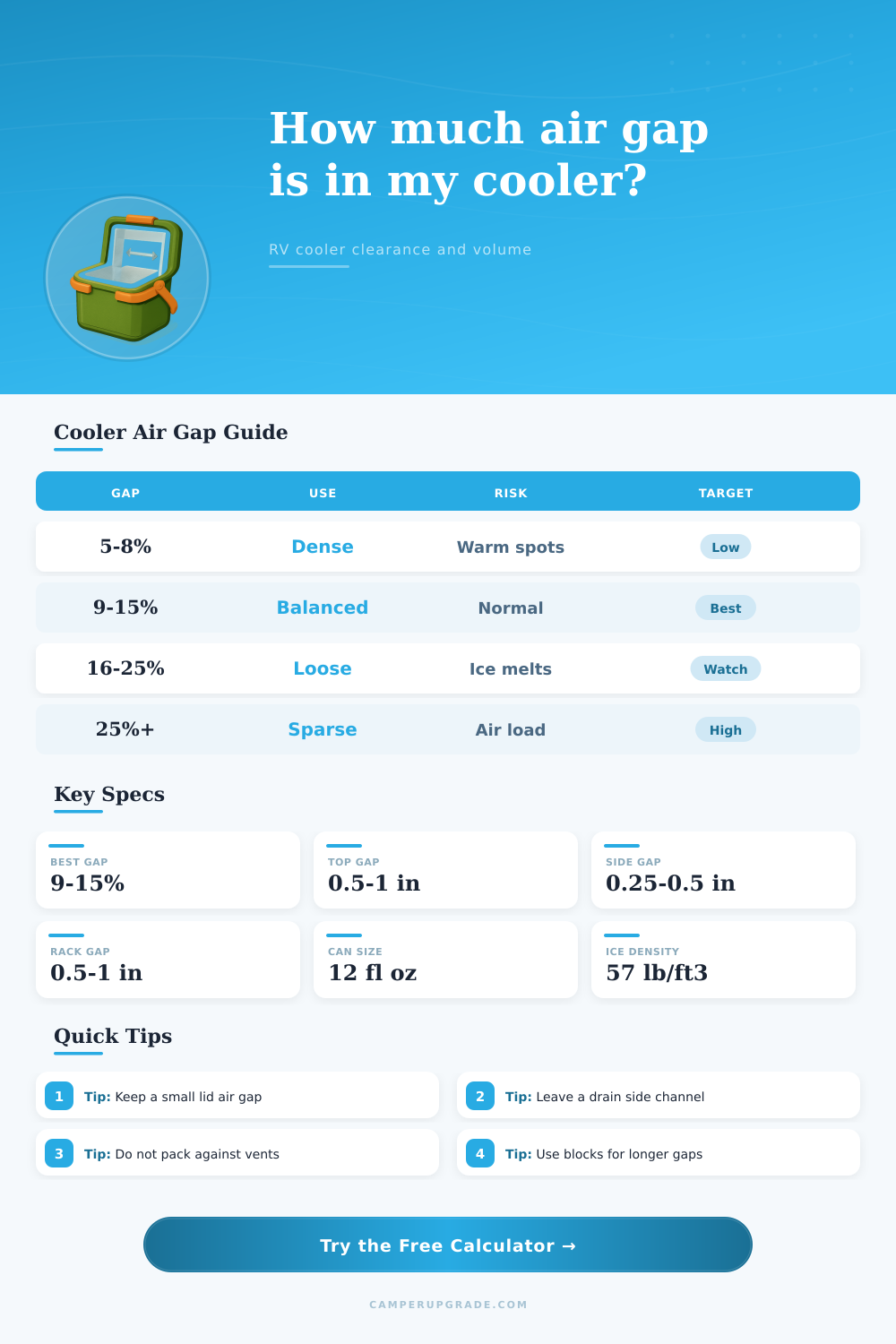
| Air gap share | Cooler behavior | Best use | Adjustment |
|---|---|---|---|
| 5% to 8% | Very dense pack, limited circulation | Short food haul with pre-chilled items | Add a top or side channel |
| 9% to 15% | Balanced volume with useful cold-air paths | Most RV food and drink coolers | Keep current layout |
| 16% to 25% | Loose pack, more air to cool after openings | Drink coolers with frequent access | Add ice mass or filler |
| More than 25% | Large air load, faster temperature swings | Partial-load transport only | Use a smaller cooler or spacer |
| Item type | Typical volume | Cubic inches | Calculator use |
|---|---|---|---|
| 12 fl oz can | 0.375 qt | 21.7 in³ | Drink displacement |
| 16 fl oz can | 0.5 qt | 28.9 in³ | Drink displacement |
| 20 fl oz bottle | 0.625 qt | 36.1 in³ | Drink displacement |
| 1 liter bottle | 1.057 qt | 61.0 in³ | Use 1 qt as close field value |
| 1 gallon jug | 4 qt | 231 in³ | Add to food container volume |
| Clearance feature | Common range | Volume formula | Why it matters |
|---|---|---|---|
| Side wall gap | 0.25 to 0.5 in | Perimeter gap x load height | Lets cold air move beside bins |
| Top lid gap | 0.5 to 1 in | Interior floor x top gap | Reduces lid contact and crushing |
| Bottom rack void | 0.5 to 1 in | Interior floor x rack height | Keeps meltwater below food |
| Drain channel | 0.25 to 0.75 in | Channel width x height x length | Preserves drainage path |
| Packing method | Air behavior | Ice behavior | Best calculation focus |
|---|---|---|---|
| Cubed ice around food | Many small voids | Fast contact cooling | Watch total air percentage |
| Block ice on bottom | Cleaner top air gap | Slow melt, longer hold | Use rack and top gap fields |
| Frozen bottles | Predictable displacement | No meltwater until thawed | Count bottles as drink volume |
| Rigid meal bins | Large straight channels | Needs side clearance | Measure food container volume |
| Fish box with rack | Bottom void is intentional | Meltwater drains away | Use spacer and drain channel |
Pack your cooler tight; but not stuffed The majority of camp wisdom assume that all ice chests are unbreakable cold-weather fortresses. They’re not. This is a changing system, where empty space will work against you and solid objects takes up space. If you stuff them too tightly, you squash the cans and block the airflow; if you pack them to loosely, you leave too much warm air in the mix. The solution lies somewhere between, taking into account not just what can fit in shell, but what’s actualy inside the box.
To find the inside dimensions simply fill out the form at the top with your interior dimensions. Then add your load and it calculates the math for you. No more guesswork as to how many bottles fits inside or what a block of ice will take up. The majority of folks just measure their exterior cooler dimensions, then presume they gets the listed capacity. That’s not normally the case. The labels account for things like lid curve, shape loss, and how the drain well eat away at the useful volume.
How to Pack Your Cooler Correctly
What you want to do is measure the interior straight dimensions (length, width, height) where the load reside. Because an inch or two off each side adds up quickly. It makes a big difference in your air gap percentage.
What are you loading? Consider how some containers displace water in a predictable way; a gallon jug will always push out that much, while rigid food bins does a good job pushing air around. And remember, a twelve-ounce can of beer (or soda) take up approximately.375 quarts. Then there’s block ice, which isn’t going anywhere, it’s got mass, and settles into a relatively stable bottom so things don’t shift around. Cubed ice is another story. Because of their size, cubes creates tiny gaps that are empty but still take up space, effectively reducing your total “solid” volume.
To account for this discrepancy, the tool allows you to input not only the number of drinks but also type of ice. For instance, if you’re loading frozen bottles, it will treat the whole thing as both displacement volume and cooling mass, that’s pretty clever, since it’ll help increase hold time without filling with meltwater right away.
Airflow and drainage are not talked about much, yet they’re crucial. To help airflow, you want a quarter- to half-inch or so gap all around (along the sides) where cold air can flow alongside your bins instead of getting stuck on their backsides. Half to one inch at the top will allow for thermal expansion while still preventing things from getting crushed once you seal up unit. And leave some kind of channel near your drain to avoid having meltwater standing around your food container. When you pack everything tightly against every surface, you’ll create pressure points that damage the insulation. This will create warm spots.
The reference table on the page explains what happens with various size gaps. It says that most useful cold-air paths tend toward a balanced volume between roughly nine and fifteen percent air share. A good rule of thumb here: That number is your best indicator of success. Below five and you’re packing a tight wad that’ll do okay on short hauls but will lack enough circulation. Above twenty-five and you’ve got a big ol’ air load that’s going to heat up fast with every lid-opening. You want as little air as possible to cool down between accesses.
Melting ice becomes a buffer here; but only if it’s not in direct contact with all other contents. It goes quicker when there isn’t anything to insulate it from. Good ice-to-air contact mean the cold mass surrounds the empty spaces instead of settling at the bottom.
Roads have their own tilt on them and add vibration that shifts your load. Soft coolers flex and change shape internally. The shape changes along with the increase in uncertain air space. Hard sided ones maintains form and the math is less guessing. Carrying a fish box adds its own twist as there will be a space at the bottom purposely left open for drainage. That completely alters how one pack it. Racks and spacers maintain proper ice contact to retain quality. They also keep protein above any meltwater.
In conclusion: To pack a cooler is to master displacement. Fill it? Nope. You can’t have an empty space. Load it with drinks and food? Sure. But only so long as they remains in place. Pack it right, account for drainage, honor that air gap and measure carefully. When the cooler is full to capacity, it should feel solid but not strained; it should of have some give so the cold does its thing, not held back by the warmth within. That’s the sweet spot. Where the drinks are frosty, and the food is safe, no matter how hard the road may get.