Jerky Marinade Ratio Calculator
Scale marinade volume, salt, cure #1, sugar, acid, spice, and expected dry yield from your trimmed meat weight.
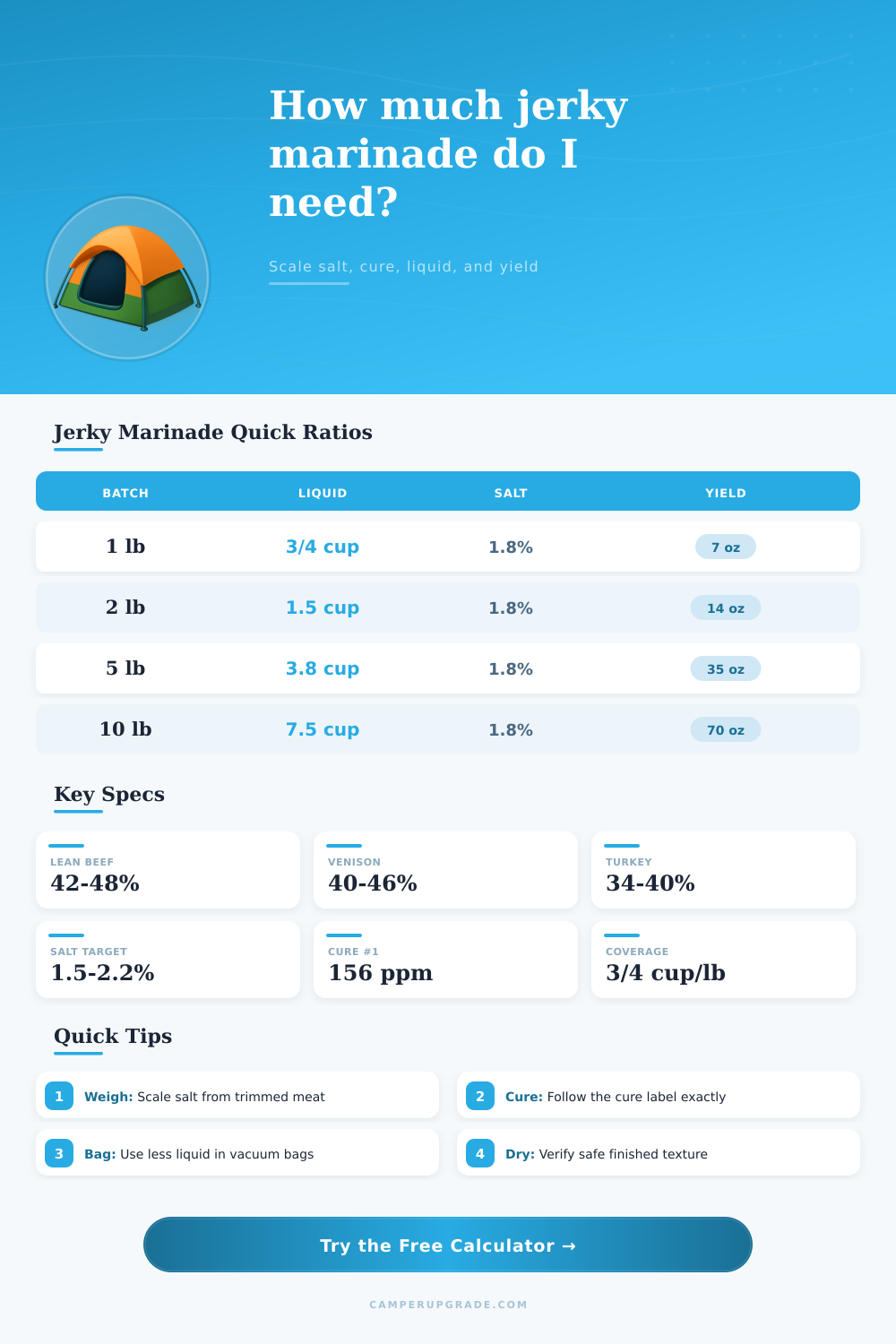
| Protein | Best lean cuts | Typical finished yield | Ratio note |
|---|---|---|---|
| Beef round | Eye round, top round, bottom round | 42% to 48% | Use 1.5% to 2.0% salt for most batches. |
| Venison | Hindquarter muscles, backstrap trim | 40% to 46% | Very lean; watch over-drying on thin slices. |
| Turkey breast | Boneless skinless breast | 34% to 40% | Lower yield; keep slices even for safe drying. |
| Pork loin | Center-cut loin, fat trimmed | 38% to 44% | Trim fat closely and use measured salt. |
| Goose or duck breast | Skinless lean breast | 36% to 43% | Remove skin and surface fat before weighing. |
| Marinade style | Salty base | Acid or fruit | Sweet and spice target |
|---|---|---|---|
| Classic soy Worcestershire | 35% to 50% | 5% to 10% | 1% to 2% sugar, 1% to 1.5% spice |
| Teriyaki sweet soy | 30% to 45% | 5% to 12% | 3% to 6% sugar, ginger and garlic |
| Black pepper trail | 40% to 55% | 0% to 8% | 0.5% to 1.5% sugar, heavy pepper |
| Chile garlic hot | 35% to 50% | 6% to 15% | 1% to 3% sugar, chile 1% to 2% |
| Dry-rub splash | 15% to 30% | 0% to 6% | Most flavor comes from weighed dry seasoning |
| Salt source | Approx salt concentration | 1/4 cup contributes | Use in calculator |
|---|---|---|---|
| Regular soy sauce | About 15% | About 9 g salt | Select regular soy and set base share. |
| Reduced-sodium soy | About 9% | About 5.4 g salt | Useful when adding salt directly. |
| Tamari | About 16% | About 9.6 g salt | Often stronger than regular soy. |
| Liquid aminos | About 14% | About 8.4 g salt | Similar salt impact to soy sauce. |
| Worcestershire | About 3% | About 1.8 g salt | Flavor base, not enough salt alone. |
| Cure or no-cure choice | Calculator assumption | Formula basis | Important limit |
|---|---|---|---|
| No cure #1 | 0 ppm nitrite | No cure weight is added | Use a validated heat and drying process. |
| 100 ppm cure target | Lighter cured batch | ppm x kg meat / 62.5 | Still follow cure label instructions. |
| 120 ppm cure target | Moderate cured batch | ppm x kg meat / 62.5 | Measure with a gram scale. |
| 156 ppm cure target | Common maximum target | 2.5 g cure #1 per kg meat | Do not exceed applicable rules or label. |
You have three pounds of trimmed beef round and a bag of soy sauce that has been in your pantry since last winter. Jerky sounds good, but you’d like it to be tasty instead of tasting like some salted leather strap. Homemade jerky fails most folks not due to impatience, but because they approach marinades as an art instead of basic chemistry.
The calculator above do the math for you: it runs the numbers so you don’t have to guess or deal with trial and error. No wasted ounces of protein here. Knowing what’s going to happen when you put heat to your meat is essential to making a solid batch.
How to Make Good Beef Jerky at Home
When you dehydrate raw muscle, most of that weight lost are water; however, if handled carelessy, some of its structure goes away as well. Leaner meats like deer backstraps and beef eye rounds contains very little intramuscular fat. Since this fat can go bad and form rancid pockets in a low-heat space, these meats is fairly predictable. This is why picking your protein type in the tool establishes expectations about yield.
For instance, one pound of beef round will result in much more finished jerky than a pound of turkey breast; just look at how much water is in each initially. Before you cut anything up, consult the reference table on the page to see how much final product each amount of starting material will produce. The table shows exactly how each kind of meat shrinks different. This helps you calculate your storage container needs properly.
The second variable that trips up beginners are salt. Specifically, they mistake its strength for its preserving ability. Yes, salt inhibits bacteria growth, pulling water out of the muscle fibers as it slowly dries over time. But too much salt will turn your jerky into a puck that’s not even worth chewing.
2%. This is a percentage of your total post-trim meat weight. And here’s the key: It includes the amount of salt already found in your liquid base. Use regular soy sauce (about 15% salt by weight) instead of reduced-sodium? That’s going to make a big dent in your overall sodium budget.
A lot of recipes fail to account for this overlap and also include more kosher salt on top, leaving you with a whole batch that will overwhelm your tastebuds for a week. The calculator deducts the salt from whatever soy or tamari you use before advising how much additional dry seasoning you should of add. It is a small but important distinction.
But what about curing agents? If your goal is to keep your jerky around longer than a few days, then I’d really suggest taking curing seriously, it’s not optional. Sodium nitrite is found in cure number one, and is used to preserve both its pinkish color and prevent botulism in oxygen-free conditions.
There is no leeway whatsoever, and dosage is strictly by weight. Do not eyeball the cure powder, and do not take a pinch between your thumb and forefinger. Weigh it out on a digital scale capable of reading weights down to at least tenths of a gram. It will do the math conversion from parts per million to real-life grams for your batch size. This helps you stay safely on the low side while getting enough to produce that tell-tale cured color and flavor without going overboard.
In other words: if you skip this step, you’re banking completely on quick drying and cold storage, which is fine if eating right now, but dicey for long-term pantry storage. Salt and cure are used for other purposes. Sugar won’t make things sweet, as you only add a small amount to offset the acid’s sharp bite and help browning. Instead, sugar will break down some connective tissue and soften meat. Acid, whether from lemon or vinegar, tenderizes the meat by breaking down connective tissue. This means that adding too much sugar isn’t necessary (you’re trying to balance against the acid).
The level of liquid added to the bag depends on what settings you choose for Marinade Coverage. If you use vacuum bags, very little fluid is required because there is no air and the pressure makes sure everything gets covered. Regular zipper bags should have enough liquid to push out the air and fully submerge the food. Otherwise, the food will sit above the marinade, creating dry spots where bacteria can grow. Tweaking here avoids either issue: too wet (requiring hours to dry) or not wet enough (creating breeding grounds for nasties).
The art of making jerky is as much an exercise in consistency (and patience) as it is in cook time. How thin or thick you cut your slices determines your wait time. Thinner slices dry fast but risk being brittle. Thicker slices take longer and result in a chewy texture. You must also be more careful to ensure none spoil before they are fully dried. More important than extreme thinness is uniformity across all slices. If unevenly sliced, some will be burned through and others will be underdone.
Finally, after you’ve prepped your ingredients and weighed out your marinating liquid per your plan, allow this to soak overnight. The longer the meat sits, the deeper the flavor penetrates beyond the surface. Soaking allows the flavor to go deeper than just the outermost layer of meat.
So, to recap: good jerky isn’t so much about covering up a bad piece of meat as it is paying homage to the ratios. Understanding the connection between protein weight, liquid, and salt/cure means no more guesswork, just a lot more product. Plan for shrinkage and sodium right off the bat, and your following batch will taste better, go further, and cost less (because there’s less waste). That kind of accuracy transforms a slap-dash camp food item into something worthy of putting in the pantry. And keeping for a while.