Coal Bed Depth Calculator
Estimate the ember depth, coal volume, fuel load, and tending interval for camp grills, Dutch ovens, fire rings, and open-hearth cooking.
Calculation breakdown
Hardwood Coals
Softwood Coals
Briquettes
Lump Charcoal
Oak or Hickory
Mesquite
Mixed Embers
Dense Charcoal
| Cooking use | Typical depth | Best surface | Expected behavior |
|---|---|---|---|
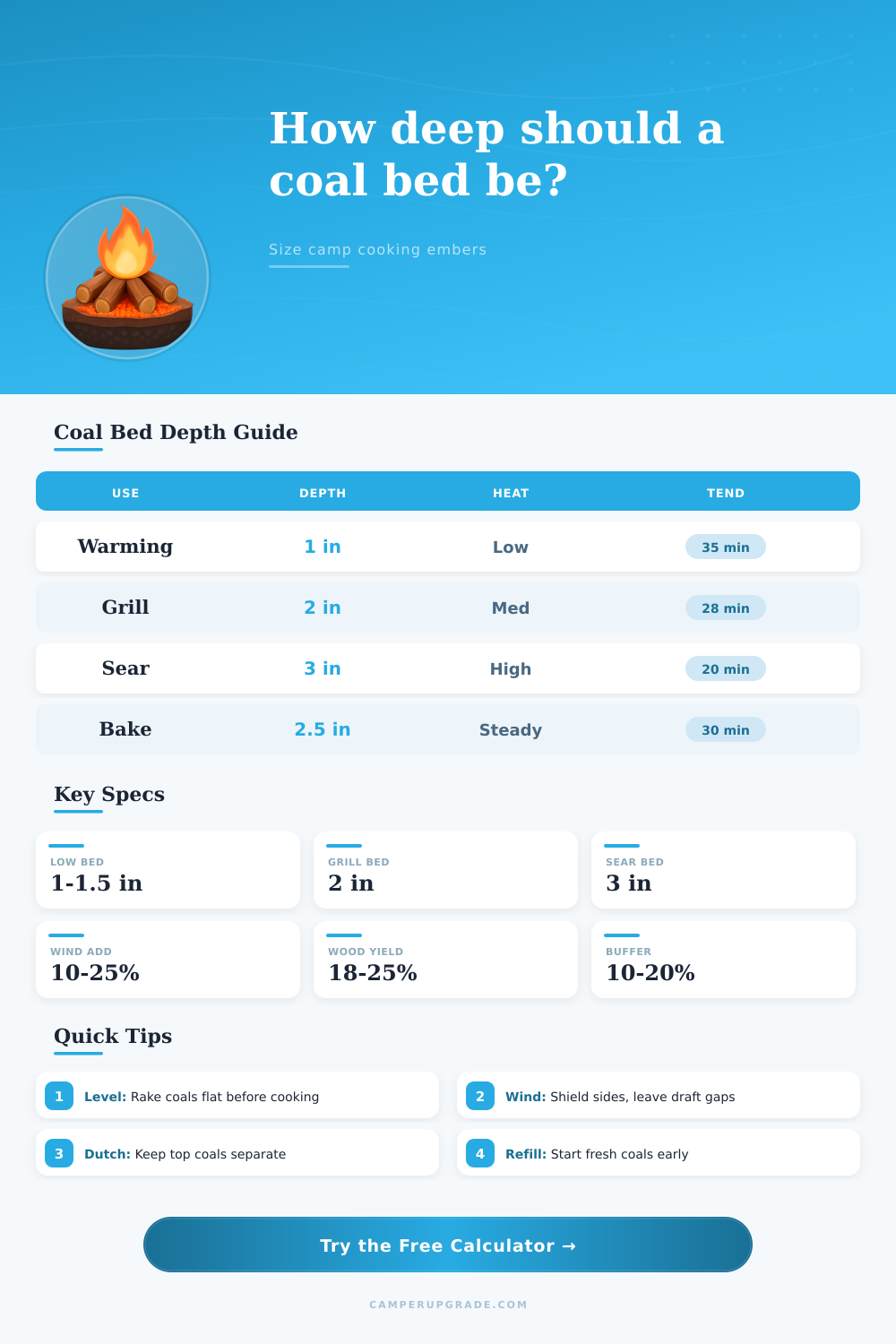
| Warming coffee or keeping pans hot | 0.75 to 1.25 in | Small even circle | Low radiant heat, long interval |
| Simmering beans, stew, or water | 1.25 to 1.75 in | Pot-width bed | Moderate heat without scorching |
| General grilling and foil packets | 1.75 to 2.5 in | Grate footprint | Medium-high heat, steady turning |
| Dutch oven bottom heat | 2 to 2.75 in | Oven diameter plus 2 in | Even bake when top coals are separate |
| Searing meat or cast iron | 2.75 to 3.5 in | Pan footprint | High short heat, quicker fuel drop |
| Long roast or covered skillet | 3 to 4 in | Wide stable bed | Longer reserve with slower adjustments |
| Fuel type | Loose coal density | Coal yield from wood | Base tending interval |
|---|---|---|---|
| Hardwood campfire coals | 16 lb/ft3 | 22% | 30 min per 2 in |
| Softwood campfire coals | 11 lb/ft3 | 18% | 22 min per 2 in |
| Charcoal briquettes | 18 lb/ft3 | Ready fuel | 38 min per 2 in |
| Lump charcoal | 13 lb/ft3 | Ready fuel | 30 min per 2 in |
| Oak or hickory coals | 17 lb/ft3 | 24% | 34 min per 2 in |
| Mixed campsite embers | 14 lb/ft3 | 20% | 27 min per 2 in |
| Bed depth | Volume over 1 sq ft | Hardwood coal weight | Use note |
|---|---|---|---|
| 1 in | 0.083 ft3 | 1.3 lb | Warm or hold |
| 1.5 in | 0.125 ft3 | 2.0 lb | Simmer |
| 2 in | 0.167 ft3 | 2.7 lb | Grill |
| 2.5 in | 0.208 ft3 | 3.3 lb | Bake |
| 3 in | 0.250 ft3 | 4.0 lb | Sear |
| 4 in | 0.333 ft3 | 5.3 lb | Roast reserve |
| Common camp setup | Coal area | Depth target | Approx coal load |
|---|---|---|---|
| 10 in skillet breakfast | 0.55 sq ft | 1.5 in | 1.3 lb hardwood coals |
| 12 in Dutch oven bottom | 0.95 sq ft | 2.5 in | 3.2 lb hardwood coals |
| 18 x 12 in foil packet bed | 1.50 sq ft | 2 in | 4.0 lb hardwood coals |
| 24 x 16 in grill grate | 2.67 sq ft | 2 in | 7.1 lb hardwood coals |
| 30 in round fire ring zone | 4.91 sq ft | 2 in | 13.1 lb hardwood coals |
| 36 x 20 in group grill | 5.00 sq ft | 2.5 in | 16.7 lb hardwood coals |
Heat causes most campfire cooking disasters, so it’s important to know what kind of heat you’re working with. The flame may seem promising, so you stoke up a roaring fire, but before you know it, you have a steak that’s cooked on the outside and uncooked in the inside. Coal depth create steady radiant heat, not the flame height. Rake away those ashes and you see that glowing bed. That’s the true cooking surface.
That layer of ember is where the real magic happen for campfire cooking physics. It tells you how much you need to prepare for weather and how quickly your meal will be done. After defining your cooking zone, the calculator do the math for you (above). But here’s where this tool gets realy helpful, it tells you how those inputs affect the results.
Why Coal Depth Matters More Than Flames
Target depth is the most important variable; it depends completeley on the task at hand. One-inch deep is adequate if you’re trying to warm some coffee or maintain warmth of some biscuits; that depth won’t retain enough heat to bake bread or sear a steak. Deeper beds holds more heat, and return to temperature quicker after adding cold food or opening the lid. That’s the key to achieving that perfect crust versus a soggy mess.
The other factor here is that harder woods (e.g., oak, maple) produce coals with higher density, tighter packing mean they last longer as a dense thermal blanket. Softer wood will actualy burn hotter early on before turning into ashes faster, requiring more tending. With lump charcoal, the variable shape form air pockets that alter oxygen access to the fuel. That’s a significant impact on burn time.
On the page, there’s a chart comparing densities. It explains the difference in weight between softwood and hardwood ember in a cubic foot. Yes, it’s about size; but also about amount of real fuel you have under your grill grate.
There’s nothing worse than having the wind throw away all of those good intentions. While you may find it pleasant outside with a gentle breeze, your coal bed lose its heat quickly. To counteract this, it begins burning quicker, creating more heat in less time. When it’s cold, however, the air act as a heat sink. It pulls energy away from the perimeter of your fire pit.
To make up for this, the tool buffers your estimated amount of fuel needed. Little things like this makes a difference when you’re looking at finishing up that roast before dark. Simply put, most folks don’t realize just how much additional fuel they’ll need because of that pesky little breeze.
Experience wins over intuition. You might think a bed of coals will last an hour, but if the depth is shallow or the wind is gusty, that heat fade in twenty minutes. No problem, you figure; just toss on another log and let it cook until everything’s done. That changes when the wind picks up or the coals gets too shallow. Then they’re gone in twenty minutes.
Staging more before they go out is the ticket. Ideally, lay down new wood far enough ahead so that it lights by the time you need to move some heat over for the next round. That way, the old bed doesn’t cool off beyond cooking depth while you wait for the new coals to take hold. There is nothing worse than that little lull where all you can do is gaze at a black-and-gray mass of ashes.
Another change-the-game factor is how far above the coals you cook. The higher you raise the grill grate, the bigger the roast, but also the farther away you are from heat. With radiant heat, distance greatly reduce its strength. You counter by increasing width (or depth) so there’s sufficient energy projected upward. Otherwise, what should of been a quick grilling session turns into a slow bake.
This is simple geometry, which most campers don’t notice until dinner is late. Coal bed depth make managing fire an exercise in reliable cooking instead of chaotic guesswork. You control your environment and stop guessing. The amount of glowing coal under your grate tell you all the information needed regarding heat stability. Learn how to read that layer and the flames will be nothing but irrelevent background noise.