Stove Pipe Height Calculator
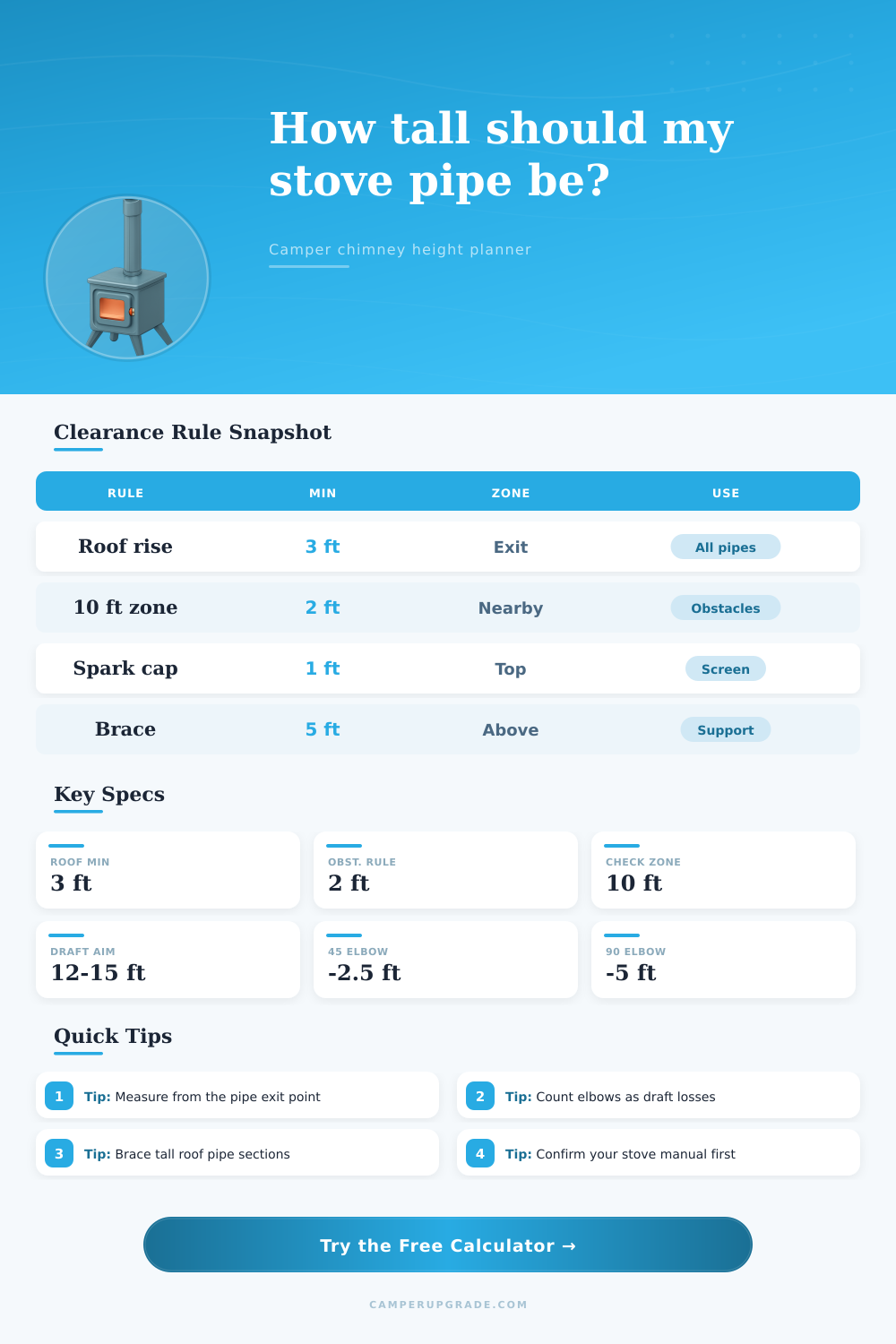
Estimate camper, trailer, wall tent, and compact cabin stove pipe height using roof clearance, the 3-2-10 rule, elbow draft loss, altitude allowance, and practical section planning.
📌Real Stove Pipe Presets
⚙Pipe Height Inputs
Calculated Stove Pipe Height
🔧Pipe Material and Spec Comparison
📊Reference Tables
| Clearance rule | Measured from | Minimum height | Calculator use |
|---|---|---|---|
| Above roof penetration | Roof surface at exit | 3 ft / 0.91 m | Base roof extension floor |
| 3-2-10 nearby obstruction | Any roof or object within 10 ft | 2 ft / 0.61 m above it | Raises required roof pipe |
| Roof pitch rise | Horizontal distance across sloped roof | Pitch / 12 per foot | Estimates higher roof plane |
| Support above roof | Unsupported chimney height | Brace near 5 ft / 1.52 m | Flags bracing need |
| Appliance type | Typical pipe | Effective draft target | Added notes |
|---|---|---|---|
| Small camper wood stove | 3-4 in | 10-12 ft | Short systems need straight pipe |
| Camp stove or hot tent stove | 4-5 in | 11-13 ft | Spark screen may reduce draft |
| RV or tiny wood stove | 5-6 in | 12-15 ft | Use listed chimney at roof |
| Diesel heater vertical exhaust | 1-3 in | Manufacturer limit | Height capped by heater manual |
| Mini pellet stove | 3-4 in | 8-12 ft | Draft fan changes requirements |
| Fitting or cap | Equivalent draft loss | When to add it | Calculator effect |
|---|---|---|---|
| 45° elbow | 2.5 ft / 0.76 m | Offset around cabinet or rafter | Subtracts from effective height |
| 90° elbow or tee | 5 ft / 1.52 m | Wall exits and cleanout tees | Large draft penalty |
| Spark arrestor screen | 1 ft / 0.30 m allowance | Wood stove cap with mesh | Raises draft target |
| Restrictive cap damper | 1.5 ft / 0.46 m allowance | Wind cap or damper cap | Raises draft target more |
| Pipe diameter | Area | Typical camper use | Height sensitivity |
|---|---|---|---|
| 3 in / 76 mm | 7.1 sq in | Small heaters, tiny stoves | High, keep very straight |
| 4 in / 102 mm | 12.6 sq in | Mini wood and tent stoves | High in short campers |
| 5 in / 127 mm | 19.6 sq in | Compact RV wood stoves | Moderate |
| 6 in / 152 mm | 28.3 sq in | Cabin-style small stoves | Moderate to low |
💡Calculation Tips
The smell of wet cardboard greeted Heather as she stirred. She had a headache. Her wood stove was operating, but its chimney pipe wasnt long enough for this chilly morning. When it ran exhaust blew back into the living space.
This is a classic camping mistake: Buy a stove, find a hole in the roof, and run pipe until it pass over shingles. On paper, that’s good enough, satisfying minimum building codes. But hot air doesn’t move like that. Only with enough vertical distance can heat rise, creating a proper vacuum effect.
How To Fix Your Wood Stove Chimney
Plug in the number of elbows in your setup plus height of the roof exit, and the calculator does the rest. No more guesswork about whether your set-up will pull smoke outward or force it back into your sleeping bag.
The problem isn’t that a camper is a cabin, it’s that it has less clearance. It have inches instead of feet. With a long chimney in your house there aren’t as many degrees of bend, but in a van or trailer shell they all matter more. This is where the tool comes into play, each elbow reduces effective height. A 90* turn will cost you roughly five feet of draft pressure equivalent.
Sounds like plenty right? But then you remember that with a short system you may only have twelve feet total to work with, and it begins to choke on itself. In small spaces you’re fighting air resistance and gravity with each fitting, which makes those hard turns particularly treacherous. Without any appliance upgrade the best thing you can do is keep your run straight.
To add to the confusion, folks measure from incorrect location. When we say three feet minimum clearance over the roof surface, that’s measured at the point the pipe goes through the deck, not from the ceiling trim nor the stove top. And if your camper features a sloped shell, the roof plane get progressively higher as you get further from the exit point. That pitch is accounted for in the calculator so that you remain safely clear of any higher points within a ten foot radius.
You don’t want sparks flying onto nearby dry fiberglass insulation or shingles, and you don’t want rain blown back into the stack. It is a simple bit of geometry, but it can make all the difference between a clean burn and a fire hazard on a windy night.
Most campers don’t consider altitude until they’re freezing their asses off in Colorado. Less dense air means there is fewer oxygen molecules, which affects how combustion gases rise. To create equal draft force as sea-level conditions, you need more vertical distance at higher elevations. This is why the tool takes into account where you plan to park and then allows some extra room for mountain passes. If you don’t allow for this, your stove may perform perfectly well in the desert but smoke and sputter when climbing past five thousand feet. It’s not like the stove broke. It just adjusted to the new conditions in the atmosphere beneath it.
Inside your camper, the closer you want to run the stovepipe to the walls, the more you need to think about material selection. Single-wall pipes runs hot and need lots of clearance; they consume valuable floor space in a small camper. Listed insulated (double-wall) chimneys operate cooler to the touch and permit much tighter running right by wooden frames, curtains, or cabinets. This is clearly laid out in the reference table at the bottom of the page. Single wall is inexpensive, but it needs space you may not have available. Insulated pipe costs a few more bucks upfront, but it also gives you safety margins in tight quarters. When you live in an eight-foot-wide vehicle, every inch matter, so you’re trading dollars for inches and that’s a fair trade-off in most situations.
And finally: What’s your support like? Anything holding up that tall part of the roof will just cause trouble if it moves (loose seals = leak). When the number exceeds five feet from the roof line, the calculator warns you that you need something there; either a guy wire or a bracket, to hold it up. Include one of those. Balance safety and support. Balance support and draft. And then forget about guessing what the smoke is doing; just light the fire and let physics sort things out.
With those numbers dialed in right, Heather would of been able to sleep better last night.